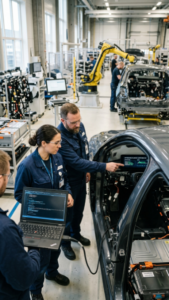
Automakers are racing to make cars updateable, connected and profitable long after sale, but the shift is testing old manufacturing cultures, safety rules and consumer trust.
The automobile is undergoing its most profound redesign in a century, and much of it is happening out of sight. The defining component is no longer only the engine, battery pack, gearbox or chassis. Increasingly, it is software: the code that controls acceleration, braking, navigation, entertainment, battery management, driver assistance, charging, diagnostics and even the business model of ownership.
The industry calls the result the software-defined vehicle. For consumers, the simpler comparison is the smartphone. A car that once left the factory as a finished mechanical product is becoming a rolling digital platform, capable of receiving updates, adding features, fixing defects and selling services years after it reaches a driveway.
That shift is changing what automakers build, how they earn money and who holds power in the global car business. It is also exposing a difficult truth: making a vehicle behave more like a phone is far harder than putting a touchscreen on the dashboard.
Traditional cars were built around dozens, sometimes more than 100, electronic control units supplied by different vendors and tied together through complex wiring. Each unit managed a specific function: windows, seats, brakes, airbags, infotainment, lighting or powertrain. The software was often fragmented, written for individual parts and locked into hardware that changed slowly.
Software-defined vehicles reverse that logic. Automakers are moving toward centralized computers, zonal electrical architectures and cloud-connected operating systems. Instead of scattering intelligence across the vehicle, they want fewer, more powerful processors that can manage multiple domains and receive updates over the air. The aim is to shorten development cycles, reduce wiring weight, improve diagnostics and allow the vehicle to evolve after purchase.
Tesla showed the commercial power of that model earlier than most rivals. Its vehicles normalized over-the-air updates that could adjust range estimates, add entertainment features, improve driver assistance or address defects without a service visit. In doing so, Tesla helped reset consumer expectations. A car, many buyers now believe, should not feel technologically frozen on the day it is delivered.
Legacy automakers have moved quickly, but unevenly. Hyundai Motor Group announced a strategy to make all vehicles software-defined and to bring over-the-air updates across models, including internal-combustion vehicles. BMW’s Neue Klasse architecture bundles major customer functions into a small number of high-performance computers, which the company calls “superbrains,” supported by a lighter zonal wiring system. Toyota has begun deploying Arene, a software platform developed by Woven by Toyota, starting with the new RAV4 as a first step toward a fully software-defined future. Mercedes-Benz is rolling out MB.OS, its in-house operating system, beginning with the new CLA. General Motors has outlined a centralized computing platform for future gasoline and electric vehicles and is moving artificial-intelligence assistants deeper into the cockpit.
The reason is not only engineering pride. Software is one of the few areas where automakers see a path to recurring revenue after years of margin pressure from electrification, battery costs and price competition. Subscriptions for advanced driver assistance, connected navigation, entertainment, remote vehicle functions, insurance services, fleet management and energy products could extend the commercial life of a car long after the original sale.
That prospect has made the dashboard a contested space. Technology companies want access to the driver and data. Automakers want to avoid becoming hardware assemblers for operating systems controlled by others. Consumers want convenience, but many remain wary of paying monthly fees for functions they believe should be included in an expensive vehicle.
The tension has already surfaced. Some automakers have tested or introduced subscriptions for heated seats, performance upgrades, hands-free driving, connectivity packages and premium navigation. In certain markets, buyers have pushed back when software-enabled features appeared to transform ownership into rental. The lesson is clear: drivers may accept paying for new digital services, but they are less forgiving when companies charge repeatedly for hardware already installed in the car.
China has intensified the pressure. Chinese electric-vehicle makers have treated the cabin as a technology product from the start, emphasizing voice assistants, app ecosystems, rapid software updates and advanced driver-assistance features. In the world’s largest auto market, buyers increasingly compare cars not only by horsepower, range or brand heritage, but by the speed and intelligence of the digital experience. That has forced European, Japanese, Korean and American automakers to accelerate software programs that once moved at the pace of model-year cycles.
Volkswagen’s experience shows the risks. Its software unit, Cariad, was created to give the German group greater control over vehicle operating systems and digital architecture, but delays and complexity weighed on several major programs. Volkswagen later turned to Rivian, forming a multibillion-dollar joint venture focused on next-generation electrical architecture and software for future vehicles. The partnership signaled something unusual for a century-old manufacturing giant: in the software race, scale alone is not enough.
The technical challenge is severe because cars are not phones. A smartphone glitch may freeze an app. A vehicle software failure can affect steering, braking, visibility, battery safety or emergency systems. Updates must be validated across climates, road conditions, regulatory regimes and years of vehicle use. Automakers also have to guarantee that new code does not interfere with safety-critical systems or create cybersecurity vulnerabilities.
Regulators are following closely. United Nations vehicle regulations on cybersecurity and software updates require manufacturers in many markets to manage cyber risks and software-update processes through formal systems. That reflects a new reality: when vehicles are permanently connected, they become potential targets. A car that can be improved remotely can also be attacked remotely if security is weak.
The rise of software-defined vehicles therefore changes the meaning of safety. Crash tests and mechanical durability still matter, but they are no longer enough. Automakers must prove they can monitor vulnerabilities, patch flaws, manage data responsibly and maintain safe software for a decade or more. A vehicle’s safety case is becoming a living file, not a one-time certification exercise.
Consumers will feel the benefits first in ordinary ways. A car may warn of a failing component before it breaks. Navigation may plan charging stops based on real-time battery temperature, traffic and station availability. Driver-assistance systems may improve through new perception software. Infotainment may become more natural as AI voice assistants replace rigid command menus. Fleet operators may use software to reduce downtime, monitor energy consumption and customize vehicles for specific routes.
But the same capabilities raise questions about privacy and control. Software-defined vehicles generate large amounts of data: location, driving behavior, cabin interactions, battery health, service history and sometimes camera or sensor information. Drivers may not always understand what is collected, how it is used or whether it can affect insurance, resale value or warranty decisions. The more a car resembles a smartphone, the more it inherits the smartphone economy’s disputes over consent, surveillance and platform power.
The used-car market will also change. A second owner may inherit a vehicle whose features depend on subscriptions, account transfers or software support. If an automaker stops updating a model, the car could feel obsolete even if the hardware remains sound. Independent repair shops may face new barriers if diagnostics, parts pairing and software authorization remain controlled by manufacturers. Lawmakers and consumer groups are likely to revisit right-to-repair rules as vehicles become more digitally locked.
For automakers, the organizational transformation may be harder than the technical one. Software development rewards rapid iteration, integrated teams and continuous testing. Car companies have long been optimized for long product cycles, supplier contracts and hardware validation. Merging those cultures is expensive and uncomfortable. The winners will not simply be the companies with the most programmers, but those that can make software, hardware, safety engineering and customer experience work as one system.
The smartphone analogy is useful, but incomplete. Cars may become updateable, personalized and connected, yet they remain heavy machines moving at high speed through public space. Their digital transformation cannot follow Silicon Valley’s old rule of moving fast and breaking things. In transportation, breaking things can break trust, and trust is the industry’s most valuable software layer.
The next decade will decide whether software-defined vehicles become a genuine improvement for drivers or just another channel for fees and data extraction. Done well, the technology could make cars safer, cleaner, easier to maintain and more useful over time. Done poorly, it could produce expensive machines that age like abandoned gadgets.
The car of the future may indeed resemble a smartphone. But the companies building it will have to remember that it is also a vehicle, a safety device, a personal space and one of the most expensive products most households ever buy. Code may define the car, but trust will define the market.