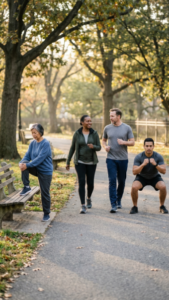
Walking, Pilates, mobility, short strength sessions and Zone 2 cardio are reshaping exercise culture around a simpler promise: get healthier without making every workout feel punishing.
NEW YORK — The modern fitness ideal is becoming less extreme. After years in which high-intensity interval training, transformation challenges and punishing gym culture dominated social feeds, many exercisers are turning toward routines that look quieter, last longer and fit better into ordinary life. The new goal is not to collapse on the floor after every session. It is to move often, build strength, keep joints working, protect the heart and return tomorrow.
The shift can be seen in the popularity of walking targets, Pilates studios, mobility videos, home workouts, 30-minute strength sessions and Zone 2 cardio. These routines are not new. Walking may be the oldest exercise program in human history. Pilates is more than a century old. Strength training has long been central to athletic preparation and healthy aging. What has changed is the way people talk about them. They are now being framed less as secondary or easy options and more as sustainable foundations for health.
That change reflects a broader correction in exercise culture. Many people are tired, busy and already under pressure from work, family, screens and rising living costs. A workout that requires expensive equipment, a long commute, perfect motivation and a recovery day afterward may be impressive, but it is also fragile. A routine built around a walk after lunch, a mat session before work, a short strength circuit at home or a steady bike ride may be less dramatic, but it is easier to repeat. In fitness, repeatability is power.
Public health guidance supports that quieter approach. The World Health Organization recommends that adults perform 150 to 300 minutes of moderate-intensity aerobic activity each week, or 75 to 150 minutes of vigorous activity, along with muscle-strengthening activity on two or more days. The U.S. Centers for Disease Control and Prevention gives similar advice, noting that 150 minutes can be broken into 30 minutes a day, five days a week, and that some physical activity is better than none. This is not a prescription for heroic effort. It is a case for consistency.
Walking has become the clearest symbol of the trend. The 10,000-step target remains a familiar benchmark because it is simple, measurable and satisfying. But the science is more forgiving than the slogan. Studies of daily step counts show that more steps are generally associated with better health outcomes, but meaningful benefits can appear below 10,000 steps, especially for people starting from low activity levels. The most important step count may be the one a person can actually maintain and gradually improve.
That message has helped walking become more than a backup plan. It is now a full routine for many people: morning walks, treadmill walks, walking meetings, incline walking, post-dinner walks and social walking clubs. Its advantages are practical. It requires little skill, little equipment and almost no planning. It can be done alone or with friends, outdoors or indoors, at a slow pace or brisk enough to raise the heart rate. For beginners, it lowers the barrier to entry. For experienced exercisers, it adds recovery and daily movement without excess strain.
Zone 2 cardio has given walking and other moderate exercise a more scientific vocabulary. The phrase usually refers to a steady effort that is challenging enough to raise breathing and heart rate but easy enough to sustain. For many people, it overlaps with the simple “talk test”: if a person can talk but not sing, the effort is likely moderate. In practice, Zone 2 can mean brisk walking, easy cycling, rowing, jogging, swimming or using an elliptical machine. Its appeal is that it feels productive without feeling punishing.
Pilates has benefited from the same appetite for controlled, lower-impact movement. Its emphasis on core strength, posture, breath, alignment and muscular control fits a moment when many people spend long hours sitting and want to feel stronger without chasing maximal intensity. ClassPass said Pilates was the most booked workout globally for the third consecutive year in its 2025 report, with bookings up 66% year over year. Low-impact training rose even faster, up 112%, while strength training also remained among the most booked categories. The numbers suggest that people are not abandoning fitness. They are redefining what a desirable workout feels like.
Mobility training has followed a similar path. Once treated mainly as a warm-up or rehabilitation tool, it has become a category of its own on social platforms and fitness apps. The appeal is easy to understand. Many people do not only want to look fit. They want to move without stiffness, squat without pain, reach overhead, sit on the floor, carry groceries, climb stairs and wake up without feeling older than they are. Mobility routines promise a practical benefit: a body that works better in daily life.
Strength training may be the most important part of the softer fitness movement because it corrects a misconception. Gentle does not mean weak. A 30-minute session with dumbbells, resistance bands or body weight can be demanding, efficient and protective. Public health guidelines include muscle-strengthening activity because muscle matters for metabolism, bone health, balance, independence and injury prevention. The difference is that many people now prefer shorter, repeatable strength sessions over marathon gym workouts designed mainly for social media display.
Home workouts remain central because they solve the problem of friction. A person who has to commute to a gym, find parking, change clothes, wait for equipment and return home may skip the session entirely. A person with a mat, a pair of dumbbells and a phone can move for 20 or 30 minutes between obligations. That convenience has made fitness more accessible, though it also places more responsibility on individuals to choose safe, credible instruction in a crowded online market.
Wearables and apps have reinforced the move toward steady routines. The American College of Sports Medicine named wearable technology the top fitness trend for 2025, followed by mobile exercise apps and data-driven training technology. These tools can encourage people to track steps, heart rate, sleep, recovery and training load. Used well, they make small progress visible. Used poorly, they can turn health into another source of anxiety. The healthiest approach may be to treat data as a guide, not a judge.
The cultural shift also reflects a new relationship with recovery. Rest days, mobility work, sleep, walking and lower-intensity sessions are increasingly described as part of training rather than evidence of laziness. ClassPass reported strong growth in sports recovery in 2025, and Strava’s 2025 Year in Sport report emphasized a wider movement culture that includes walking, weight training, running clubs and social connection. The message is less about punishing the body and more about keeping it available for life.
There are risks in the trend. Low-intensity exercise can be oversold as a cure-all. Social media can turn even gentle fitness into another aesthetic pressure. A person with heart disease, pregnancy, injury, chronic pain or other medical concerns may need professional guidance before changing activity levels. And while walking and mobility are valuable, they do not fully replace strength training or more challenging cardiovascular work for those who can safely do it. Balance still matters.
But the broad direction is healthy. A fitness culture that welcomes beginners, respects recovery and values consistency may reach more people than one built around exhaustion. The person who walks 7,000 steps most days, lifts weights twice a week, does mobility before bed and takes an easy bike ride on Sunday may not look like an athlete in an advertisement. But that person is building something more durable than a 30-day transformation.
The future of fitness may be less about intensity as identity and more about movement as infrastructure. People want routines that survive travel, deadlines, parenting, stress and aging. They want strength without burnout, cardio without dread and progress without punishment. The softer era of fitness is not about doing less because health matters less. It is about doing enough, often enough, for long enough that health has a chance to become ordinary.