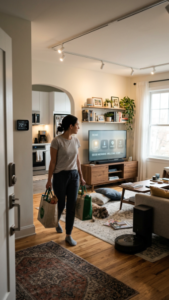
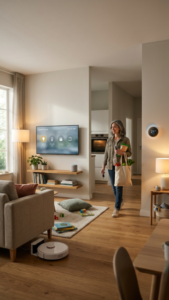
After years of app-controlled lights and disconnected gadgets, the next phase of connected living is about homes that understand context, coordinate devices and act with less human instruction.
For more than a decade, the smart home promised a future that rarely matched daily life. Consumers bought connected bulbs, smart plugs, video doorbells, speakers, thermostats, robot vacuums and app-controlled appliances. The devices worked, often impressively, but the experience was frequently fragmented. A home could be filled with smart products and still require too many taps, too many apps and too much patience.
That is beginning to change. The next generation of smart home technology is moving from remote control to contextual automation. The goal is no longer simply to turn on the lights from a phone. It is to make lighting, temperature, security, audio, television, robots and appliances respond together to what is happening in the home.
A truly smart home understands the difference between morning and night, weekday and weekend, guest and resident, empty room and occupied nursery, normal activity and possible emergency. It does not wait for every command. It learns routines, reads signals from sensors and coordinates devices in ways that feel less like operating equipment and more like living in an attentive environment.
This shift was visible across the consumer technology landscape at CES 2026, where artificial intelligence, robotics, wearables, smart appliances, energy systems and connected home products were among the most prominent categories. The industry’s message was clear: the smart home is becoming less about individual gadgets and more about ecosystems that can perceive, decide and act.
The change is partly technical. Earlier smart homes were built around isolated products. A camera belonged to one brand, a thermostat to another, lights to another, a speaker to another and a robot vacuum to yet another. Each device might have been intelligent on its own, but the home as a whole was not. The user became the integration layer, manually linking routines and troubleshooting conflicts.
Contextual automation tries to remove that burden. If the home knows a resident has arrived after sunset, it can unlock the door, turn on entry lighting, lower the alarm state, adjust the temperature and resume music in the kitchen. If everyone leaves, it can turn off lights, reduce heating or cooling, start the robot vacuum, arm security and check whether an appliance was left running. If a child wakes at night, hallway lighting can rise softly without flooding the house with brightness.
This is not science fiction. Many of the individual pieces already exist. Motion sensors, presence detection, smart locks, cameras, thermostats, speakers, connected appliances, energy meters and robot cleaners are widely available. What has been missing is coordination, reliability and trust.
Interoperability is the first requirement. Consumers do not want to rebuild their homes around one company’s ecosystem. The Matter smart home standard, backed by major technology and device companies through the Connectivity Standards Alliance, was created to make products from different brands work together more easily. Its newer releases have expanded support for energy management, home appliances and devices such as heat pumps, batteries, solar systems and water heaters. That matters because the home of the future will not only be convenient. It will also need to manage electricity more intelligently.
Energy may become one of the strongest reasons for smart home adoption. As electric vehicles, heat pumps, home batteries, rooftop solar and dynamic electricity pricing become more common, households will need systems that decide when to charge, cool, heat, store or delay energy use. A smart dishwasher that runs when electricity is cheaper is useful. A home that coordinates the dishwasher, battery, solar inverter, thermostat and EV charger is more powerful.
Artificial intelligence is the second requirement. Voice assistants made smart homes easier to control, but they often remained command systems. The next phase is less about saying, “Turn off the living room lamp,” and more about saying, “Set the house for movie night,” or not saying anything at all. In that scenario, the lights dim, the TV activates, the speaker system changes mode, the thermostat adjusts and the robot vacuum avoids the room.
AI also changes security. A traditional camera records motion. A more intelligent system can distinguish a delivery worker from a family member, a pet from a person, a package from a passing shadow, or a broken glass event from ordinary noise. The value is not more alerts. It is fewer, better alerts. A smart home that constantly panics is not smart. It is stressful.
Robotics is the third frontier. The robot vacuum was the first mass-market home robot because the task was clear, repetitive and bounded. CES 2026 showed a broader ambition: robots that can assist with household tasks, interact with appliances and move from single-purpose cleaning toward more general home support. The promise is appealing, especially for aging populations and busy households. The reality remains difficult. Homes are messy, unpredictable spaces filled with stairs, pets, children, cables, dropped clothes and objects that were not designed for robots.
That gap between demonstration and daily reliability is important. A robot that works on a trade-show floor is not the same as a robot that can help in a crowded kitchen at 7 p.m. The smart home will succeed only when technology handles ordinary disorder, not just ideal conditions.
Wearables may become an underrated part of the system. A smartwatch or smart ring can tell the home whether someone is asleep, exercising, stressed, approaching the front door or waking up. Used responsibly, those signals could make automation more personal. The bedroom could cool before sleep. Lights could brighten gradually when a resident wakes. A home could detect that an older adult has not moved as usual and send a careful alert. But the same intimacy raises privacy concerns. A home that knows too much about the body must be governed by strong consent, local processing and clear data rules.
Privacy is the central test. The smartest home is also the most observant home. Cameras, microphones, motion sensors, energy meters, locks, appliances and wearables can reveal when people wake, cook, bathe, leave, return, argue, sleep or live alone. Consumers may accept automation, but they will not accept feeling watched by their own walls. The industry’s challenge is to make intelligence feel protective rather than invasive.
Security is equally serious. A hacked laptop is bad. A hacked front door, camera system or thermostat is more personal. As more homes become connected, manufacturers must treat software updates, encryption, identity management and vulnerability response as basic safety obligations, not optional premium features. A truly smart home must fail safely. Doors should open when they need to. Lights should work when the internet is down. Heating and cooling should not depend on a cloud outage.
This is why the next smart home may be less flashy than expected. The winning products may not be the most dramatic gadgets, but the systems that quietly work across brands, respect privacy and reduce decisions. The future is not necessarily a refrigerator that talks too much. It is a kitchen that knows when the oven, ventilation, lighting and energy use should coordinate without turning dinner into a software project.
The market is also learning that automation must be reversible. People want help, not domination. A home should suggest, adapt and remember, but it should also allow residents to override it easily. The best automation feels like a thoughtful assistant. The worst feels like a stubborn landlord.
The real smart home will arrive unevenly. Wealthier households will adopt integrated systems first. Renters and apartment dwellers may rely on smaller, portable devices. Older homes may need upgraded wiring, networking or sensors. Different countries will move at different speeds depending on energy prices, housing patterns, privacy law and broadband quality.
Still, the direction is clear. The smart home is leaving its novelty phase. The question is no longer whether a lamp can connect to Wi-Fi. It is whether the home can understand what the resident is trying to do and make the environment support that intention.
For consumers, the best test is simple. A smart home should save time, reduce stress, improve safety or lower energy use. If it only adds apps, passwords and notifications, it is not smart enough. The next generation will be judged not by how many devices are connected, but by how rarely the resident has to think about them.
The smartest home may be the one that finally disappears into the background.