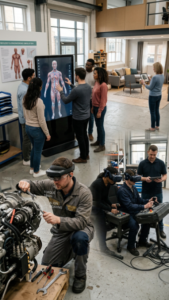
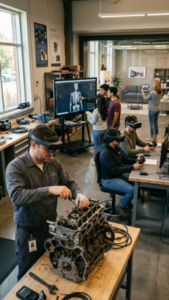
Once defined by gaming and metaverse hype, immersive technology is finding a steadier role in work, training, design, education, retail and 3D collaboration.
SAN FRANCISCO — The promise of virtual and augmented reality was once sold in grand, almost theatrical language. People would attend meetings as avatars, shop in digital malls, play inside endless fantasy worlds and perhaps one day live significant portions of their lives in the metaverse. Much of that vision arrived too early, cost too much or asked too much of ordinary users. But a quieter version of the technology is now gaining ground.
It is called spatial computing, and its most important future may be less spectacular than its early marketing suggested.
Spatial computing refers to digital systems that understand and interact with physical space. It includes augmented reality, virtual reality, mixed reality, digital twins, 3D interfaces, immersive training simulations and tools that place digital information into the user’s real environment. The technology can still be used for games, entertainment and social experiences. But its more durable momentum is coming from practical tasks: training a worker, reviewing a 3D design, helping a technician repair equipment, teaching anatomy, planning a store layout, or letting a shopper see whether a sofa fits in a living room.
That shift matters because it moves AR and VR away from novelty and toward utility. The question is no longer whether people want to escape into a headset for hours. It is whether immersive technology can solve problems that flat screens, video calls and conventional software handle poorly.
Capgemini has listed spatial computing among the technology directions to watch as enterprises prepare for 2026, placing it within a broader landscape of AI-driven convergence, digital twins, real-time 3D and intelligent operations. In its analysis of spatial computing, digital twins and AI, the consulting firm describes a future in which digital and physical realities increasingly interconnect across industries, from healthcare and manufacturing to education and retail.
This is a more grounded vision than the metaverse boom. It does not require every office worker to wear a headset all day. Instead, it identifies moments when spatial understanding adds value. A surgeon may need to view scans in context. A designer may need to examine a full-scale product model. A pilot trainee may need repeated exposure to rare emergency scenarios. A factory manager may need to simulate a production line before moving machinery. A remote expert may need to see exactly what a field technician sees and draw an instruction in space.
The strongest early business case is training. Virtual reality can place workers in realistic but safe environments: a warehouse during a safety incident, a hospital room with a distressed patient, an aircraft cockpit under pressure, a construction site with hazards, or a retail floor during a difficult customer interaction. Instead of reading a manual or watching a video, trainees practice decisions with their bodies and attention engaged.
PwC’s widely cited study of VR for soft-skills training found that VR learners could be more focused than e-learning or classroom learners and that immersive training became more cost-effective at scale. The exact results depend on the program, hardware and instructional design, but the broader point is clear: VR works best when experience matters. It is less useful for memorizing simple facts and more useful for situations that require judgment, presence, repetition and emotional realism.
Education is moving in a similar direction. Meta made its education offering generally available in 2025, describing mixed and virtual reality as a way to give students access to immersive experiences they might not otherwise encounter. A school may not be able to take every student to an archaeological site, inside a human cell, onto the surface of Mars or through a complex engineering system. A headset or 3D shared environment can make those lessons more vivid, though it cannot replace good teaching or careful curriculum design.
Design and engineering may be even better suited to spatial computing. Many products are three-dimensional, but much of the work to build them still happens on flat screens. Architects, car designers, industrial engineers, game developers, medical device teams and urban planners often need to understand scale, movement, ergonomics and spatial relationships. Viewing a model in 3D can reveal problems that a drawing or monitor may hide. It can also reduce the need for physical prototypes, travel and repeated revisions.
Digital twins expand that idea further. A digital twin is a virtual model of a real object, system or environment that can be monitored, simulated and optimized. In manufacturing, logistics, energy, aviation and city planning, spatial computing can make those models easier to understand and manipulate. Instead of looking at data tables alone, users can walk through a simulated factory, inspect a machine, visualize airflow, test a robot path or forecast bottlenecks before changing the physical world.
Retail provides the most consumer-friendly version of the trend. Augmented reality shopping tools let customers preview furniture, appliances, glasses, makeup, clothing or home décor before buying. The technology is not always perfect, and scale, lighting and texture still matter. But the practical value is obvious: shoppers want fewer surprises. A couch that looks good on a product page may overwhelm a small apartment. A light fixture may be the wrong size. A paint color may shift in natural light. AR turns imagination into a test.
The workplace case is more mixed. Virtual meeting rooms attracted attention during the remote-work boom, but many employees still prefer video calls because they are cheaper, faster and less physically demanding. Spatial computing is more persuasive when the work itself is spatial: reviewing a product, training on equipment, inspecting a site, guiding a repair, or collaborating on a 3D model. The technology struggles when it tries to replace ordinary office conversation.
Apple’s Vision Pro helped revive mainstream attention by framing the category as spatial computing rather than simply virtual reality. Apple has promoted enterprise uses including productivity, product design, immersive training and guided work. Microsoft’s mixed-reality tools have long emphasized remote assistance, allowing a technician wearing a headset or using a mobile device to connect with an expert who can see the worksite and annotate the physical space. These use cases are less glamorous than consumer fantasy worlds, but they answer real business needs.
The challenge is that spatial computing still carries friction. Headsets can be expensive, heavy or isolating. Battery life, comfort, hygiene, field of view, prescription lenses, motion sickness, device management and security all matter in corporate deployments. Software must be tailored to a workflow, not merely ported from a 2D screen. A headset that impresses executives in a demo can fail if workers find it uncomfortable after 20 minutes or if the content is not updated with operational changes.
There are also social limits. Wearing a headset changes how people interact with colleagues, customers and classmates. In some environments, it can feel isolating or inappropriate. In others, such as industrial training or remote maintenance, it may feel natural because the task already requires specialized equipment. The practical future of spatial computing depends on matching device, environment and job.
AI may accelerate adoption. Generative AI can help create 3D assets, translate instructions, summarize spatial data, guide users through tasks and make digital twins more responsive. Computer vision can help systems understand rooms, tools, gestures and objects. AI agents may eventually operate inside spatial environments, assisting workers not just with text answers but with visual guidance. The convergence of AI and spatial computing could make immersive systems less scripted and more adaptive.
Still, the industry is learning from earlier overreach. The next phase is unlikely to be a sudden mass migration into virtual worlds. It will be a slower spread of specific tools into specific workflows. A medical school may use VR anatomy labs. A retailer may use AR fitting tools. A manufacturer may use digital twins for factory planning. A utility may use mixed reality for field repairs. A design firm may review full-scale models in shared 3D space.
That may be exactly what the technology needs. The most successful computing shifts often become ordinary before they become universal. Smartphones were not only communication devices; they became cameras, maps, wallets, tickets, health trackers and work tools. Spatial computing may follow a similar path, not as a single destination but as a set of capabilities that appear where space matters.
The age of AR and VR as spectacle is giving way to spatial computing as infrastructure. Its value will not be measured by how futuristic it looks, but by whether it reduces mistakes, improves training, speeds design, deepens learning and helps people make better decisions in the physical world. After years of hype, immersive technology may finally be finding its most practical reality.