From mini-LED televisions and OLED panels to AR glasses, foldable devices, smart projectors, in-car displays and AI-driven sound, entertainment technology is moving beyond sharper pictures toward more adaptive, personal and spatial experiences.
NEW YORK — For decades, the promise of home entertainment was simple: a bigger screen, a sharper picture and louder sound. The next generation of display technology is more ambitious. It wants to know where viewers are sitting, what they are watching, how bright the room is, whether the screen is in a car, on a wall, in a pocket, on a face or folded into a bag.
The screen is no longer just a rectangle. It is becoming an environment.
That shift is visible across consumer technology. Mini-LED televisions are getting brighter and more precise. OLED panels are becoming thinner, more flexible and more durable. Augmented-reality glasses are trying to move digital information out of the phone and into the field of vision. Foldable screens are pushing phones and laptops into hybrid forms. Cars are turning dashboards into cinematic surfaces. Smart projectors are becoming easier to place in small apartments. Audio systems are using artificial intelligence to adjust sound around the listener.
The result is a more complicated entertainment market, but also a more practical one. Consumers are not only being asked to choose between screen sizes. They are being asked to choose the kind of room, device and routine they want technology to support.
Mini-LED remains one of the clearest examples of the new competition. By using thousands of smaller backlights divided into local dimming zones, mini-LED televisions can deliver high brightness and stronger contrast than traditional LED LCD sets. That makes them attractive for bright living rooms, sports, gaming and high dynamic range movies. They do not produce light pixel by pixel in the same way OLED does, but they are often less vulnerable to brightness limitations and can be more affordable at very large sizes.
OLED, meanwhile, keeps its strength in black levels, response time, thinness and viewing angles. It remains a favorite for cinema enthusiasts and premium devices because each pixel can turn on and off independently. The technology is also spreading beyond living-room televisions into laptops, tablets, foldables, cars and near-eye displays. Manufacturers are working to improve brightness, durability and efficiency, addressing the historic concerns that kept OLED from dominating every category.
The rivalry between mini-LED and OLED is no longer a simple winner-takes-all contest. It is becoming a question of use case. A sunlit family room may favor a very bright mini-LED set. A dark home theater may favor OLED. A laptop may need efficiency and thinness. A car display may need fast response in heat and cold. AR glasses may require extremely small, bright panels that can sit close to the eye without draining a battery too quickly.
This is why the most important display innovation may be context awareness. A screen that looks excellent in a showroom can fail in daily life if it reflects every window, crushes dark detail, struggles with sports motion, overwhelms a bedroom at night or forces users to adjust settings constantly. The future screen will be judged less by peak specifications alone and more by how intelligently it adapts.
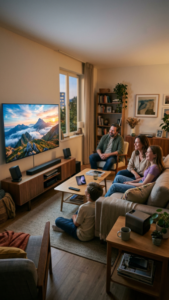
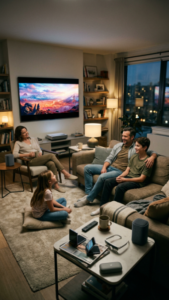
Dreame’s new mini-LED television concept shows how far that thinking is going. The company has drawn attention for an RGB mini-LED TV with robotic, AI-guided speakers that physically rotate and reposition based on where the viewer is sitting. The idea is striking because it treats sound as something spatial and active rather than fixed. Instead of assuming the audience is always centered on a sofa, the system tries to follow the real behavior of a household: people move, stand, sit off-axis, cook nearby, walk in and out, or watch from different parts of the room.
Whether such robotic audio becomes a mainstream feature remains uncertain. Moving parts add cost, complexity and durability questions. But the concept points to a broader trend. Entertainment systems are trying to adjust themselves rather than asking users to build a perfect home theater. Cameras, microphones, sensors and AI calibration can tune picture and sound to the room. The goal is not only higher fidelity, but less effort.
Smart projectors are moving in the same direction. Once associated with dark rooms, complicated placement and office presentations, projectors are becoming more consumer-friendly. Ultra-short-throw models can sit near a wall and create a large image without ceiling mounting. Portable models now combine batteries, streaming software, autofocus, auto-keystone correction and built-in speakers. For renters, students and families without space for a massive television, the projector offers a different promise: a screen that can appear when needed and disappear when not.
The challenge for projectors remains physics. Ambient light still matters. Wall quality still matters. Built-in sound is often limited. A projector may feel magical at night and disappointing at noon. But for many buyers, especially younger consumers living in smaller spaces, flexibility may matter as much as pure picture quality.
Foldable screens represent another version of flexibility. The technology has moved from curiosity to category, though still at premium prices. Foldable phones let a device shift between pocket screen and small tablet. Foldable laptops and rollable concepts suggest workspaces that can expand and collapse. The engineering problems are difficult: hinges, creases, dust resistance, battery layout, repair cost and long-term durability. But the consumer appeal is clear. People want larger screens without carrying larger objects all the time.
Augmented-reality glasses are the most ambitious display category because they challenge the phone itself. The first mass-market path may not be fully immersive AR. It may be lightweight smart glasses that handle audio, cameras, translation, navigation, calls and AI assistance before eventually adding better visual overlays. The hardware obstacles remain serious: battery life, heat, privacy, field of view, brightness, weight, prescription support and social acceptance. A display on the face has to be useful enough to justify being visible to everyone else.
Still, the logic is powerful. A phone requires looking down. AR promises information while looking forward. Directions could appear in the street. Captions could appear in conversation. A recipe could stay visible while cooking. A mechanic could see instructions while using both hands. Entertainment could become less about sitting in front of a screen and more about placing digital content into ordinary space.
Cars are another frontier. As vehicles become more electric, connected and software-driven, the cabin is becoming a display environment. Dashboards, passenger screens, rear-seat entertainment, head-up displays and panoramic interfaces are changing how drivers and passengers interact with information. The danger is distraction. The opportunity is clarity. A good in-car display can simplify navigation, charging, safety alerts and media. A bad one can bury basic controls behind menus and turn driving into screen management.
That tension is central to the next phase of entertainment technology. More display does not automatically mean better experience. A wall of screens, a folding device, an AR overlay or an AI sound system can impress briefly and irritate daily if it solves no real problem. Consumers have learned to distinguish novelty from usefulness.
AI audio may become one of the more practical advances because it can improve experiences without demanding much attention. Systems can analyze room shape, speaker placement, content type and listener position, then adjust dialogue clarity, bass, surround effects or volume balance. For households, the most appreciated feature may not be cinematic thunder. It may be the ability to hear dialogue clearly without waking children or raising the remote every five minutes.
The entertainment industry is therefore moving toward personalization, but not always in the way streaming platforms first imagined. It is not only about recommending the next show. It is about reshaping the viewing and listening environment around the person, the room and the moment.
The risk is that entertainment technology becomes too expensive, too fragmented and too dependent on software support. A great screen can be undermined by bad menus, intrusive ads, abandoned updates or confusing standards. Consumers already navigate HDR formats, refresh rates, HDMI versions, app ecosystems, audio codecs and privacy settings. The industry’s challenge is to make advanced technology feel simple.
The next great entertainment device may not be the one with the longest spec sheet. It may be the one that disappears into the evening: a TV that adjusts to sunlight, a projector that aligns itself, glasses that help without overwhelming, a car display that informs without distracting, speakers that make voices clear from any seat, and software that respects the viewer’s attention.
The future of screens is not only brighter, sharper or bigger. It is more aware. And as entertainment moves from panels to rooms, cars, glasses and flexible surfaces, the question for consumers will be less “How good is the display?” and more “How well does it fit the way I actually live?