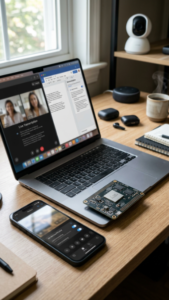
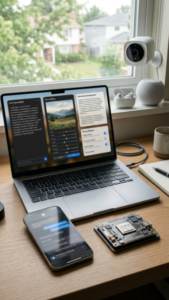
As laptops, phones, cameras, cars and home devices gain dedicated processors for AI, the next technology race is shifting from distant data centers to the machines people use every day.
A new phrase has entered the language of consumer technology: the AI chip. It now appears in laptop launches, phone ads, camera systems, car dashboards and smart-home devices, often with the promise that artificial intelligence will run faster, more privately and more efficiently on the device itself. For many buyers, the claim can sound vague. Computers have always had chips, and software has always improved over time. What is different now is that manufacturers are adding specialized processors designed to handle AI tasks locally, without sending every request to a distant cloud server.
The most important of these processors is often called an NPU, or neural processing unit. A traditional CPU is flexible and handles general computing tasks. A GPU is strong at parallel processing and became essential for graphics, gaming and large-scale AI training. An NPU is designed specifically for the repeated mathematical operations used in machine learning, such as recognizing speech, improving photos, detecting objects, translating language or summarizing text. The goal is not just more power. It is more efficient power.
That distinction explains why new laptops and phones increasingly advertise AI hardware. Running AI in the cloud can be powerful, but it has costs. It requires internet connectivity, sends data away from the device, adds latency and consumes expensive data-center resources. Running AI locally can make features respond faster, work offline or semi-offline, use less battery for certain tasks and keep more personal information on the device. For consumers, the benefit may show up as instant transcription, better background blur, smarter photo editing, real-time translation, cleaner video calls or a voice assistant that understands context more quickly.
The laptop industry has turned this into a new product category. Microsoft’s Copilot+ PC label requires a neural processing unit capable of more than 40 trillion operations per second, commonly described as 40 TOPS. That number has become a marketing shorthand for AI readiness, even though real performance depends on memory, software, model design and battery management as much as raw TOPS. Still, the label has pushed chipmakers and PC brands to compete around AI capability in a way that resembles earlier races over processor speed, screen resolution or camera megapixels.
This is why consumers now see AI mentioned in almost every premium laptop announcement. Qualcomm, Intel, AMD and Apple all want to convince buyers that their chips can run the next generation of local AI features. For PC makers, the timing is important. The traditional laptop market has matured, and many users no longer upgrade every two years. AI gives manufacturers a new reason to sell replacement devices: not just faster spreadsheets or better video streaming, but a machine that can summarize documents, organize files, enhance calls, help create images and support intelligent applications without relying entirely on the cloud.
Phones are moving in the same direction. For years, smartphone chips have used machine learning to improve photography, face unlock, voice input and battery behavior. What has changed is the arrival of generative AI models small enough to run on handheld devices. Newer phones can generate text suggestions, summarize recordings, edit images, interpret scenes through the camera and support more context-aware assistants. The phone is becoming less like a passive screen and more like a personal AI terminal.
Privacy is one of the strongest selling points. A phone knows where its owner goes, who they contact, what they photograph, what they write and what they ask. The more personal AI becomes, the more sensitive the data becomes. Device makers therefore emphasize that some AI tasks can happen locally. Apple has promoted a model in which many tasks run on device, while more complex requests may use Private Cloud Compute. Google has pushed Gemini Nano for on-device features on Pixel devices, while Samsung allows users to control whether certain Galaxy AI features use online processing. These systems are not identical, but they reflect the same pressure: AI must become more useful without making users feel that every private detail is being uploaded somewhere unknown.
Edge AI extends beyond phones and laptops. In security cameras, local AI can distinguish between a person, pet, vehicle or tree movement before deciding whether to send an alert. In cars, AI chips help process camera, radar and sensor data for driver assistance, cabin monitoring, voice control and navigation. In factories, edge devices can inspect products without sending every image to the cloud. In home appliances, local intelligence can recognize patterns and adapt behavior with lower delay. The edge is not one device. It is the growing layer of intelligence placed near the user, the road, the machine or the sensor.
Speed matters because many real-world decisions cannot wait for a round trip to a data center. A car detecting a pedestrian, a camera identifying a fall, or a headset translating speech in real time needs low latency. Even a laptop feature such as eye contact correction or background replacement works better when it does not depend on a busy internet connection. Local AI can make digital services feel more immediate because the computation happens where the data is created.
Cost is another reason companies are pushing edge AI. Large AI models running in data centers are expensive. Every cloud request can involve specialized servers, energy, cooling, networking and maintenance. If millions of routine AI tasks can run on consumer devices instead, companies may reduce cloud costs and reserve data centers for heavier work. This is one reason chipmakers, software firms and device brands are working together to optimize smaller AI models for local hardware.
But the AI chip is not magic. Many of the most advanced AI tasks still require cloud computing, especially those involving large language models, complex reasoning, high-end image generation or access to constantly updated information. On-device AI is often best for smaller, frequent, personal and time-sensitive tasks. Cloud AI remains stronger for heavy computation. The future is likely to be hybrid: the device handles what it can privately and quickly, while more demanding requests move to protected cloud systems.
There are also real limits in marketing claims. TOPS numbers can be useful, but they do not tell the whole story. A device with a high AI performance figure may still deliver disappointing results if applications are not optimized, memory is limited, thermals are poor or developers do not support the hardware. Consumers should ask what features actually run on the device today, not only what the chip might support tomorrow. The difference between “AI-ready” and “useful AI” can be large.
Software will determine whether AI chips become essential or merely fashionable. A laptop with an NPU needs applications that know how to use it. A phone with a powerful neural engine needs features that save time rather than decorate advertisements. A smart camera must reduce false alerts. A car must improve safety without confusing drivers. Hardware creates the possibility, but software creates the habit.
The security questions are equally important. Local processing can reduce exposure by keeping data on the device, but it does not automatically guarantee privacy. Devices still collect data, run models, store outputs and sometimes connect to cloud services. Users need clear controls, transparent settings and honest explanations of what happens locally and what leaves the device. As AI becomes more personal, trust will depend on design choices that ordinary people can understand.
For developers, the spread of AI chips opens a new frontier. Instead of building only for cloud APIs, they can design apps that run smaller models locally, preserve privacy and respond instantly. Qualcomm’s AI Hub, Apple’s developer tools, Google’s Android AI efforts and Microsoft’s Windows AI platform all point toward a market where software must be optimized for different chips and device classes. This could create new opportunities, but also new fragmentation.
The reason every laptop and phone now says it has an AI chip is simple: the industry believes the next generation of computing will be judged by how intelligently devices act on behalf of their users. The keyboard, screen and camera will still matter. But so will the invisible processor deciding whether speech becomes text instantly, whether a photo can be edited without upload, whether a car sees danger quickly, and whether a home device can understand context without sending everything away.
AI chips are turning artificial intelligence from a distant service into a local feature. The change will not eliminate the cloud, and it will not make every device intelligent overnight. But it marks a major shift in where computing happens. The next phase of AI will not live only in data centers. It will live in the laptop on a desk, the phone in a pocket, the camera above a door, the car on a road and the appliances inside a home. The promise is faster, more private and more useful technology. The test will be whether it genuinely makes everyday life easier.