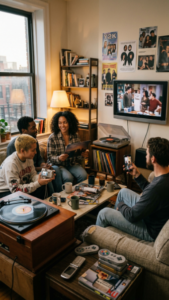
From legacy sequels and classic sitcoms to vinyl records, retro games and Y2K aesthetics, audiences are turning the past into one of the most powerful formats of the present.
The future of entertainment is increasingly arriving dressed as the past. In cinemas, familiar characters return older, wiser or only lightly changed. On streaming platforms, viewers scroll past new releases to rewatch comfort comedies and long-running dramas. On social media, teenagers remix songs released before they were born, imitate fashion from the 1990s and early 2000s, and turn old television scenes into new memes. In music stores, vinyl records sit beside smartphones, marketed not as outdated technology but as emotional objects.
Nostalgia entertainment has moved from a marketing tool to a central strategy across film, television, music, gaming and online culture. It is not simply the revival of old titles. It is a system of feeling: the promise that a movie, song, game, logo, costume or sound can reconnect audiences to a safer, simpler or more emotionally legible time, even when that memory is selective, borrowed or commercially engineered.
The trend is visible at the box office. Legacy sequels and reboots have become some of Hollywood’s most dependable bets because they offer built-in recognition in a crowded market. The recent opening of “The Devil Wears Prada 2,” two decades after the original, showed how powerful that recognition can be. The sequel earned $77 million in the United States and Canada and $156.6 million internationally in its first weekend, according to studio estimates reported by The Associated Press. Women made up about three-quarters of domestic ticket buyers, and streaming viewership for the original film surged in the weeks before the sequel’s release.
For studios, such results are hard to ignore. A familiar title reduces the cost of explanation. Audiences already know the tone, the characters, the world and often the catchphrases. Marketing can begin with a memory rather than a premise. A poster, a song cue or a returning actor can do the work of a trailer. In an era when theatrical attendance remains uneven and streaming has fragmented attention, nostalgia gives entertainment companies something rare: a shortcut to emotional awareness.
Yet nostalgia’s current strength is not limited to older viewers remembering their own youth. Gen Z has become one of the most important engines of retro culture, often embracing eras it experienced only through fragments, uploads and family archives. The 1990s and 2000s are not always personal memories for younger audiences; they are aesthetic worlds available for editing. Low-rise jeans, flip phones, old digital cameras, pop-punk sounds, sitcom clips and early internet graphics circulate as raw material for identity and humor.
This makes contemporary nostalgia different from earlier cycles of revival. In the past, nostalgia often traveled through anniversaries, reunion tours or television reruns. Today, it moves through algorithms. A song from the 1980s can become a soundtrack for a dance trend. A sitcom line from the 2000s can become a reaction meme. A video game character can return through fan edits before a studio announces a remake. The feed does not separate old and new by decade. It tests whether something still produces engagement.
Streaming has intensified that collapse of time. Nielsen reported that streaming represented 44.8% of total U.S. television usage in May 2025, surpassing the combined share of broadcast and cable for the first time. As streaming becomes the default viewing environment, older titles are no longer buried in late-night reruns or DVD shelves. They sit beside new originals, ready to be discovered, replayed and recommended. The past has become searchable.
The numbers suggest that audiences are using that access heavily. Digital i, which tracks streaming behavior, reported that the share of U.S. viewing time on major subscription platforms devoted to series that first launched more than 10 years earlier rose to 37% in the first half of 2025, up from 32% in the first half of 2021. It also found that viewing share for titles at least two years old had not fallen below 68% in measured half-year periods since 2021. In other words, the streaming age is not only producing new shows. It is extending the life of old ones.
The appeal is partly practical. Familiar shows are easy to enter, easy to pause and emotionally predictable. Viewers exhausted by work, news, economic uncertainty or the infinite choice of streaming menus often return to stories whose rhythms they already know. A comedy with hundreds of episodes can function less like an event and more like a domestic atmosphere. It plays while people cook, study, rest or scroll. Nostalgia becomes not just entertainment but background stability.
Music shows the same tension between digital abundance and tactile longing. Streaming dominates recorded music revenue, but vinyl continues to grow as a premium physical format. The Recording Industry Association of America reported that U.S. vinyl revenues reached $1.4 billion in 2024, the eighteenth consecutive year of growth, and that vinyl albums outsold CDs in units for the third year in a row. The record has become both a listening format and a collectible symbol, especially for fans who want a physical relationship with music in an era of invisible libraries.
This does not mean audiences are rejecting technology. Retro entertainment often succeeds because it combines old aesthetics with modern convenience. Vinyl purchases are posted on Instagram. Cassette-style visuals appear in digital campaigns. Old songs resurface through TikTok edits and YouTube Shorts. Classic games are remastered for new consoles. Nostalgia today is rarely a pure return to the past. It is the past redesigned for platforms, playlists, recommendation systems and online fandom.
Fan culture has become one of nostalgia’s most powerful distribution networks. YouTube’s Culture & Trends research has described a shift from fans as consumers to fans as creators, with reaction videos, costume recreations, deep dives and commentary expanding the life of entertainment properties. The report said 80% of fans use YouTube at least weekly to consume content about the person or thing they follow, and 65% of Gen Z respondents described themselves as video content creators. Nostalgia spreads because fans do not merely remember; they reproduce.
That reproduction can be affectionate, ironic or critical. A young creator may celebrate an old teen drama while mocking its fashion and gender politics. A film fan may rank childhood franchises while questioning whether they need another sequel. A musician may sample a recognizable hook and place it in a sound that belongs to the present. Nostalgia entertainment often works best when it acknowledges that the past is not perfect. The strongest revivals do not simply repeat old formulas; they ask what those formulas mean now.
The commercial danger is creative dependence. When companies lean too heavily on familiar intellectual property, the market can become crowded with sequels, remakes and brand extensions that feel safe but unnecessary. Nostalgia can protect investment, but it can also narrow imagination. New voices may struggle for financing if executives believe audiences will only buy what they already know. The past then becomes not a source of inspiration but a gatekeeper.
There is also a risk of emotional simplification. Nostalgia often edits out discomfort. The 1990s can be remembered as carefree while ignoring its exclusions. The 2000s can be revived as playful while forgetting the harsher celebrity culture and social pressures that shaped that period. Entertainment built on memory must decide whether to preserve the glow, complicate it or exploit it. Audiences are increasingly alert to the difference.
Still, nostalgia’s durability reflects a real human need. In a media environment defined by speed, crisis and constant novelty, familiar entertainment offers orientation. It gives people a shared reference point when culture feels fragmented. It lets parents and children watch the same characters from different emotional angles. It allows Gen Z to build identity from archives and millennials to revisit adolescence with adult distance. It gives studios a business model, but it gives audiences a feeling of continuity.
The most successful nostalgia entertainment understands that the past is not a destination. It is a language. A returning character, an old song, a grainy camera texture or a sitcom theme can open the door, but the work still has to speak to the present. Audiences may come for recognition, but they stay for relevance. That is why nostalgia has become so valuable: it is memory, marketing and reinvention at once.
Entertainment has always recycled itself. What is different now is the speed, scale and intimacy of the recycling. Every generation can access every previous generation’s culture, then cut it, caption it, review it, parody it and sell it back in a new form. The past is no longer behind the audience. It is in the feed, in the queue, on the shelf and on the screen, waiting to be made new again.