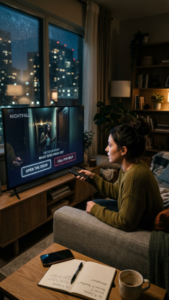
After the first wave of choose-your-own-adventure streaming faded, audience participation is re-emerging through live video, games, polls and hybrid formats that blur the line between watching and playing.
For most of television history, the viewer’s role was clear: sit down, tune in and watch. Interactive streaming has challenged that bargain by asking audiences to make choices, cast votes, send commands, influence outcomes and sometimes become part of the performance itself. The idea is not simply that viewers can watch what they want, when they want. It is that they can affect what happens next.
The promise has always been seductive. A thriller in which the audience decides whether a character opens a door. A survival show where viewers choose which route the host should take. A romance in which the lead’s future is shaped by the remote control. A livestream where thousands of comments, polls and digital rewards steer a creator’s decisions in real time. In each case, entertainment moves away from passive consumption and toward participation.
The most famous modern test of the format came from Netflix’s “Black Mirror: Bandersnatch,” released in 2018 as an interactive film that let viewers choose the path of a young video game developer. It was part movie, part puzzle and part experiment in control. The project became a cultural event not only because of its branching storylines, but because it forced viewers to think about the strange power of choice itself. In 2019, it won the Emmy Award for Outstanding Television Movie, a sign that Hollywood’s traditional institutions were willing to recognize interactive storytelling as more than a gimmick.
Netflix expanded the idea across genres. “You vs. Wild” invited viewers to guide Bear Grylls through survival scenarios. “Cat Burglar” brought interactivity to animation and trivia. “Trivia Quest” tried to turn a daily quiz into a serialized streaming experience. “Choose Love,” promoted by Netflix as its first interactive romantic comedy, allowed audiences to influence the lead character’s romantic and personal decisions. The format seemed to offer a way for streaming platforms to deepen engagement without merely adding more titles to already crowded libraries.
Yet the first wave also exposed the limits of interactive film and television. Branching narratives are expensive to produce because they require extra scenes, more complex editing, technical infrastructure and careful continuity management. Writers must build multiple paths that feel meaningful without becoming chaotic. Actors may have to perform alternate versions of the same emotional beat. Editors and engineers must make transitions feel seamless. For the viewer, the novelty can be exciting, but it can also interrupt the emotional flow of a story.
That tension helps explain why interactive shows have not replaced traditional series. The act of choosing can make a viewer feel powerful, but it can also become tiring. Many people turn to television precisely because they want to relax, not manage a decision tree. A conventional drama asks the audience to surrender to the storyteller. An interactive drama asks the audience to become a co-pilot. That can be thrilling in short bursts, but demanding over long sessions.
Netflix’s later pullback illustrated the commercial challenge. In 2024, the company confirmed that it would delist nearly all of its interactive shows and films, leaving only a small number available after Dec. 1 of that year. A company spokesperson told The Verge that the technology had served its purpose but had become limiting as Netflix focused on other technological efforts. The statement did not mean audience participation had failed as an idea. It suggested that the original interactive-special model was too narrow to become a central pillar of streaming.
At the same time, interactivity has flourished elsewhere. On YouTube Live, creators use live chat, polls, Q&A sessions, reactions and chat summaries to make broadcasts feel more like conversations than programs. Twitch has gone even further by building an entertainment culture around real-time audience participation. Viewers can vote in polls, spend Channel Points, trigger on-screen events, use extensions, influence gameplay and help shape the mood of a broadcast. In this environment, participation is not a special feature. It is the format.
The difference is important. A scripted interactive film must anticipate choices before release. A livestream can respond to the audience in the moment. If viewers are bored, the creator can change direction. If a poll produces an unexpected result, that result becomes part of the show. If chat creates a running joke, the community can turn it into a shared event. The story does not branch from a fixed map; it evolves through feedback.
This is why interactive entertainment is increasingly moving toward hybrid forms. The future may not look like one viewer choosing between two plot options on a television screen. It may look like a live competition where viewers vote on challenges, a reality series with audience-influenced eliminations, a sports broadcast with personalized camera angles, a music performance shaped by fan requests, or a narrative game delivered through a streaming subscription. The center of gravity is shifting from “interactive episode” to “participatory ecosystem.”
For media companies, the attraction is obvious. Participation can increase attention, loyalty and data. A viewer who votes, comments or chooses a storyline is providing a stronger signal than a viewer who simply watches. Those signals can help platforms understand what audiences want, which characters they favor, which endings they prefer and which moments produce engagement. For advertisers, interactive formats can also offer measurable actions rather than passive impressions.
But participation creates new risks. When viewers are asked to shape content, platforms must decide whose voices matter most. Is the outcome driven by a majority vote, paying fans, frequent users or algorithmic weighting? If rewards and paid features influence participation, wealthier or more devoted users may have more power than casual viewers. In livestreams, real-time interactivity can also produce harassment, manipulation or mob behavior unless moderation is strong. A format built on audience energy can quickly become vulnerable to audience abuse.
There is also a creative risk. If every decision is optimized for engagement, storytelling may become more reactive and less daring. Audiences may vote for familiar outcomes, popular characters or immediate gratification. The best stories often depend on surprise, discomfort or a creator’s willingness to take the audience somewhere it did not expect to go. Too much interactivity can flatten that authority. The challenge is to let viewers participate without turning art into a popularity contest.
For younger audiences, however, the boundary between watching and playing is already weak. A teenager who moves from TikTok Live to Roblox to Twitch to Netflix does not necessarily see separate categories of entertainment. Video, chat, gaming, music and social identity flow together. In that world, a show that ignores participation may feel old-fashioned. A show that uses participation intelligently may feel alive.
The strongest interactive formats are likely to be those that respect both sides of the screen. Viewers want agency, but they also want craft. They want to feel heard, but not burdened. They want choices that matter, but not so many that the story loses momentum. They want community, but not chaos. The platforms and creators that understand these limits may succeed where earlier experiments struggled.
Interactive shows are therefore entering a second phase. The first phase asked whether viewers wanted to choose the ending. The next phase asks a more complicated question: how much power should audiences have over entertainment as it happens? The answer will vary by genre, platform and generation. A mystery may need controlled branching. A livestream may thrive on improvisation. A reality competition may benefit from voting. A drama may need to protect the writer’s design.
What is clear is that the viewer is no longer just a viewer. In the streaming era, the audience can be a participant, a signal, a collaborator, a moderator, a player and sometimes a character in the event itself. The screen still tells stories, but more often now, it listens back.