As audiences move from scheduled shows to personality-driven channels, creators are taking over the work once handled by small production houses, from development and casting to distribution, marketing and merchandising.
The entertainment business is entering a period in which the smallest viable studio may be a person with a camera, a loyal audience and a disciplined production calendar. Across YouTube, TikTok, Instagram, Twitch, podcasts, newsletters and connected television, creators are increasingly performing the role that small studios once owned: identifying an audience, developing formats, producing episodes, selling sponsorships, distributing content and building intellectual property that can travel into merchandise, live events and licensing.
The shift does not mean that Hollywood studios, television networks or professional production companies are disappearing. Large-scale scripted drama, theatrical franchises, animation, sports rights and premium documentary still require capital, legal infrastructure, crews, insurance, unions and global distribution muscle. But in the middle layer of entertainment — comedy formats, talk shows, lifestyle series, youth programming, product-led storytelling, reaction shows, explainers, micro-dramas and live community programming — creators are proving that a studio no longer needs to begin with a soundstage.
The traditional small studio was built around development risk. A producer found talent, shaped a concept, raised money, shot a pilot, pitched buyers and waited for a platform or network to decide whether the audience might exist. The creator model reverses that sequence. The audience comes first. A creator tests ideas in public, reads comments, watches retention data, edits the format and returns the next day with a better version. Instead of a pilot season, there is a permanent feedback loop.
That loop is changing who has leverage. A creator with millions of subscribers is not merely a performer available for hire. The creator may control direct distribution, viewer data, sponsor relationships, community trust and a backlog of formats already proven with an audience. For advertisers and media buyers, that can be more attractive than a polished but untested show from a small studio. For platforms, it supplies regular programming without the full cost of commissioning traditional television. For fans, it feels closer, faster and more responsive.
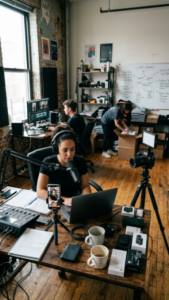
The economics explain much of the change. A small studio often carries fixed costs before a single piece of content is released. Creators tend to build from variable costs: a home set, a small team, freelance editors, cloud tools, AI-assisted workflows, remote guests and platform-native analytics. As revenue grows, the most successful creators add producers, lawyers, operators, brand teams and development executives. At that point, they begin to look less like influencers and more like independent entertainment companies.
This professionalization is already visible. Major creator-led businesses are hiring executives from television, film, sports and consumer brands. Some are building writers’ rooms, sales departments and legal teams. Others are developing live tours, consumer products, podcasts, children’s programming, documentaries and licensing deals. The playbook is familiar to anyone who understands the old studio system: build audience loyalty, extend the brand, own the relationship and turn attention into a portfolio of revenue streams.
What is new is the route to scale. A creator does not need permission from a broadcaster to launch a show. A comedian can test a character on short video before building a live tour. A gaming creator can turn a channel into an events business. A beauty creator can move from tutorials into product development. A food creator can turn a recipe series into packaged goods, books and restaurant partnerships. A podcaster can become a talk-show host without ever entering a network studio.
The audience is also behaving differently. Younger viewers are often less loyal to institutions than to personalities. They may not know which company produced a program, but they know which creator explained a story clearly, made them laugh, answered their comment or appeared in their feed every morning. This personal connection is difficult for small studios to manufacture because it depends on repetition, authenticity and perceived access. The creator is not just the face of the show. The creator is the distribution strategy.
For traditional producers, this is both a threat and an opportunity. The threat is obvious: creators can compete for attention, advertising budgets and talent at lower cost and greater speed. A lean creator team can publish weekly or daily, while a small studio may spend months developing a slate. If a format fails, the creator moves on quickly. If it works, the audience has already validated it.
The opportunity is partnership. Small studios still know how to scale production quality, manage complex shoots, clear rights, negotiate distribution, protect intellectual property and build formats that survive beyond one personality. The most durable creator-led companies may not reject studio discipline; they may absorb it. The future could belong to hybrid businesses where creators supply audience intimacy and studios supply production architecture.
Connected television is accelerating that convergence. Creator content was once assumed to belong mainly on phones. Now YouTube and other video platforms are increasingly present in living rooms, where long-form creator shows compete beside streaming series, sports highlights and film libraries. That migration matters because television screens still attract premium advertising budgets. When creator programming becomes living-room programming, the distinction between online video and television becomes less useful.
The same pattern is emerging in branded entertainment. Brands that once hired small studios to produce digital campaigns increasingly work directly with creators or creator agencies. The creator brings not only production but distribution and credibility. A product placement inside a creator’s recurring show can feel more natural than a conventional ad. A sponsored challenge, review, tutorial or documentary-style episode can be tested, clipped and amplified across several platforms.
Still, the creator-led model carries risks. Not every popular personality can run a company. Charisma does not automatically translate into management, accounting, labor standards, child safety, brand safety or long-term creative development. Many creator businesses remain dependent on platform algorithms they do not control. A change in recommendation systems, monetization rules or audience taste can weaken a company quickly.
There is also a creative risk. When every decision is measured by watch time, click-through rate and comment velocity, creators may be pushed toward repetition, outrage or excessive intimacy. The studio system had its own failures, but it often created distance between audience demand and creative decision-making. Creator-led entertainment removes much of that distance. The result can be more responsive and more human, but also more volatile.
Labor is another unresolved question. Behind successful creators are editors, researchers, camera operators, moderators, producers, managers and assistants who may work under startup-like pressure. As creator companies grow, they will face the same scrutiny as traditional media employers. The language of authenticity will not protect them from questions about pay, safety, working hours, contracts and ownership.
The most important question is whether creator-led entertainment can outlive individual fame. Small studios were built to produce many shows with many talents. Creator companies often begin with one voice, one face or one group dynamic. To become lasting institutions, they need formats, characters, brands and teams that can survive beyond the original spark. Some are already attempting that transition by developing new hosts, new verticals and new audience segments.
For viewers, the change is already here. A teenager’s favorite comedy show may come from a bedroom set. A parent’s trusted shopping guide may be a livestream host. A sports fan’s daily program may be a creator podcast clipped across social feeds. A music audience may discover artists through creator-led channels rather than traditional television. Entertainment is becoming less defined by where it was produced and more by who gathers the audience.
Creator-led entertainment is not the end of the studio. It is the unbundling of the small studio into a faster, personality-driven operating system. Development happens in public. Marketing is built into the content. Distribution is direct. Community is visible. Commerce sits nearby. The creator is the showrunner, the channel and, increasingly, the company.
The next phase will test whether these businesses can combine speed with durability. The creators who succeed will not simply replace small studios by being cheaper or louder. They will replace them where they can be more trusted, more adaptive and more closely connected to the audience. In that sense, the new studio may not look like a building at all. It may look like a feed, a chat window, a camera and a community that returns every day.