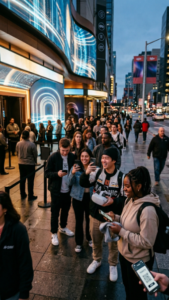
From smart glasses and virtual reality headsets to giant LED domes and interactive museums, audiences are being invited not just to watch entertainment but to step inside it.
The new entertainment venue does not always look like a cinema, a concert hall or a theme park. It may be a headset, a warehouse, a museum gallery, a stadium-scale dome or a city street layered with digital images through a phone camera. The audience may not sit still. They may walk, turn, touch, scan, speak, play, film and share. In the emerging business of immersive entertainment, the old promise of spectacle is being rewritten into a more active proposition: do not just watch the story, enter it.
Augmented reality, virtual reality, 3D visuals and 360-degree environments are no longer confined to technology fairs or gaming expos. They are becoming part of concerts, sports broadcasts, branded pop-ups, museum exhibitions, theme parks, cinema, education and social media culture. The transformation is uneven, and the industry still faces questions about cost, comfort and mass adoption. But the direction is clear. Entertainment companies are competing to make audiences feel surrounded.
The shift reflects a broader problem in media: attention has become harder to win. Streaming libraries are crowded, social platforms move at high speed, and consumers have grown accustomed to skipping, scrolling and multitasking. Immersive entertainment offers a different kind of value. It creates presence. A 360-degree film can make a viewer feel placed inside a landscape. A VR game can turn a player into a character. An AR filter can transform a concert poster into a moving image. A large-scale LED venue can make thousands of people feel as if they are flying over mountains, floating under the ocean or standing inside a fictional universe.
For younger audiences, the attraction is especially powerful because immersive entertainment fits the way they already use media. Gen Z and Millennials are comfortable moving between physical and digital spaces. They may discover an experience on TikTok, buy a ticket through an app, attend with friends, record parts of the event, and continue the experience online through clips, filters and fan edits. The event is not only consumed; it is documented and circulated.
That social layer is one reason immersive entertainment has become attractive to investors and media companies. A conventional advertisement may be ignored, but an interactive installation can become user-generated content. A 3D projection on a building can draw crowds. A branded AR game can travel through phones. A virtual concert can reach fans who cannot attend in person. The experience becomes both product and marketing.
The market, however, is not moving in a straight line. The strongest momentum may not be in bulky VR headsets, despite years of industry hype. Research firms have reported softness in traditional VR hardware, with demand still concentrated among gamers and early adopters. High prices, limited must-have content, device weight, battery life and social awkwardness remain barriers. Many consumers are intrigued by VR but do not yet see a reason to wear a headset regularly at home.
At the same time, broader extended reality is gaining ground through lighter and more familiar devices. Smart glasses, phone-based AR and mixed-reality tools suggest that immersion may arrive gradually rather than through a sudden headset revolution. The most successful products may be those that feel less like equipment and more like everyday accessories. Instead of asking users to disappear into a device, the next phase may add digital layers to the world they already occupy.
This distinction matters for entertainment. Full VR remains powerful for gaming, training simulations, virtual rides and cinematic experiments. But AR may be more scalable for concerts, sports and live events because it does not remove people from the room. Fans can point a phone at a stage and see animated effects. Museum visitors can scan an artifact and see it reconstructed. Sports spectators can view statistics overlaid on the field. A festivalgoer can follow an interactive map, unlock digital collectibles or participate in a story unfolding across the venue.
The rise of 360-degree venues shows another path. Instead of selling millions of headsets, operators can build shared immersive spaces where technology surrounds the audience. Sphere in Las Vegas has become the most visible example, using a vast wraparound LED display, spatial audio, haptic seating and environmental effects to turn concerts and films into multi-sensory events. Its importance is not only architectural. It demonstrates that immersion can be collective. Audiences still gather in one place, but the room itself behaves like a screen, a speaker and a special-effects system.
Theme parks, museums and cultural attractions have been moving in a similar direction for years. Projection mapping, interactive floors, motion platforms, scent, surround sound and responsive lighting have become standard tools in the design of high-end attractions. Themed entertainment increasingly borrows from gaming, cinema and architecture. A visitor is not just looking at a dinosaur skeleton, a historical battlefield or a fantasy kingdom. The visitor is moving through a constructed world designed to trigger emotion, learning and memory.
Cinema is also adapting. Traditional 3D had cycles of boom and fatigue, especially when audiences felt the effect was added as a premium-priced afterthought. But newer immersive formats are more ambitious. Premium large-format screens, high frame rates, spatial audio and 3D production designed from the start can still make theatrical viewing feel distinct from home streaming. For studios, that distinction is crucial. If audiences are going to leave the couch, the theater must offer scale, sound and sensory impact that a living room cannot match.
The same logic applies to sports and concerts. A fan may watch highlights on a phone within minutes, but immersive technology can make the live or premium broadcast experience feel richer. Sports leagues are experimenting with alternate camera angles, virtual replays, volumetric capture and mixed-reality graphics. Concert producers are using LED architecture, motion tracking and real-time visual engines to build shows that respond to music rather than merely decorate it. The stage becomes less like a platform and more like a moving environment.
Artificial intelligence is accelerating this transition. AI-assisted 3D modeling, image generation, motion capture cleanup and real-time rendering can reduce production time and open immersive design to smaller studios. A museum, theater company or independent artist may soon be able to create interactive environments that once required a Hollywood-scale budget. The risk is oversupply. If every brand builds an “immersive experience,” audiences will become more selective. Technology alone will not be enough.
That is the central lesson emerging across the sector: immersion is not the same as quality. A headset can still deliver a boring story. A 360-degree room can still feel empty. A 3D film can still fail if the characters do not matter. The best immersive entertainment uses technology to deepen emotion, not replace it. The audience must feel that the format serves the experience.
There are also ethical and practical concerns. Immersive systems collect data about bodies, gestures, voices, eyes, movement and location. That information can improve design and accessibility, but it can also create privacy risks. The industry will need clearer standards on consent, data use and child safety. Accessibility is another challenge. Motion sickness, visual impairment, hearing differences and mobility limitations can exclude some users unless experiences are designed inclusively from the beginning.
Cost may be the biggest constraint. High-end immersive venues require expensive screens, computing infrastructure, maintenance and custom content. VR and AR devices remain beyond the reach of many households. Ticketed immersive exhibitions can be expensive, particularly in major cities. If the sector wants to become mainstream rather than elite, it must offer different price points and formats, from free phone-based AR to premium destination experiences.
Still, the appeal is durable because it answers a basic cultural desire. In an age of endless flat screens, people want entertainment that feels tangible. They want to stand inside the image, hear sound move around them, share wonder with friends and carry proof of the moment back to their networks. The screen is not disappearing. It is expanding into rooms, glasses, streets and bodies.
Immersive entertainment is unlikely to replace film, television, gaming or live events. Instead, it is becoming a layer across all of them. The future may not belong to one device or one format, but to a hybrid ecosystem in which audiences choose how deeply they want to enter a story. Sometimes that will mean wearing a headset. Sometimes it will mean walking into a 360-degree venue. Sometimes it will mean lifting a phone and seeing the familiar world change.
The next great entertainment battle may not be over who has the biggest library. It may be over who can build the most convincing world.