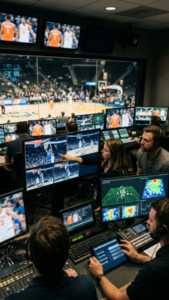
As the NBA tests cloud and artificial intelligence tools for real-time clips, 360-degree replays and tailored statistics, the next broadcast may look different for every fan.
For generations, the sports highlight has been a shared ritual. A dunk, a buzzer-beater, a crossover or a blocked shot would be cut into a short package, replayed on television, posted online and argued over by fans who had seen the same sequence from the same angle. That model is not disappearing. But it is being joined by a more individualized version of sports media, one in which a fan may soon ask for every touch by a favorite player, every defensive possession by a rising rookie, every three-point attempt from a preferred camera angle and a quick postgame summary built around the team they follow most closely.
Artificial intelligence is moving the highlight from a fixed editorial product to a customizable experience. In basketball, where each game produces hundreds of possessions, thousands of tracking data points and constant changes of pace, the technology is especially attractive. The National Basketball Association has already spent years building digital products that personalize content, recommend videos and attach advanced statistics to the viewing experience. More recent cloud partnerships and AI experiments point toward a deeper shift: real-time, fan-specific storytelling at scale.
The idea is simple to understand and technically difficult to execute. A viewer who supports the Golden State Warriors but follows a young player on another team may not want the same recap as a neutral fan. A fantasy basketball player may care about rebounds, usage rate and minutes played. A coach may want to see spacing and defensive rotations. A casual fan may prefer a 90-second summary with dramatic plays and plain-language context. A mobile-first viewer may want vertical clips. An international fan may want a different language, a different commentary style or a replay that explains the rules as the action unfolds.
AI highlights promise to serve those different needs without waiting for a human editor to produce dozens of separate packages after every game. The system can identify a play, tag the players involved, connect the moment with statistics, match it to user preferences and distribute a clip almost immediately. The result could be a personalized reel: every assist by a favorite guard, every block by a center, every late-game possession by a chosen team, or every moment that changed win probability in the final five minutes.
The NBA is a useful case study because it sits at the intersection of live entertainment, global fandom, betting, fantasy sports, social media and advanced analytics. Fans no longer consume games only through a full television broadcast. Many follow through phone alerts, short clips, league apps, social platforms, alternate broadcasts, podcasts and postgame analysis. For younger viewers especially, the highlight is often not a supplement to the game. It is the main point of contact.
That reality creates pressure on leagues to make highlights faster, smarter and more relevant. The traditional recap answers one question: what happened in the game? Personalized AI highlights try to answer a more specific question: what happened that matters to me? The difference may define the next phase of sports broadcasting.
In practical terms, a personalized system depends on several layers of technology. Cameras capture the game from multiple positions. Player-tracking systems generate movement data. Cloud infrastructure stores, processes and distributes video. Machine-learning models identify events, classify plays and connect them with statistics. Recommendation systems decide what a particular user is likely to care about. Generative AI can then produce a short written or spoken summary, translating numbers into language that feels closer to a postgame briefing than a box score.
The most visually striking development is 360-degree replay. Instead of showing a dunk or layup from a single sideline camera, a replay system can use multiple camera feeds and AI processing to create a spherical view of the action. The fan is no longer locked into the original broadcast angle. A drive to the rim can be seen from behind the ballhandler, from above the paint, from the defender’s perspective or from a rotating view that reveals spacing and timing. In basketball, where inches and angles often decide a play, that added perspective can change how fans understand what they have seen.
The promise goes beyond spectacle. A 360-degree replay can show how a screen created separation, how a weak-side defender arrived late, or how a pass opened because two players moved in opposite directions. For analysts and serious fans, that makes the highlight more educational. For casual viewers, it can make a complicated play easier to appreciate. For the league and its media partners, it creates a premium layer of engagement that may keep users inside official platforms longer.
The same logic applies to statistics. A standard highlight might show a player hitting five three-pointers. A personalized AI version could add shot quality, defender distance, speed before the catch, historical comparison, lineup context or how the shot affected win probability. A fan who likes analytics could receive a data-rich version. A fan who wants simplicity could receive a plain-language summary: the player created space quickly, made difficult shots and changed the game in the fourth quarter. The content can be the same play, but the explanation can be tailored.
This is where AI becomes less like a clip machine and more like a newsroom assistant. It can sort through the overwhelming volume of a game and propose different storylines: the star performance, the tactical adjustment, the bench unit that swung the second quarter, the rookie’s defensive growth, the injury impact, the late-game decision, the statistical anomaly. Human producers and editors may still decide what deserves emphasis, especially for major broadcasts and official editorial products. But AI can reduce the time between the final buzzer and a polished summary.
There are risks in that speed. Sports highlights are not just data events; they are acts of storytelling. A model may identify the loudest play but miss the most important one. It may overvalue scoring and undervalue defense, screen setting or off-ball movement. It may reinforce the popularity of stars while making it harder for lesser-known players to break through. If personalization becomes too narrow, fans may see only what confirms their existing loyalties and miss the broader drama of the game.
There are also questions about transparency. Fans should know when a summary, voiceover or recommended clip has been generated or heavily assisted by AI. Leagues and broadcasters will need safeguards against errors, misleading statistics and fabricated context. In a live sports environment, even a small mistake can spread quickly. A wrong stat, a mislabeled player or an AI-generated quote that sounds authentic but is not real could undermine trust.
Privacy and data use will also matter. Personalized highlights depend on knowing what fans watch, search, replay, share and ignore. That data can improve recommendations, but it also raises familiar concerns about profiling, consent and commercial targeting. Sports leagues already operate in a media economy built on user engagement. AI makes that economy more powerful, and therefore more sensitive.
Rights management may be another challenge. The NBA operates across national markets, broadcast partners, streaming services, social platforms and subscription products. A clip that can be generated instantly for one fan may not be available in the same way to another fan in a different country or on a different platform. The future of personalized highlights will not be shaped by technology alone. It will also be shaped by media contracts, licensing rules and commercial strategy.
Still, the direction is clear. Sports viewing is becoming more interactive, more mobile and more personalized. The old broadcast told everyone where to look. The new model may let each fan choose the player, the statistic, the language, the angle and the length of the recap. A star’s night can become a cinematic reel. A role player’s defensive work can become a coaching clip. A full game can become a two-minute summary or a searchable library of moments.
For the NBA, the opportunity is not merely to create more clips. It is to deepen the relationship between fans and the game. The best AI highlight will not replace the live broadcast, the roar of the arena or the collective drama of a close fourth quarter. Its value will be in helping fans understand more, find what they care about faster and return to the game with greater attention.
The future highlight may begin with a question rather than a producer’s cut: show me my team’s best plays, show me my favorite player’s touches, show me why the defense collapsed, show me the game in one minute, show me the final shot from every angle. In that world, the highlight is no longer just a replay of what happened. It becomes a personalized map of why it mattered.