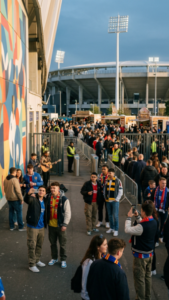
No longer confined to the scoreboard, modern sport is expanding into fashion, music, social media, celebrity culture, fandom, memes and event experiences that follow fans long after the final whistle.
The game is still the reason people gather. The score still matters. Championships still turn athletes into legends and defeats into civic grief. But in 2026, sport is no longer only a contest between teams or individuals. It has become a lifestyle system, a daily entertainment feed, a fashion runway, a music platform, a social-media language, a travel plan, a dating topic, a meme factory and a commercial ecosystem built around belonging.
The old model of sports consumption was simple: buy a ticket, watch the match, read the recap, wait for the next fixture. The new model is continuous. Fans follow players’ tunnel outfits before kickoff, watch behind-the-scenes clips after training, debate referee decisions on TikTok, buy limited-edition jerseys, stream athlete podcasts, save stadium food recommendations, share reaction memes and treat major events as cultural festivals. The match is now the anchor, not the whole product.
That transformation has been building for years, but it is accelerating as media, technology and consumer habits converge. Deloitte’s 2026 sports industry outlook describes sport as an expanding frontier of entertainment, culture and everyday life. The wording captures a broad shift: leagues and teams are not only competing with one another for fans, but with streaming platforms, music festivals, video games, influencers, fashion drops and every other form of attention in a crowded digital economy.
For younger fans especially, sport is often entered through culture before competition. A teenager may first notice a basketball player’s sneakers, a footballer’s hairstyle, a tennis star’s documentary, a Formula 1 driver’s livestream or a women’s soccer team’s social-media personality before understanding tactics or league tables. Knowledge still deepens fandom, but the gateway has widened. Style, humor, values and access can be as powerful as winning.
Fashion has become one of the most visible signs of this change. The pregame walk, once a logistical moment between the bus and locker room, has turned into a photographed stage. Athletes now arrive dressed not merely as competitors but as cultural figures. Their jackets, handbags, jewelry, sneakers and tailoring circulate online within minutes. Sportswear brands, luxury houses and independent designers understand that the athlete is no longer only a performer inside the arena. The athlete is a media channel.
Music has followed the same path. Halftime shows, walkout songs, locker-room playlists and victory celebrations have long linked sport and sound. What is different now is the scale and integration. A major final can function like a concert, a fashion show and a broadcast event at the same time. Stadiums are designed to hold spectacle. Broadcasts linger on celebrities in the crowd. Social teams clip celebrations for platforms where many viewers may never watch the full game. The event becomes divisible: a goal for one audience, a song for another, a celebrity reaction for a third.
Social media has changed the emotional timeline of fandom. A match no longer begins at kickoff or ends at full time. It starts with lineup rumors, travel photos, pregame fits, fantasy picks and influencer predictions. It continues through live clips, group chats, memes and instant analysis. Afterward, the conversation becomes a second event: tactical breakdowns, player interviews, apology posts, fan edits, conspiracy theories and jokes. For many fans, the digital afterlife of a game is as important as the game itself.
Memes are now part of sports language. A missed penalty, a stunned coach, a dramatic fan reaction or a player’s celebration can travel farther than the official highlight. Humor makes sport portable. It allows casual fans to participate without expert knowledge. It also softens the boundary between supporter and observer. Someone who does not know the standings may still understand the joke, share the clip and become part of the cultural moment.
Behind-the-scenes access has become another pillar of the sports lifestyle. Documentaries, mic’d-up segments, training-ground videos and athlete-owned media give fans a sense of intimacy that older sports coverage rarely offered. The modern fan wants performance, but also personality. They want to know how an athlete recovers, eats, dresses, parents, travels, fails and responds to pressure. This demand can humanize athletes, but it can also create a relentless expectation of visibility. Privacy becomes harder when authenticity is part of the brand.
Fandom itself is changing from passive loyalty to active identity. Supporting a team can shape what people wear, where they travel, what they post, who they meet and how they spend weekends. Fans organize online communities, produce edits, buy merchandise, attend watch parties and participate in arguments that feel both playful and deeply personal. The club or athlete becomes part of a fan’s self-description, similar to music taste, fashion style or political values.
This has major business implications. Teams and leagues are no longer selling only seats and broadcasts. They are selling membership, data-driven personalization, exclusive access, merchandise, food, hospitality, digital content and year-round community. The season ticket is being reimagined as a lifestyle subscription. The stadium is being reimagined as a sports district. The athlete is being reimagined as a creator and entrepreneur. The fan is being reimagined as a participant in an always-on entertainment economy.
Women’s sports are central to this new landscape. Their growth is not simply a story of delayed recognition, though it is that as well. It is also a story of different fan behavior. Many women’s sports communities have grown through social engagement, values-driven loyalty, player access, fashion, activism and a sense of shared discovery. Brands increasingly recognize that these audiences are not secondary versions of men’s sports audiences. They are distinct cultural communities with their own language and expectations.
Streaming has also reshaped the sports lifestyle. Live rights remain valuable because sport is one of the few entertainment products that still commands real-time attention. But streaming has made sports consumption more fragmented and more flexible. Fans can watch full matches, condensed highlights, documentaries, tactical clips, player interviews and creator commentary across multiple platforms. The result is not one audience, but many overlapping audiences: the purist, the casual viewer, the bettor, the fashion follower, the fantasy player, the meme consumer and the documentary fan.
The stadium experience has had to evolve in response. Attending a game is increasingly judged not only by the quality of play, but by transport, food, Wi-Fi, seating, music, safety, sightlines, merchandise, social-media backdrops and the sense that the event is worth leaving the house for. Fans accustomed to premium digital entertainment expect live events to deliver memory, not just access. A weak game can still produce a strong night out if the experience feels communal, theatrical and shareable.
There are risks in this expansion. When sport becomes entertainment lifestyle, the line between passion and over-commercialization can blur. Fans may feel exploited by constant merchandise drops, dynamic pricing, fragmented subscriptions and expensive event packages. Athletes may face pressure to perform as influencers even when they want to focus on competition. Younger fans may encounter gambling promotions, toxic online abuse or unrealistic expectations around bodies, wealth and fame. The culture around sport can be joyful, but it is not automatically healthy.
There is also a question of authenticity. Fans are quick to punish brands, leagues and athletes that appear to manufacture community without respecting it. Sport’s power comes from uncertainty, loyalty, memory and local meaning. Entertainment can amplify those qualities, but it can also flatten them into content. A club is not only a media company. A player is not only a brand. A fan is not only a consumer. The industry’s challenge is to grow without stripping away the emotional roots that made sport valuable in the first place.
Still, the direction is clear. The future of sport will be measured not only in scores, trophies and ratings, but in cultural presence. A successful team will live across wardrobes, playlists, group chats, documentaries, streetwear, stadium districts and social feeds. A major event will be judged by what happens before, during and after the game. A great athlete will be recognized not only for performance, but for narrative, style and connection.
Sport has always been more than sport. It has carried nationalism, class, race, gender, money, joy and grief. What is different now is that the machinery around it has become faster, more visual, more commercial and more intimate. The match remains sacred, but it is surrounded by a lifestyle that never really switches off.
In that sense, the modern fan is not only watching sport. They are wearing it, posting it, remixing it, traveling for it, joking about it, arguing through it and building identity around it. The final whistle may still end the contest. It no longer ends the entertainment.