As dating apps lose some of their cultural shine, running clubs, pickleball meetups, tennis groups, gym communities and recreational leagues are turning fitness into a low-pressure way to meet people offline.
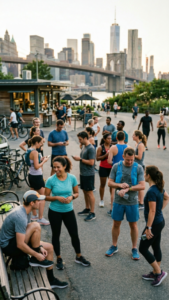
On a weekday evening in many American cities, the new social scene does not always begin at a bar. It may start at a park entrance, a coffee shop corner, a waterfront path or the curb outside a running store. People arrive in bright shoes and breathable shirts, check their watches, stretch briefly, introduce themselves awkwardly and then begin moving together. Some are training for a race. Some are trying to get healthier. Some are new to town. Some are single. Many are there because exercise has become one of the few socially acceptable ways to meet strangers without appearing desperate, over-scheduled or trapped behind a screen.
The running club has become a kind of real-world social network. It has profiles, but they are visible in motion: pace, effort, humor, consistency, kindness, how someone treats a beginner falling behind. It has status signals, from carbon-plated shoes to race medals and GPS watches, but it also has a democratic appeal. The basic invitation is simple: show up, run a few miles, talk afterward. Unlike a dating app, it does not require a perfect opening line. Unlike a nightclub, it does not depend on alcohol, loud music or late hours. Unlike a private gym, many clubs are free.
The phrase “running clubs are replacing dating apps” is partly exaggeration and partly diagnosis. Dating apps are not disappearing. Millions of Americans still use them, and many couples still meet online. But the cultural mood around swiping has changed. For some users, apps feel transactional, repetitive and emotionally draining. A match can vanish. A conversation can stall. A date can feel like an interview. Running clubs offer something different: repeated contact, shared effort and the possibility of attraction developing in public, gradually and with context.
That context matters. Fitness groups solve one of the hardest problems of adult life in the United States: how to meet people regularly without making the meeting itself feel like the entire point. A running club gives strangers a reason to stand beside each other. A pickleball meetup creates rotating partners and light competition. A tennis group makes small talk easier because the next serve is always coming. A recreational soccer or kickball league gives people a team identity before they have to invent one. The activity reduces the pressure of connection.
This is why social fitness has moved beyond elite endurance culture. The new wave is not only marathoners chasing personal records. It includes beginners doing two miles at a conversational pace, women-only clubs focused on safety and belonging, sober-curious groups replacing happy hour, neighborhood pickleball meetups, office gym communities, tennis ladders, cycling crews, climbing gyms and recreational leagues built as much around friendship as performance. The workout is the invitation. The community is the product.
Several forces are pushing Americans toward this model. The first is loneliness. Public health officials have warned that social isolation is not merely a mood problem but a health issue associated with higher risks of depression, anxiety and physical disease. After years of remote work, fragmented schedules and online communication, many people are seeking structured ways to be around others. Fitness groups provide recurring, low-cost contact that can become friendship through repetition.
The second force is dating fatigue. Online dating expanded romantic options but also made connection feel like work. Users often describe a cycle of swiping, messaging, ghosting and returning to the app with lower expectations. In-person fitness groups do not guarantee romance, but they restore some of the social cues missing online: eye contact, energy, humor, courtesy, confidence and chemistry. Attraction is not judged only by a photograph or a prompt. It is observed over time.
The third force is the rise of “third places,” or the search for them. Many Americans lack affordable spaces outside home and work where they can gather regularly. Coffee shops can be expensive, bars are not appealing to everyone, and private clubs exclude many by cost. Running routes, public courts, parks and community gyms offer a more open form of social infrastructure. A weekly run can become a standing appointment with the city itself.
Brands have noticed. Athletic companies now sponsor community runs, shoe demos and race-week events. Local running stores host meetups that bring customers back every week. Gyms market not just equipment but belonging. Pickleball facilities are being built as social venues, not only sports courts. Dating apps themselves have experimented with in-person events, acknowledging that even digital matchmaking depends on offline chemistry. The line between wellness business and social club is becoming harder to draw.
The appeal is especially strong for younger adults, but it is not limited to them. Gen Z may speak most fluently about replacing “doomscrolling” with movement, but millennials juggling work and family also use fitness groups to preserve friendship. Older adults join walking clubs, tennis ladders and pickleball games for mobility and companionship. Newcomers to a city use run clubs as a map of neighborhoods and people. In a mobile society, social fitness can provide instant routine.
There is also a gender dimension. Women’s running clubs and women-led fitness communities have grown partly because they offer safety, encouragement and a break from male-dominated sports spaces. For some women, a group run creates freedom to exercise outdoors without feeling alone. For others, it offers friendship without the ambiguity of a mixed social scene. At the same time, mixed clubs can become dating spaces whether organizers intend that or not, raising questions about boundaries, harassment and the need to protect the group’s original purpose.
The best clubs understand that social fitness works only when it is inclusive. A run club that becomes a speed contest will lose beginners. A pickleball meetup that is dominated by regulars may intimidate newcomers. A gym community that turns every class into a dating pool can become uncomfortable. Organizers increasingly set norms: no one gets left behind, different pace groups are welcome, introductions are encouraged, consent matters, and socializing after the workout is optional rather than required.
The economics are important, too. Social fitness is often cheaper than conventional dating. A first date involving drinks, dinner, rideshare and tips can be expensive. A run followed by coffee costs far less. A park workout may cost nothing. For young adults facing rent pressure, inflation and student debt, the math matters. Fitness also feels like a productive expense. Shoes, a gym membership or a tournament fee can be justified as health spending, even if the deeper reason is connection.
Still, the trend has contradictions. Social fitness can become performative, with clubs turning into content farms for Instagram and TikTok. Expensive gear can create subtle class barriers. Pace groups can reproduce status hierarchies. Some people may feel excluded by body type, disability, age or lack of athletic experience. And while a run club may be a healthier setting than a bar for many, it should not be romanticized as a cure for loneliness or a replacement for deeper community institutions.
There is also the risk of turning every human need into a lifestyle category. People do not join running clubs only because they want to optimize cardiovascular health or find a partner. They join because modern life often makes casual friendship strangely difficult. The power of a club is not the mileage. It is the repeated invitation: same place, same time, familiar faces, small talk becoming real talk.
That may explain why the movement has spread so quickly. Social fitness offers a rare combination of self-improvement and social permission. It allows people to say they are going for a workout when they are also looking for friendship, routine, confidence, flirtation, recovery or a reason to leave the apartment. It makes vulnerability easier because everyone is slightly out of breath.
The future of dating apps will not be decided by running clubs alone. Technology will remain part of how people meet. But the rise of social fitness shows a correction in American social life. After years of measuring connection through screens, people are rediscovering the value of shared physical presence. They want to see how someone moves through the world, not only how they describe themselves online.
The run ends where it began. People stop their watches, compare routes, take a group photo, drink water, laugh about the hill and ask who is coming next week. Some will become faster. Some will become friends. Some may fall in love. Most will simply return because, for an hour, the city felt less anonymous. That is the promise of the running club as social network: not a perfect match, but a place to show up again.