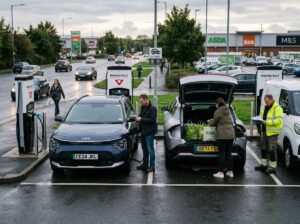
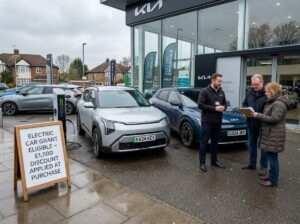
The inclusion of Kia’s compact electric models in Britain’s Band 2 subsidy list highlights the government’s effort to narrow the price gap between battery-powered cars and conventional rivals.
LONDON — Kia’s EV3 and EV4 Motion are again drawing attention in Britain’s electric vehicle market after being listed among models eligible for the UK government’s Electric Car Grant, a subsidy designed to reduce the upfront cost of new zero-emission cars and accelerate the country’s transition away from petrol and diesel vehicles.
The models sit in Band 2 of the scheme, qualifying for a discount of up to £1,500, applied by the seller at the point of purchase rather than claimed separately by the customer. For buyers, that detail matters: the grant is not a post-sale rebate or a tax adjustment, but a visible reduction in the advertised transaction price of qualifying vehicles. For manufacturers, it is becoming a strategic tool in an increasingly competitive market where price, range, charging speed and brand trust all influence the decision to switch to electric.
The continued mention of the EV3 and EV4 in grant discussions reflects a broader shift in the UK market. Electric cars are no longer confined to early adopters or premium buyers. They are moving into mainstream family transport, where monthly payments, deposit contributions and government-backed discounts can determine whether a customer signs an order or remains with a hybrid or combustion-engine vehicle.
Kia has positioned the EV3 as a compact electric SUV aimed at households seeking practicality without moving into the higher price brackets that have often defined the EV market. The EV4, meanwhile, extends Kia’s electric range into a more traditional hatchback and fastback format, with the Motion grade introduced as a way to combine a longer-distance driving proposition with pricing and specification that can qualify under the grant rules. Together, they show how carmakers are adjusting trim structures, battery options and equipment levels to meet subsidy thresholds while still appealing to consumers who expect modern technology and usable range.
The UK Electric Car Grant, launched in July 2025 and scheduled to run until March 2030, was created to support new electric cars priced at or below the government’s threshold and meeting technical and sustainability criteria. Eligible vehicles must produce zero tailpipe emissions, offer a minimum battery range of 100 miles, and meet warranty requirements for both the vehicle and the battery. The programme divides qualifying cars into two bands: Band 1 models can receive up to £3,750, while Band 2 models can receive up to £1,500.
That structure has made eligibility a commercial talking point. A £1,500 reduction will not erase the entire price difference between an electric car and a petrol alternative in every segment, but it can shift the calculation for buyers comparing finance offers. In the UK, where many private customers purchase cars through personal contract purchase agreements and fleet operators assess vehicles by whole-life cost, a lower on-the-road price can influence monthly payments, residual value assumptions and benefit-in-kind calculations.
Kia says the grant applies to selected versions of its electric line-up, including EV3 Air and EV3 GT-Line, EV4 Air and EV4 Motion, as well as other eligible models. The company has promoted the discount alongside finance offers, underscoring how government support and manufacturer incentives increasingly work in tandem. Rather than relying solely on one headline price cut, brands are building packages around deposits, interest rates, trade-in values and charging-related messaging.
The EV3 is particularly important for Kia because compact SUVs are among the most heavily contested categories in the British market. Buyers in this segment often want the higher seating position and flexible interior of an SUV, but without the cost and size of larger electric models. A grant-backed price helps the EV3 compete not only with electric rivals from European, Korean and Chinese brands, but also with petrol hybrids that remain familiar and widely available.
The EV4 Motion serves a different purpose. By expanding the EV4 range with a grant-eligible grade, Kia can target drivers who prefer the lower, more aerodynamic shape of a hatchback but still want a long-range electric car for motorway use and family travel. The Motion badge also signals a growing trend in the EV industry: manufacturers are not only launching new models, but refining specific trims to satisfy regulatory, subsidy and consumer affordability requirements.
For the British government, the grant is one part of a wider policy effort to increase the share of zero-emission vehicles in new car sales. The UK’s zero-emission vehicle mandate requires manufacturers to sell a rising proportion of electric cars over the decade, creating pressure to move beyond premium models and into higher-volume segments. Subsidies can help, but they operate in a market shaped by interest rates, insurance costs, charging access and household budgets.
Consumers remain cautious. Many drivers see the benefits of electric motoring, including lower running costs for those able to charge at home, reduced local emissions and smoother driving characteristics. But they also weigh concerns about public charging reliability, long-distance convenience, depreciation and the upfront price of new cars. In that environment, government grants function as a confidence signal as much as a financial incentive.
The design of the UK scheme also reflects an attempt to reward cleaner manufacturing. Cars are assessed not just as zero-emission vehicles at the tailpipe, but against broader sustainability standards. That approach has drawn attention from industry observers because it could favour manufacturers with lower-carbon supply chains or production processes, while excluding or limiting support for models that might otherwise appear affordable and competitive.
For Kia, the inclusion of EV3 and EV4 variants strengthens a UK electric strategy already built around a broadening product range. The brand has moved from being a challenger in the electric market to a mainstream player with models covering small, compact, family and multi-purpose segments. Grant eligibility gives dealers a clearer message at a time when showroom conversations often begin with cost rather than technology.
The competitive landscape is intensifying. Citroën, Renault, Nissan, Vauxhall, Peugeot, Volkswagen, Skoda and other brands also have models listed under the grant scheme. Chinese manufacturers, many of which have entered the UK with aggressively priced electric vehicles, are pressuring established automakers to justify their pricing through design, warranties, dealer networks and aftersales service. In such a market, a £1,500 grant can help, but it does not guarantee success.
Dealers say clarity matters. Buyers who discover late in the process that one trim qualifies while another does not may delay or cancel a purchase. That makes the naming of specific grades, such as EV4 Motion, commercially significant. A model’s eligibility must be simple enough to explain in advertising, on finance quotes and in conversations with customers comparing several vehicles online before ever visiting a showroom.
The grant may also influence how future EVs are specified. Larger wheels, heavier equipment packages and higher-performance versions can affect price or efficiency, potentially pushing vehicles outside eligibility limits. Automakers are likely to continue balancing desirable features against the need to keep key versions within grant rules. In that sense, the EV3 and EV4 Motion are not just beneficiaries of the scheme; they are examples of how policy can shape product planning.
For buyers, the practical message is straightforward but worth checking carefully: eligibility depends on the exact model and derivative, not simply the badge on the bonnet. A Kia EV3 or EV4 may appear on the government list, but customers should confirm the qualifying trim, battery and price with the dealer before placing an order. The discount is intended to be included automatically in the purchase price, removing the need for individual applications.
The longer-term question is whether grants can convert interest into sustained demand. Britain’s EV market has grown rapidly, but private retail uptake has often lagged fleet purchases. A subsidy that narrows the initial price gap may help bring more private buyers into the market, particularly if combined with wider improvements in charging infrastructure and clearer information about battery life and ownership costs.
The renewed focus on the Kia EV3 and EV4 Motion therefore carries significance beyond two model names on a government list. It shows how the UK’s electric transition is entering a more practical phase. Policy, pricing and product design are converging around the same issue: making electric cars feel less like a premium experiment and more like a normal choice for ordinary drivers.
If that shift continues, grant-eligible models such as the EV3 and EV4 Motion could play an important role in determining how quickly electric vehicles move from headline growth to everyday adoption. The £1,500 discount may be modest in the context of a new car purchase, but in a market where confidence and affordability are often decisive, it gives Kia and its customers a clearer route into the next stage of Britain’s electric car market.