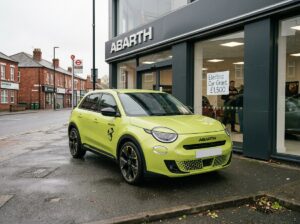
The performance-focused electric crossover now qualifies for a £1,500 government discount, putting its on-the-road price at £32,495 and sharpening competition in Britain’s fast-changing EV market.
LONDON — Abarth’s electric ambitions received a timely boost this week after the 600e, the Italian brand’s high-performance battery-powered crossover, became eligible for the United Kingdom’s Electric Car Grant, reducing its price by £1,500 for retail buyers.
The confirmation places the Abarth 600e among a growing list of electric vehicles supported by the government scheme, which is designed to make zero-emission cars more affordable as Britain pushes toward the planned phase-out of new petrol and diesel cars. With the grant applied, the Abarth 600e is now priced from £32,495 on the road, according to Stellantis, Abarth’s parent company.
The move follows a broader price repositioning by Fiat and Abarth earlier in 2026 and comes at a critical point for the UK electric car market. Battery-electric vehicle registrations are rising, but private demand remains sensitive to price, charging access and wider economic pressures. For manufacturers, each additional eligible model offers a chance to narrow the gap between electric and combustion-powered vehicles in a market where affordability has become one of the central battlegrounds.
Abarth, historically known for small, noisy, petrol-powered performance cars, is attempting to carry its sporting identity into the electric era. The 600e is central to that effort. Based on the same broad Stellantis platform family as other compact electric crossovers, it has been styled and tuned to present itself as a more aggressive, performance-led alternative to mainstream EVs.
The government grant does not transform the Abarth 600e into a budget car. At more than £32,000, it remains a premium proposition compared with many compact hatchbacks and small SUVs. But the £1,500 reduction lowers the barrier for buyers who may have been weighing the car against cheaper electric rivals, manufacturer-backed discounts or even petrol and hybrid alternatives.
The UK’s Electric Car Grant provides two levels of support: up to £3,750 for vehicles meeting the highest sustainability criteria and £1,500 for models qualifying in the second band. The scheme applies to eligible new zero-emission cars, with the discount incorporated by the seller into the purchase price rather than requiring the buyer to apply separately.
The Abarth 600e joins the Fiat 600e on the list of eligible models. Fiat’s electric crossover is now priced from £25,495 with the grant applied, while the Abarth version sits higher in the range as the more performance-oriented choice. The difference reflects Abarth’s positioning: sharper styling, stronger performance credentials and a brand identity built around driver engagement.
For Stellantis, the eligibility decision is commercially useful. The group has been under pressure across Europe to improve electric vehicle sales while managing costs, regulatory targets and increasingly aggressive competition from Chinese and Korean automakers. In the UK, brands are also navigating the Zero Emission Vehicle mandate, which requires manufacturers to sell a rising share of zero-emission cars or face penalties.
The timing is significant. UK battery-electric registrations rose strongly in April 2026, but industry data still shows the market below the trajectory required by government targets. That gap has led automakers and trade bodies to call for stronger consumer incentives, arguing that fleet buyers have adopted EVs more quickly than private motorists.
Abarth’s challenge is more specific. It must persuade performance-car buyers that electrification can deliver more than low running costs and regulatory compliance. Electric motors offer instant torque and rapid acceleration, characteristics that suit a sporty brief. Yet enthusiasts who grew up with the brand’s petrol models may need convincing that an electric crossover can carry the same emotional appeal.
The 600e is Abarth’s answer to that question. Its design emphasizes visual aggression, with a wider stance, bolder bodywork and the scorpion branding associated with the company’s racing heritage. The pitch is not simply that it is an electric car, but that it is an Abarth adapted for a market in which tailpipe emissions are being regulated out of new-car showrooms.
The grant also reflects how government policy is beginning to shape the pricing strategies of automakers. When the UK’s previous plug-in car grant ended in 2022, several manufacturers introduced their own temporary discounts to soften the impact on buyers. Fiat later reintroduced a manufacturer-backed electric grant for models including the 500e, 600e and Abarth variants. Now, official eligibility under the renewed government scheme gives the discount a clearer policy foundation.
For consumers, the most practical effect is simplicity. The grant is reflected in the advertised transaction price, avoiding a separate claims process. That matters in a market where EV buyers already face a complex set of considerations, including charging tariffs, home charger installation, insurance costs, depreciation and battery range.
The Abarth 600e’s qualification may also place pressure on rival brands. In the compact EV segment, buyers are increasingly comparing not only range and equipment but also the net price after grants or manufacturer incentives. A £1,500 difference can affect monthly finance payments, especially for private buyers who are more exposed to interest rates and household budget pressures than company-car users.
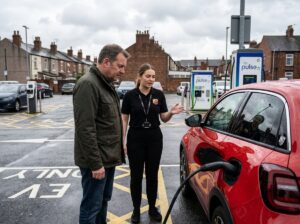
Still, the grant’s impact should not be overstated. Price remains only one part of the EV adoption equation. Public charging reliability, regional disparities in infrastructure and the cost gap between home and rapid charging continue to influence buying decisions. For households without driveways, electric running costs can be less predictable than official comparisons suggest.
There is also a broader debate over the design of the UK grant. Because eligibility is linked not only to price but also to environmental criteria, including production sustainability, the scheme has created winners and losers across the industry. Some models qualify for the higher £3,750 discount, many receive £1,500, and others receive nothing. That has made the grant both an incentive for consumers and a signal to manufacturers about how the government wants cleaner supply chains to evolve.
For Abarth, the result is straightforward: its newest electric performance model is now cheaper in Britain than it was before the grant decision. That gives dealers a clearer sales message and gives the brand a stronger footing in a market where electric performance is becoming more crowded.
The question is whether a lower price can broaden the appeal of a car that occupies a niche within a niche: a sporty electric crossover from a brand long associated with compact petrol hot hatches. Abarth will hope the answer is yes. The company’s future depends not only on building electric cars, but on convincing buyers that the character of the scorpion badge can survive without an exhaust note.
In that sense, the grant is more than a discount. It is a test of how quickly performance brands can adapt to a market being reshaped by policy, regulation and consumer economics. The Abarth 600e now has government support behind its price. Whether that is enough to turn curiosity into sales will depend on how convincingly it delivers the excitement its badge promises.