The pause underscores a wider recalibration inside Honda and Acura, where hybrids, delayed redesigns and shifting demand are reshaping the company’s North American product strategy.
NEW YORK — Acura’s plan for an electric successor to the RDX has been placed on hold, according to a recent industry report, marking another sign that Honda’s premium brand is slowing parts of its battery-electric rollout while it protects near-term sales with hybrids and existing gasoline models.
The move, reported as part of a broader delay affecting several next-generation Honda and Acura vehicles, comes at a delicate moment for Acura. The RDX has long been one of the brand’s most important models in the United States, sitting in the lucrative compact luxury SUV segment and serving as a bridge between Acura’s lower-priced entry models and the larger MDX. A disruption to that line therefore carries more weight than a routine product-cycle adjustment.
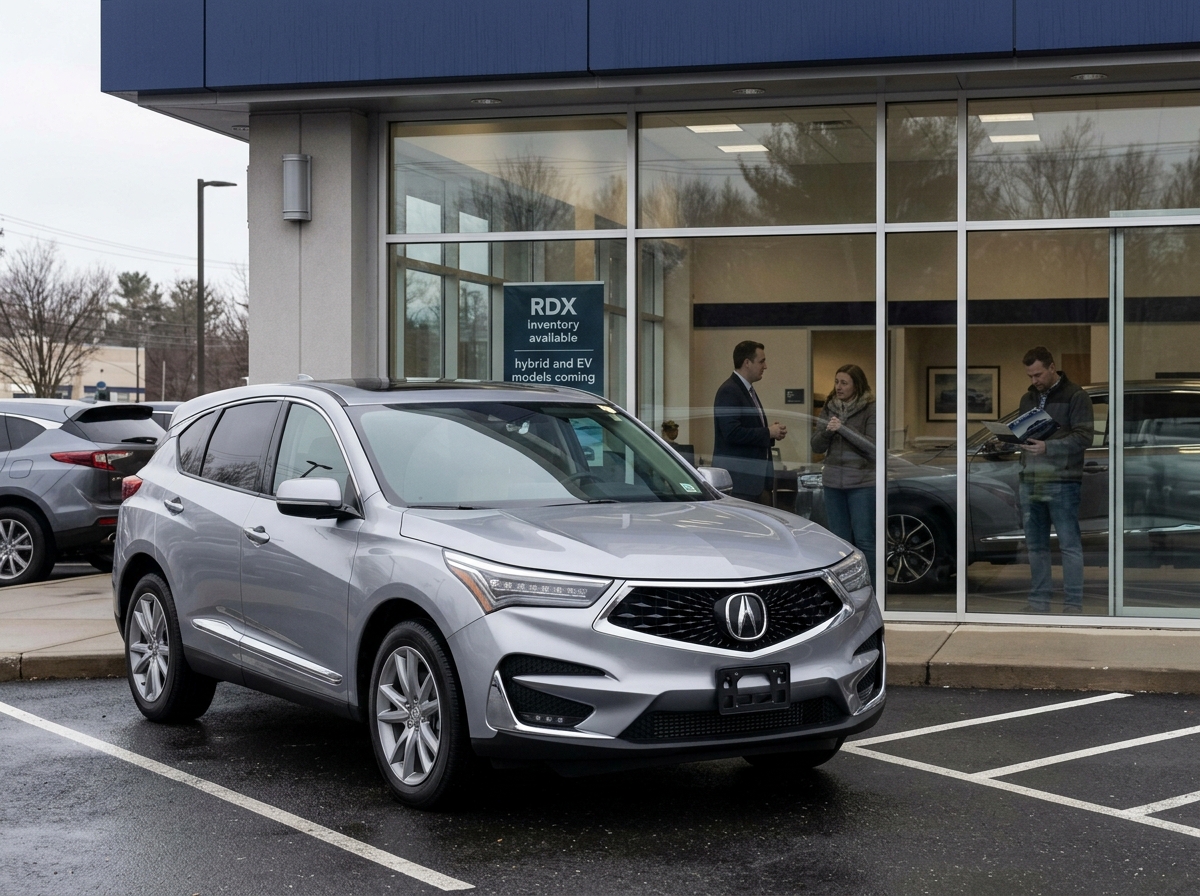
The reported pause also follows Acura’s earlier confirmation that production of the current RDX would end in 2026, with dealers expected to rely on remaining inventory for much of the year. At the time, Acura said the next RDX would return with a two-motor hybrid system, a first for the brand’s SUV lineup. That announcement already suggested a turn away from an immediate all-electric replacement. The latest report indicates the electric pathway has been pushed further into uncertainty.
For Honda, Acura’s parent company, the decision reflects a more cautious approach to electrification in North America after several years in which automakers promised rapid EV expansion. The market has since become more complicated. Battery-electric sales continue to grow in some segments, but demand has been uneven, incentives have changed, charging concerns remain a barrier for many households and luxury buyers have become more selective.
Honda has been adjusting in response. The company has said it will maintain a flexible and balanced strategy, increasing production of more affordable trims for core Honda models and gateway Acura vehicles. That language points to a broader priority: keeping showroom traffic stable while avoiding excessive investment in models that may not yet have sufficient customer demand.
The RDX situation is especially revealing because it sits at the center of multiple industry pressures. Compact luxury SUVs are among the most competitive and profitable vehicles in the U.S. market. Acura competes not only against Japanese and Korean rivals, but also against German luxury brands that offer a mix of gasoline, hybrid, plug-in hybrid and electric products. Leaving a gap in the RDX line risks sending repeat customers to Lexus, BMW, Mercedes-Benz, Audi, Genesis or Volvo.
Dealers have been particularly sensitive to that risk. Reports earlier this year described concern among Acura retailers over the production halt, because the RDX has historically accounted for a meaningful portion of Acura’s U.S. volume. Even with the smaller ADX now in the lineup and the MDX remaining available above it, the RDX occupies a distinct middle ground that many luxury customers understand and trust.
The planned hybrid successor may help reduce that risk, but timing remains critical. A two-motor hybrid RDX would give Acura a more fuel-efficient alternative at a time when many buyers are interested in electrification but not ready to rely fully on public charging. It would also align Acura more closely with Honda’s strength in hybrid systems, an area where the company has built credibility through models such as the Accord Hybrid and CR-V Hybrid.
An electric RDX successor, by contrast, would require Acura to compete directly in a premium EV market that has become less predictable. Early luxury EV buyers helped establish demand for high-priced electric SUVs, but the next stage depends on mainstream acceptance, charging convenience and resale confidence. Those conditions vary sharply by region. In coastal states and major metropolitan areas, EV adoption is stronger. In other markets, dealers often find that customers still prefer gasoline or hybrid models.
The reported delay also raises questions about Acura’s broader EV identity. The brand introduced the ZDX as its first modern electric SUV, using General Motors’ Ultium platform, but that model was part of a transitional partnership rather than a fully in-house Honda EV program. Acura then previewed the RSX as a new electric SUV built on Honda’s own EV architecture and scheduled for production at Honda’s Ohio EV Hub. The RSX was meant to signal a more independent electric future for the brand.
But an EV strategy built around a few halo or niche models is different from one that replaces core volume nameplates. The RDX is not merely another badge. It is a familiar product with an established customer base. Moving that nameplate directly into an electric future would require Acura to balance brand continuity with the realities of EV pricing, charging expectations and production cost.
The reported pause suggests Honda is not ready to make that leap on the original timeline. It does not necessarily mean Acura is abandoning electric SUVs. Rather, it suggests the company is trying to sequence them more carefully, allowing hybrids to carry more of the near-term burden while Honda continues developing its next-generation EV platform, software and manufacturing base.
That caution is consistent with a wider industry shift. Several automakers have recently delayed, revised or canceled electric models as they reassess demand and profitability. In North America, the expiration or restructuring of EV incentives has made pricing more difficult. At the same time, tariffs, battery sourcing rules and consumer uncertainty have added complexity to planning. Automakers that once treated EV expansion as a straight-line transition are now managing a more uneven path.
For Acura, the challenge is sharpened by its relatively small lineup. The brand has already ended TLX sedan production, leaving the Integra as its main car offering and pushing Acura even more heavily toward crossovers and SUVs. That makes each SUV decision more consequential. A delayed or uncertain RDX replacement affects not only one model, but the brand’s overall showroom balance.
There is also a brand-positioning issue. Acura has long promoted itself around performance, technology and value relative to European luxury brands. An electric RDX could have supported that message if it delivered strong acceleration, modern software and competitive range at a price below premium German EVs. But if battery costs or market demand made that equation difficult, a hybrid successor may be a safer way to preserve Acura’s performance image without forcing customers into a full EV commitment.
The competitive threat will not pause while Honda recalibrates. Lexus has leaned heavily into hybrids, giving Toyota’s luxury brand a strong answer for buyers who want efficiency without charging. Genesis and Volvo have pushed deeper into electric SUVs. German automakers continue to offer broad powertrain choices. Acura must therefore avoid appearing absent from either side of the transition: not too slow on EVs, but not so aggressive that it loses buyers who still want familiar ownership patterns.
The RDX decision may ultimately be read as a sign of pragmatism rather than retreat. Hybrids are gaining renewed importance because they address emissions, fuel economy and consumer anxiety at the same time. They are also easier for dealers to explain and for households to adopt. For a brand with limited margin for product missteps, that matters.
Still, the symbolism of an electric RDX successor being placed on hold is significant. It shows how quickly the industry’s assumptions have shifted. Only a few years ago, many automakers expected luxury buyers to move first and fastest into EVs. Now, even premium brands are being forced to ask whether every core model should go electric immediately, or whether a longer hybrid bridge is more commercially realistic.
Honda and Acura have not walked away from electrification. The company continues to prepare EV production capacity and software-defined vehicles, and Acura’s RSX remains central to the brand’s next-generation electric message. But the RDX pause makes clear that electrification will not advance evenly across every nameplate.
For customers, the practical outcome is uncertainty. Buyers who want the current RDX may need to act while inventory remains available. Those waiting for the next RDX are likely to see a hybrid before they see a full EV. And those expecting Acura to turn one of its most familiar SUVs into a battery-electric model now face a longer and less certain timeline.
For the broader market, the message is equally clear. The EV transition is continuing, but it is no longer being treated by every automaker as a race at any cost. In Acura’s case, the future of the RDX appears to be moving through a hybrid detour before any electric successor gets another green light.