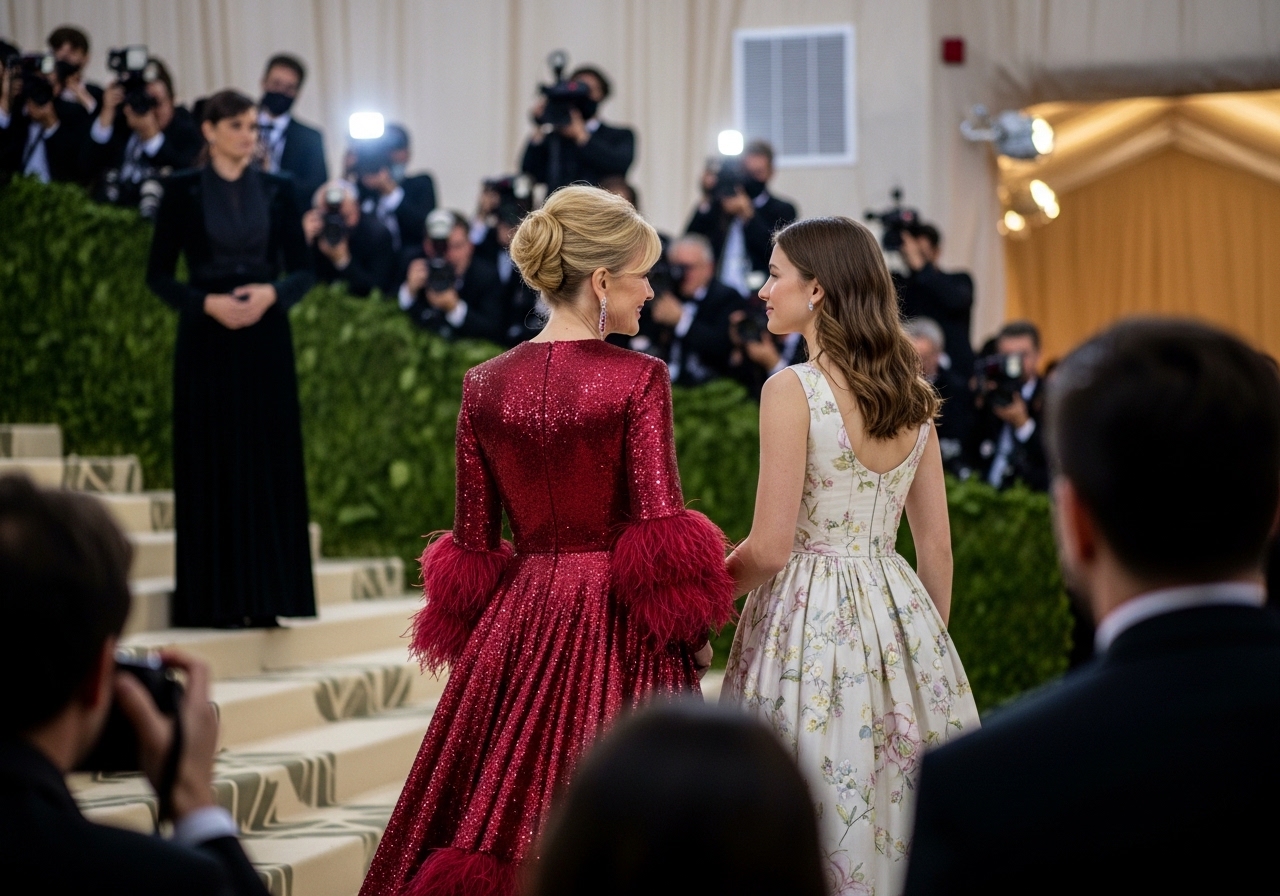
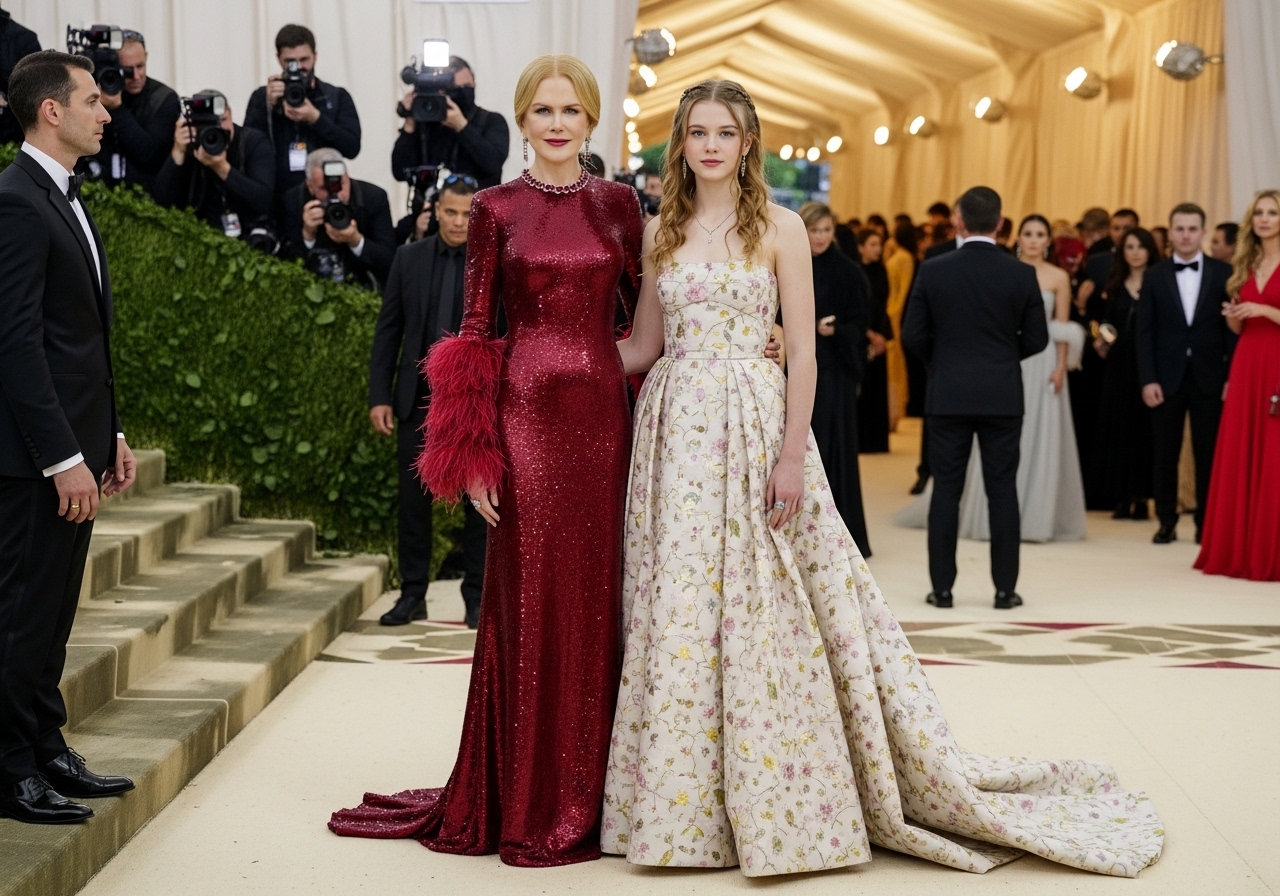
The Oscar-winning actor and Met Gala co-chair turned fashion’s biggest night into a rare mother-daughter appearance, as Sunday Rose made a closely watched debut on the museum steps.
Nicole Kidman arrived at the 2026 Met Gala with an unexpected and personal companion: her 17-year-old daughter, Sunday Rose Kidman-Urban. On a night built around spectacle, art history and celebrity pageantry, the mother-daughter pairing became one of the evening’s most discussed moments, blending family visibility with the heavily choreographed glamour of fashion’s most scrutinized red carpet.
The pair appeared together on Monday, May 4, at the Metropolitan Museum of Art in New York, where Kidman served as one of the gala’s co-chairs. Sunday Rose’s attendance marked her Met Gala debut and placed her squarely in the expanding public conversation around celebrity children, fashion houses and the increasingly early entry of second-generation stars into global style culture.
Kidman, 58, wore a dramatic red Chanel gown that combined sequins, feathers and a long-sleeved silhouette, a look that matched the evening’s artistic brief while also reinforcing her long association with high fashion. Speaking on the carpet, she linked the color red to its use across art history, placing her outfit within the event’s broader theme. Sunday Rose appeared beside her in a pale floral gown designed by Jonathan Anderson for Dior, giving the evening a notable cross-house fashion contrast: Kidman in Chanel, her daughter in Dior.
The 2026 Met Gala was organized around the Costume Institute’s exhibition “Costume Art,” with the dress code “Fashion Is Art.” As usual, the event brought together actors, musicians, designers, models, athletes, executives and cultural figures. Yet despite the intensity of the red carpet, Kidman and Sunday Rose offered a quieter subplot: a famous mother introducing her daughter to one of the most exclusive platforms in fashion.
That introduction was not without controversy. Since 2018, the Met Gala has generally maintained a rule that attendees must be at least 18 years old, a policy previously described as connected to the event’s suitability for younger guests. Sunday Rose is 17 and does not turn 18 until July. Her appearance therefore drew immediate attention from fashion observers and social media users, many of whom noted that she appeared to have been allowed to attend because she was accompanied by her mother, who held a prominent official role as a co-chair.
Sunday Rose was not the only under-18 guest to attract notice this year. Blue Ivy Carter, the 14-year-old daughter of Beyoncé and Jay-Z, also appeared at the event. Beyoncé, like Kidman, was among the 2026 co-chairs. Their daughters’ attendance suggested that the gala’s age rule, while widely understood, may allow rare exceptions when minors attend with parents or guardians who are central figures in the event.
For Kidman, the appearance carried symbolic weight beyond the question of red-carpet access. The Australian actor has long been one of Hollywood’s most visible figures at major fashion events, with a Met Gala history stretching back more than two decades. She first attended the gala in 2003 and has returned multiple times, often favoring polished, high-glamour looks that align with her screen image: elegant, controlled and theatrical without appearing careless.
This year, however, the focus was divided. Sunday Rose has been stepping gradually into the fashion world, including a runway appearance for Miu Miu’s Spring/Summer 2025 show in Paris. Her Met Gala debut deepened that public profile and placed her in front of an international audience accustomed to treating the museum steps as a launching pad for style identities.
The decision to appear with Kidman also reflected a broader trend in celebrity culture. The children of major entertainers, models and public figures are increasingly visible at fashion weeks, brand campaigns and high-profile events before they have fully established independent careers. For fashion houses, those figures carry built-in recognition and social media attention. For the young guests themselves, the exposure can create opportunity but also scrutiny.
Sunday Rose’s appearance was therefore read in several ways. To some observers, it was a poised debut by a teenager entering the fashion world under the guidance of a famous parent. To others, it raised familiar questions about access, privilege and the rules that govern elite cultural events. The Met Gala has always balanced institutional prestige with celebrity power, and moments like this show how flexible that balance can become when global names are involved.
Kidman’s role as co-chair made the evening particularly significant. Co-chairs are not ordinary attendees; they help define the public image of the gala and serve as visible ambassadors for the event. In 2026, Kidman shared that role with Anna Wintour, Beyoncé and Venus Williams, a group that connected film, fashion, music and sport. Bringing Sunday Rose as her date gave Kidman’s appearance a family dimension that stood out amid the polished formality of the evening.
The mother-daughter dynamic also softened the usual Met Gala narrative. Much coverage of the event centers on rankings, designer credits, beauty details and viral moments. Kidman and Sunday Rose added a more intimate frame: a veteran of global fame walking beside a daughter beginning to navigate public attention. Photographs from the carpet showed them moving together through the press line, with Sunday Rose appearing composed despite the scale of the event.
The fashion choices reinforced that generational contrast. Kidman’s red Chanel gown drew on old-Hollywood drama and the authority of a star accustomed to major carpets. Sunday Rose’s floral Dior look was lighter and more youthful, aligning with her emerging fashion identity rather than trying to replicate her mother’s established image. Together, the looks suggested coordination without duplication, a useful balance for a first Met Gala appearance.
The reaction also showed how the Met Gala remains a powerful stage for shaping public narratives. A guest can arrive as a daughter, a model, a muse, an actor, a co-chair or all of those things at once. Sunday Rose’s debut was not merely a fashion moment; it became part of a wider story about celebrity families and the future of fashion visibility.
For Kidman, the evening added another chapter to a long relationship with the Met Gala. For Sunday Rose, it marked a highly visible step into a world where image, access and identity are closely linked. The question now is whether the appearance will be remembered as a singular family outing or as an early milestone in Sunday Rose’s own fashion career.
On a night devoted to the idea that fashion can stand beside art, Kidman and her daughter offered one of the gala’s clearest human images: inheritance, presentation and transformation unfolding in real time on the museum steps. The red carpet has always been a place where public personas are made. In 2026, Sunday Rose arrived there not alone, but beside a mother who knows better than most how powerful that stage can be.