
New animal studies suggest that persistent pain may be driven by specialized brain circuits distinct from ordinary protective pain, raising hopes for targeted treatments that could avoid some risks of opioids.
BOULDER, Colorado — Scientists investigating why some pain fades while other pain lingers for months or years have identified a little-known brain region that may act like a switch for chronic pain, a finding that could reshape how researchers understand one of medicine’s most common and difficult conditions.
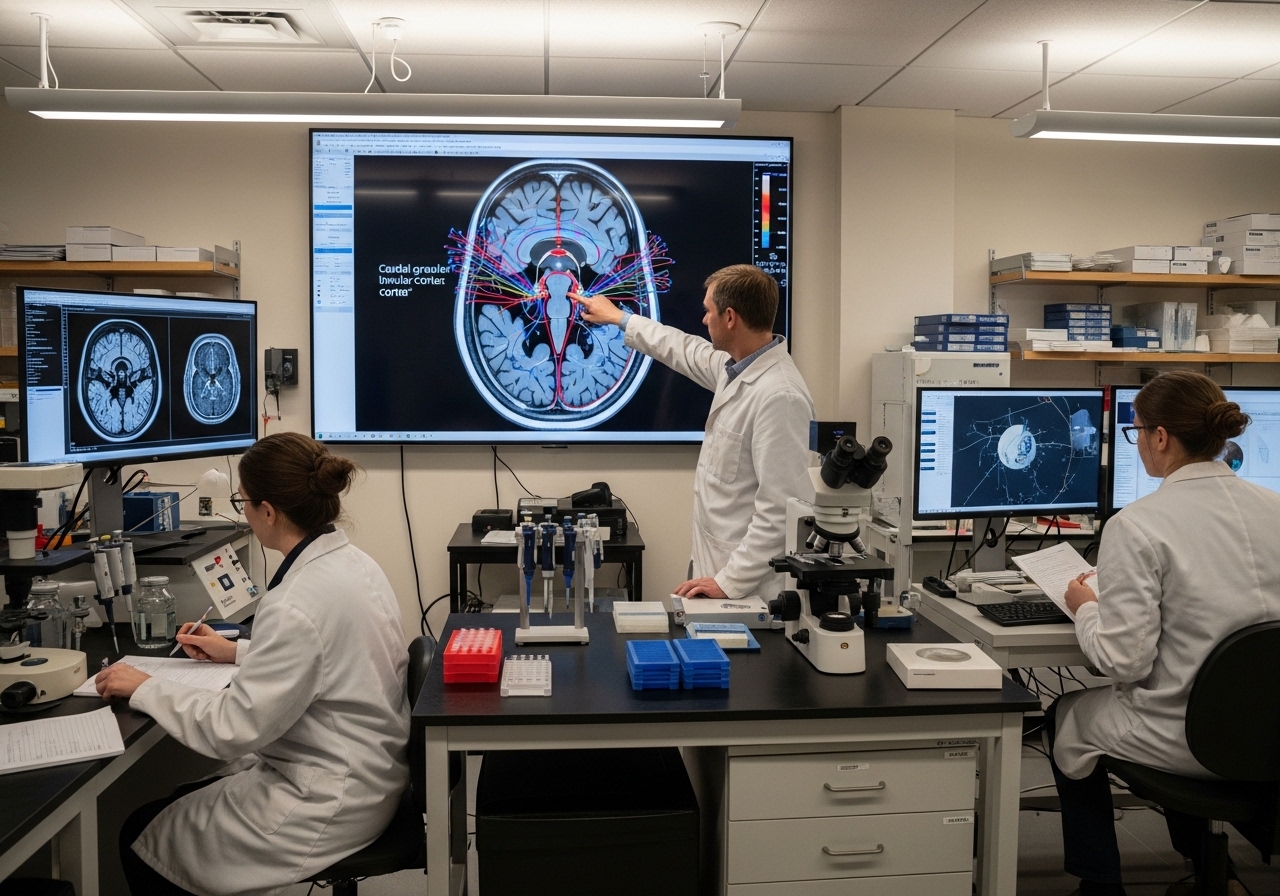
The study, led by researchers at the University of Colorado Boulder and published in the Journal of Neuroscience, focused on the caudal granular insular cortex, or CGIC, a small region buried deep within the insula. In experiments on rats, scientists found that silencing a pathway involving this region could prevent chronic pain from developing after nerve injury and could also halt pain sensitivity once it had already become established.
The discovery does not mean doctors can now turn off chronic pain in patients. The work remains preclinical, based on animal experiments and advanced laboratory techniques that are not ready for routine human use. But the findings offer a striking clue to a central mystery: why the nervous system sometimes continues to send pain signals long after an injury has healed.
Pain normally serves a protective purpose. A burn, cut or broken bone triggers signals that warn the body to avoid further damage. That acute pain is usually temporary and useful. Chronic pain is different. It can persist after tissue repair, distort ordinary sensation and make harmless touch feel painful, a condition known as allodynia. For people living with it, pain is no longer a warning system. It becomes a continuing disease state.
The Colorado team’s findings suggest the CGIC is not simply processing pain in the moment. Instead, it appears to help decide whether pain becomes persistent. Researchers reported that the CGIC sends signals through a pathway involving the somatosensory cortex and the spinal cord, helping maintain sensitivity even after the original injury should no longer dominate the nervous system.
That distinction is important. For decades, pain treatment has often relied on broadly acting medications that dampen the nervous system, reduce inflammation or change how pain is perceived. Opioids can be effective for some forms of severe pain but carry serious risks, including dependence, overdose and reduced effectiveness over time. A therapy that could target only the circuitry responsible for chronic pain, while preserving the body’s ability to detect new injuries, would represent a major advance.
In the Colorado experiments, the researchers used modern neuroscience tools to manipulate precise populations of brain cells. When they turned off cells in the CGIC-related pathway soon after injury, pain did not become long-lasting. When they silenced the pathway in animals already showing chronic pain-like behavior, the hypersensitivity subsided. The result supports the idea that chronic pain is not merely acute pain that refuses to stop, but a separate state maintained by defined brain circuits.
A separate study from Stanford University, published in Nature, reached a related conclusion from another angle. Stanford researchers mapped a circuit running from the spinal cord to the thalamus and somatosensory cortex, then back through brainstem structures to the spinal cord. In mouse models of inflammatory and neuropathic pain, silencing parts of that circuit reduced chronic mechanical hypersensitivity while leaving normal acute pain responses largely intact.
Together, the studies strengthen an emerging view in neuroscience: chronic pain may be biologically separable from the immediate pain that protects the body from harm. That matters because many patients fear that powerful pain relief could leave them unable to detect danger. If researchers can identify circuits that drive pathological pain without disrupting ordinary warning signals, future treatments may be more precise.
The CGIC has attracted scientific interest before. Earlier work from the same Colorado laboratory suggested that this region was involved in allodynia, and human studies have found overactivity in related insular regions among people with chronic pain. The insula is involved in processing bodily sensations, emotion and internal awareness, making it a plausible hub for pain that becomes tied to mood, attention and memory.
Still, the new findings come with important limits. The experiments were performed in animals, and chronic pain in humans is far more diverse. A person with diabetic neuropathy, a back injury, migraine, fibromyalgia, arthritis or post-surgical nerve damage may have overlapping symptoms but different underlying biology. A circuit that is crucial in one type of pain may be less important in another.
Researchers also do not yet know what causes the CGIC pathway to switch into a pain-maintaining mode. Injury, inflammation, stress, immune signals, genetics and previous pain experiences may all influence whether pain resolves or becomes chronic. The next challenge is not only to map the circuit, but to understand why it becomes activated in some individuals and not others.
Even so, the work fits into a broader shift in pain science. Researchers increasingly view chronic pain as a condition of the nervous system rather than just a symptom of tissue damage. That shift can be validating for patients whose scans or blood tests do not explain the severity of their suffering. It also makes treatment more complicated, because pain may persist even when the original injury is no longer visible.
The potential treatment implications are significant but distant. One possibility is drug development aimed at specific cell types or receptors within the chronic-pain circuit. Another is targeted neuromodulation, using implanted or external devices to alter abnormal brain activity. Brain-machine interfaces, focused ultrasound, gene-based tools and precision drug delivery are all being explored in neuroscience, but translating them safely to pain care will require years of testing.
Safety will be central. The brain circuits involved in pain often overlap with systems that regulate movement, mood, attention, sleep and emotion. Turning down pain without causing cognitive, emotional or sensory side effects is a difficult task. The fact that the new studies suggest chronic pain can be separated from acute pain is encouraging, but any human therapy would need to prove that separation in clinical trials.
The stakes are high. Chronic pain affects millions of adults and is associated with disability, depression, lost work, sleep disruption and heavy health-care costs. In the United States alone, federal health agencies estimate that roughly one in four adults lives with chronic pain, and a substantial share report pain severe enough to limit daily activities. Globally, chronic pain is one of the leading reasons people seek medical care.
The findings also arrive in the long shadow of the opioid crisis. For years, physicians have struggled to balance the moral urgency of relieving pain with the dangers of drugs that can cause dependence and overdose. Non-opioid medications, physical therapy, psychological therapies, nerve blocks and lifestyle interventions can help many patients, but relief is often incomplete. A new class of treatments aimed at the brain’s chronic-pain machinery could eventually widen the options.
Experts caution, however, that the phrase “pain switch” should not be taken too literally. Chronic pain is unlikely to be controlled by one simple on-off button. The CGIC may be a command node in one pathway, while the Stanford circuit identifies another loop that sustains mechanical hypersensitivity. Different pain conditions may recruit different networks, and human pain is shaped by biology, psychology and environment.
That complexity does not diminish the importance of the discovery. Instead, it shows why chronic pain has been so hard to treat. If the brain and spinal cord can create self-sustaining loops of sensitivity, then treating only the original injury may not be enough. Doctors may need ways to interrupt the loop itself.
For patients, the immediate message is cautious hope. The research does not provide a new prescription, device or procedure that can be used now. It does provide a clearer target for future work and a stronger biological explanation for why chronic pain can continue after healing. That may help move the field beyond the outdated assumption that persistent pain without obvious injury is less real.
The next phase will require confirming similar mechanisms in humans. Researchers will need brain-imaging studies, clinical biomarkers, careful patient subgrouping and eventually trials of targeted interventions. They will also need to determine whether the same circuits are involved across different pain syndromes or only in specific forms of nerve-related hypersensitivity.
For now, the studies mark a meaningful step in the long effort to decode pain’s transition from warning signal to chronic disease. Scientists are beginning to identify the circuitry that keeps pain alive, and perhaps the points where that circuitry can be interrupted. If those findings hold up in humans, the future of pain treatment may depend less on numbing the entire system and more on finding the precise switch that should never have stayed on.