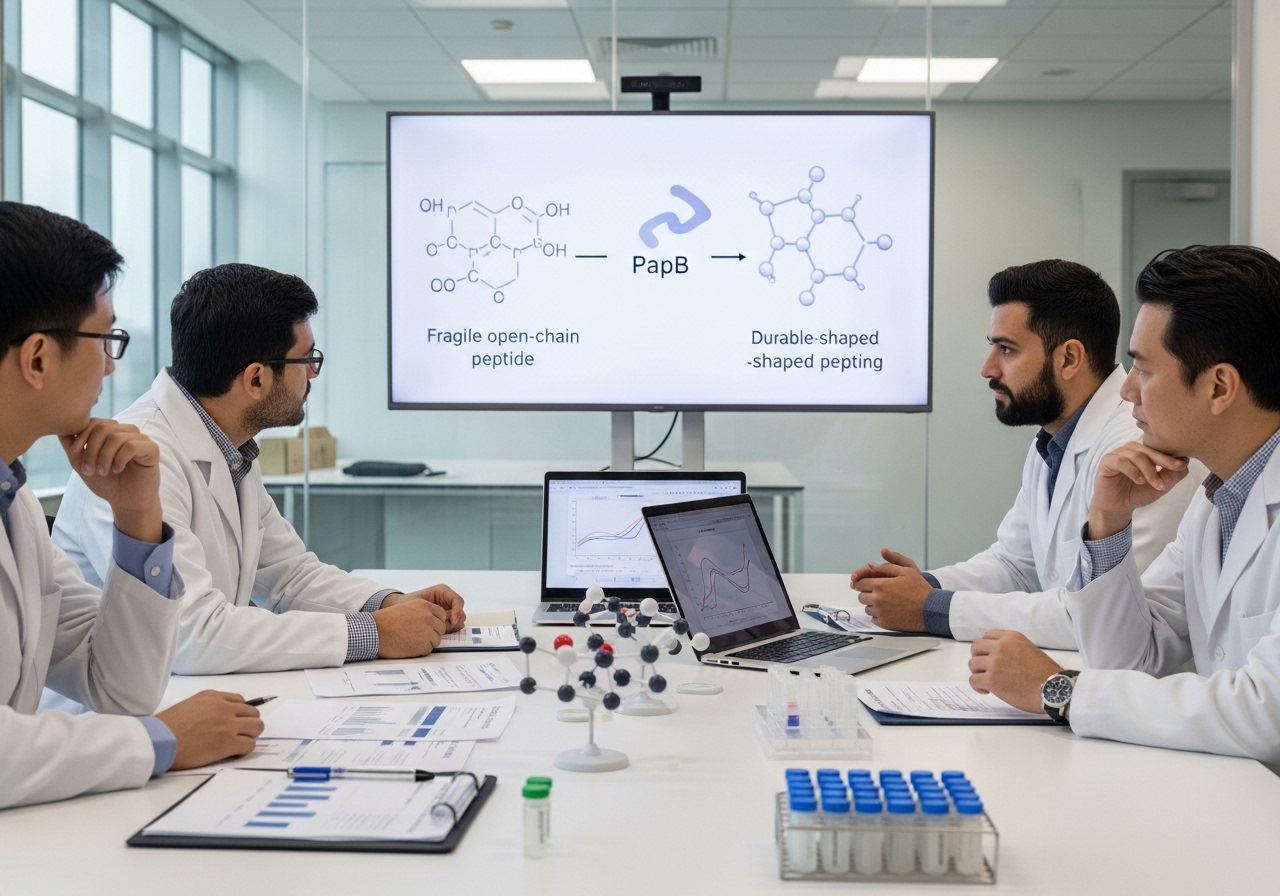
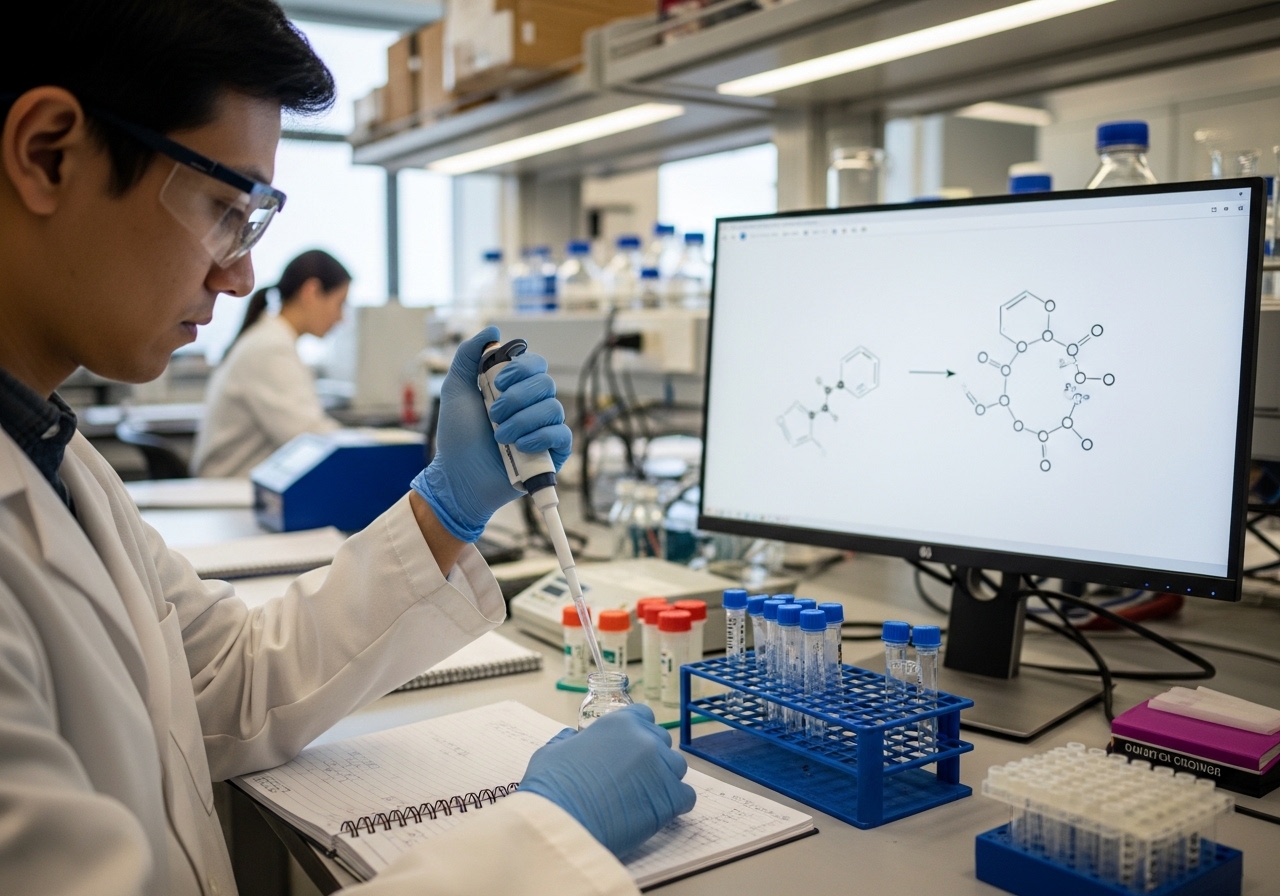
Researchers say PapB can reshape peptide-based medicines into more durable ring structures, raising hopes for stronger next-generation treatments for diabetes, obesity and other diseases.
A newly reported enzyme discovery could offer drug developers a cleaner way to make some of medicine’s most promising but fragile molecules more stable, longer-lasting and potentially more effective.
Researchers at the University of Utah have identified an enzyme called PapB that can modify therapeutic peptides — short chains of amino acids used in a growing number of modern drugs — by tying their ends into compact ring-shaped structures. The process, known as macrocyclization, can make peptide molecules harder for the body to break down, allowing them to remain active for longer periods.
The finding has attracted attention because it may be relevant to the next generation of GLP-1 medicines, the class of drugs that includes semaglutide, the active ingredient in Ozempic and Wegovy. These medications have transformed treatment for type 2 diabetes and obesity, but the broader scientific importance of the study reaches beyond any single brand or disease area. It points to a possible method for improving peptide drugs across multiple fields, including metabolic disease, gastrointestinal disorders and cancer.
Peptide drugs occupy a valuable but difficult middle ground in pharmaceutical science. They are larger and more biologically precise than many traditional small-molecule pills, but generally smaller and simpler than antibodies or other large biologic drugs. Because peptides can closely mimic signals used naturally by the body, they can be highly effective. But that same biological familiarity creates a problem: the body is also very good at recognizing and dismantling them.
Enzymes called proteases routinely cut peptides and proteins into smaller pieces as part of normal biological recycling. For a drug, that can mean a short half-life, reduced effectiveness and the need for repeated dosing or chemical modifications. Pharmaceutical companies already use a range of strategies to extend the action of peptide drugs, including amino acid substitutions, fatty-acid attachments, formulation changes and sustained-release systems. The Utah work suggests another tool may be available: using an enzyme to create a precise chemical “lock” that protects the peptide’s vulnerable ends.
PapB belongs to a class of enzymes known as radical SAM enzymes, which perform chemically challenging reactions in biology. In the study, the researchers used PapB to create macrocyclic GLP-1-like peptides by forming a thioether bond, a sulfur-carbon linkage that closes the peptide into a ring. The key advantage, according to the researchers, is that PapB appears able to do this without requiring extra “leader” sequences that many enzymes need in order to recognize and process their targets.
That matters for drug development. Adding extra recognition sequences can make a process less practical, especially when scientists are working with complex drug-like molecules that have already been optimized for potency, safety and manufacturing. A late-stage enzymatic step that can modify a molecule with high precision could be more attractive because it may allow researchers to improve an existing peptide scaffold rather than redesign the entire molecule from the beginning.
The study tested PapB on three GLP-1-like peptides and found that the enzyme could convert the linear molecules into cyclic versions. It also tolerated unusual amino acids, which are often used in modern peptide drugs to improve stability, potency or pharmacokinetics. That flexibility is one of the reasons the research is being described as a practical advance rather than only a biochemical curiosity.
The medical appeal is straightforward. If a peptide can be made more resistant to degradation, it may stay in circulation longer, interact more effectively with its biological target or require less frequent dosing. For patients, that could eventually mean more convenient treatment schedules. For drug companies, it could mean new ways to refine successful therapeutic classes without relying entirely on more complicated chemical synthesis.
But the discovery is still early. The study shows a promising method for modifying peptide molecules in the laboratory. It does not mean that a new version of Ozempic, Wegovy or any other drug is ready for patients. Any medicine created or improved through this approach would still need extensive testing, including studies of safety, potency, immune response, metabolism, manufacturing consistency and clinical benefit.
That caution is important because peptide behavior in the body is complex. Making a drug last longer is not automatically better. A longer half-life can improve convenience, but it can also prolong side effects if the drug causes problems. Changing a molecule’s shape may alter how strongly it binds to its target, how it activates cellular signaling pathways, how it is cleared from the body and how the immune system responds. In pharmaceutical development, durability is only one part of the equation.
Still, the timing of the research is significant. Peptide drugs are increasingly important in global medicine. GLP-1 medicines have become some of the most commercially and clinically influential products in the pharmaceutical market, with demand driven by diabetes care, obesity treatment and research into broader metabolic and cardiovascular benefits. At the same time, scientists are searching for peptide-based therapies against targets that have been difficult to reach with conventional small molecules.
Macrocyclic peptides are especially attractive in that search. Their ring shape can give them more structural rigidity than linear peptides, helping them bind targets more selectively and resist enzymatic breakdown. In some cases, cyclic peptides can reach biological surfaces that are difficult for small molecules to influence and too small or complex for antibodies to access efficiently. The challenge has been making them in ways that are precise, scalable and compatible with drug-like structures.
Traditional chemical macrocyclization can be powerful, but it is not always simple. Peptides have many reactive sites, and controlling exactly where a bond forms can be difficult. Harsh reaction conditions may damage delicate molecules or produce unwanted byproducts. Enzymes, by contrast, are nature’s precision catalysts. When they work well, they can carry out specific reactions under mild conditions with remarkable selectivity.
PapB’s promise lies in that precision. By acting like a molecular tool that closes a peptide into a defined ring, it could reduce some of the complexity associated with chemical modification. Researchers and biotechnology companies may be able to use it to generate libraries of cyclic peptides, compare their stability and activity, and identify candidates with improved therapeutic profiles.
The work also reflects a broader trend in drug discovery: the use of biological machinery to solve chemical manufacturing problems. Enzymes are increasingly being explored not only as drug targets but as tools for making drugs. Their ability to perform selective reactions has made them valuable in green chemistry, pharmaceutical synthesis and the development of complex biologic-inspired molecules. PapB fits into that shift by offering a biological route to a chemical architecture that drug developers already want.
For patients, the most visible future applications may be in injectable medicines where dosing burden matters. Many peptide drugs cannot be taken easily by mouth because they are broken down in the digestive tract. Longer-acting injectable versions can improve adherence, particularly for chronic diseases that require ongoing treatment. If enzymatic macrocyclization can help create drugs that remain active longer without sacrificing safety, it could become part of the next wave of long-acting therapies.
The commercial implications are also clear. GLP-1 medicines have become a central battleground for large pharmaceutical companies, and any technology that can improve potency, duration or manufacturing efficiency will draw attention. But the University of Utah researchers have emphasized that the value of PapB is not limited to blockbuster obesity and diabetes drugs. The same principle could apply to many peptide-based compounds whose clinical promise is limited by fragility.
The next steps will determine how far the discovery can travel. Scientists will need to test whether PapB-modified peptides perform better in biological systems, whether the modifications can be manufactured consistently at scale and whether the altered molecules behave safely in animals and humans. They will also need to learn how broadly the enzyme can be programmed across different peptide sequences and therapeutic targets.
For now, the study offers a compelling proof of concept. A tiny enzyme can take molecules that are powerful but vulnerable and reshape them into forms that may better withstand the body’s defenses. In a field where small structural changes can determine whether a drug succeeds or fails, that is a meaningful advance.
The discovery does not promise an immediate revolution in medicine. It does, however, add a precise new instrument to the drug developer’s toolkit. If PapB and related enzymes can be adapted broadly, fragile peptide medicines may become tougher, longer-lasting and more practical — not by overwhelming biology, but by borrowing one of biology’s own most elegant machines.