
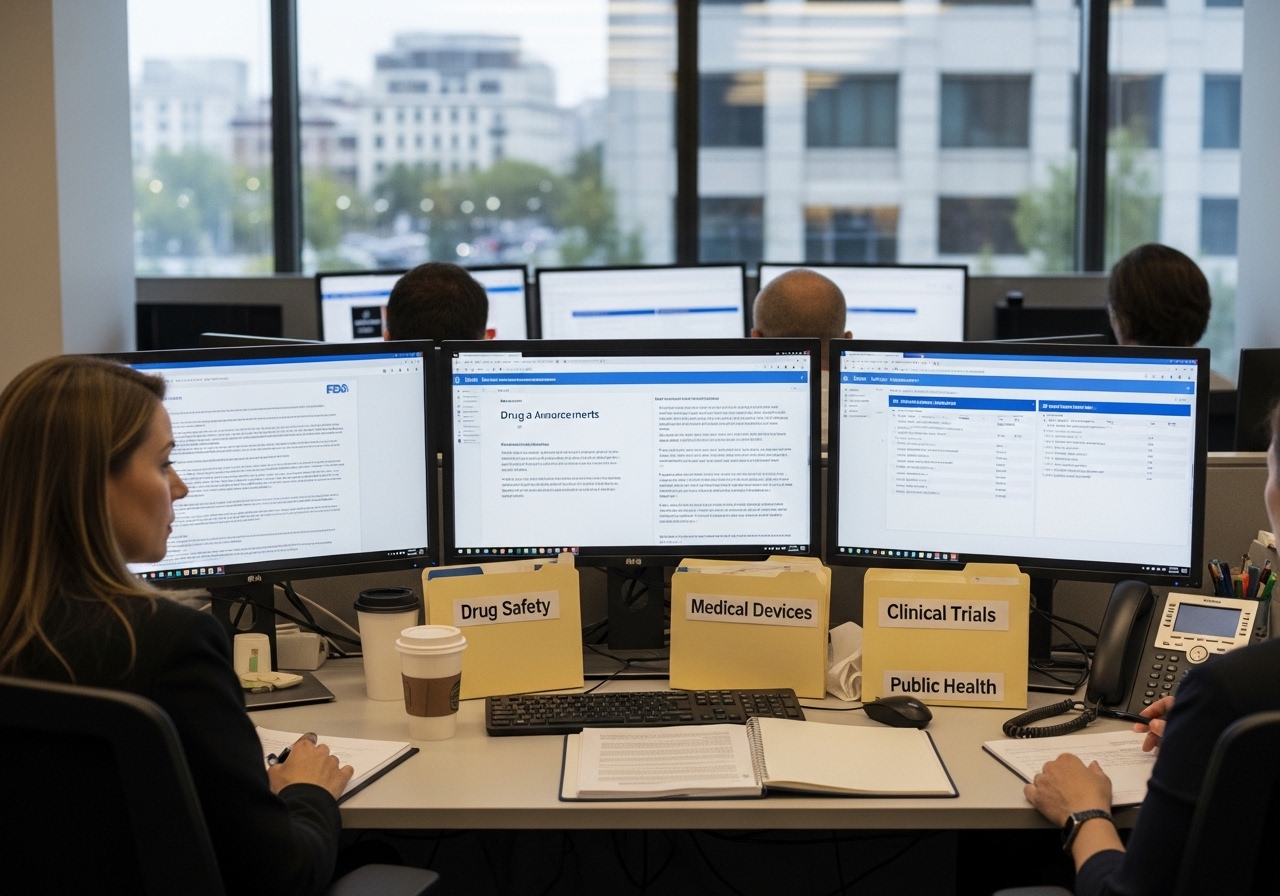
Recent agency notices show a regulator balancing faster access to medical innovation with demands for transparency, evidence quality and postmarket safety monitoring.
WASHINGTON — The U.S. Food and Drug Administration’s Newsroom continues to publish a steady stream of announcements on drugs, medical devices and public health safety, offering a real-time view of how one of the world’s most influential health regulators is trying to manage innovation, access and risk.
The latest FDA Newsroom updates cover a broad regulatory landscape. Recent notices include expanded access for an investigational pancreatic cancer drug, market authorization decisions involving electronic nicotine delivery products, a new Medicare-aligned pathway for breakthrough medical devices, draft safety guidance for genome-editing therapies, stronger pressure on clinical trial sponsors to disclose results, and a new adverse event monitoring platform intended to modernize safety surveillance across FDA-regulated products.
Taken together, the announcements show an agency operating on several fronts at once. It is trying to accelerate access to promising treatments and technologies while responding to long-standing criticism that regulatory systems can be slow, fragmented or opaque. At the same time, the FDA is emphasizing that speed must be matched by evidence, safety monitoring and public visibility into risks that may emerge after products enter the market.
One of the most consequential recent updates involves medical devices. In April, the FDA and the Centers for Medicare & Medicaid Services announced the Regulatory Alignment for Predictable and Immediate Device pathway, known as RAPID. The pathway is designed to speed Medicare coverage for certain FDA-designated Class II and Class III Breakthrough Devices by aligning regulatory and coverage evidence expectations earlier in product development.
The policy addresses a recurring problem in medical technology: FDA authorization does not automatically mean broad patient access. A device may be cleared or approved, yet Medicare coverage decisions can lag, delaying adoption for older Americans and people with disabilities. RAPID is intended to narrow that gap by allowing CMS to engage earlier with manufacturers, understand what evidence will matter for Medicare beneficiaries and prepare coverage decisions closer to the moment of FDA authorization.
For device makers, the announcement signals a more coordinated federal approach to innovation. For patients, the promise is quicker access to technologies that address unmet medical needs. For payers and clinicians, the challenge will be ensuring that faster coverage does not weaken evidence standards or encourage premature use of devices before their real-world benefits are well understood.
The FDA’s drug-related updates show a similar tension between access and oversight. The agency recently permitted expanded access for an investigational pancreatic cancer drug, a pathway that allows certain patients with serious or immediately life-threatening diseases to receive investigational medical products outside clinical trials when no comparable or satisfactory alternatives are available. Pancreatic cancer remains among the most difficult cancers to treat, and expanded access decisions often attract attention because they sit at the emotional intersection of scientific uncertainty and urgent patient need.
Expanded access does not mean a drug has been proven safe and effective for general use. It means the FDA has allowed a route for use under specific circumstances, usually when the potential benefit may justify the potential risk. Such decisions reflect the agency’s role not only as a gatekeeper, but also as a regulator asked to respond to patients and physicians seeking options when conventional treatment has failed.
Another drug-related notice points to the future of advanced therapeutics. The FDA issued draft guidance on safety standards for human gene therapy products involving genome editing technologies. The guidance focuses on next-generation sequencing methods to assess risks such as off-target editing and loss of genome integrity. These risks are central to the safety debate around therapies designed to alter genetic material inside or outside the body.
Genome editing holds significant promise for rare diseases, inherited disorders and conditions that have historically lacked effective treatment. But its power also creates regulatory complexity. A therapy that modifies DNA must be evaluated not only for immediate therapeutic effect, but also for unintended genetic changes that could have lasting consequences. By outlining expectations for sequencing strategies, sample selection, analysis and reporting, the FDA is attempting to provide developers with a clearer safety framework before products advance deeper into clinical testing.
The agency’s recent push on clinical trial transparency is another major theme. In April, the FDA said it had reminded more than 2,200 medical product companies and researchers to submit required results information to ClinicalTrials.gov. The agency said many trials that appear likely to fall under mandatory reporting requirements still lack submitted results, creating gaps in the public record.
The issue is not merely administrative. When clinical trial results are missing, especially negative or inconclusive results, doctors, researchers and patients may receive a distorted picture of a product’s safety and effectiveness. Publication bias can make medical evidence appear stronger or more favorable than it really is. By pressuring sponsors and investigators to comply with reporting rules, the FDA is reinforcing the principle that the public record should include failures as well as successes.
That effort has direct implications for drug development and public trust. Patients who volunteer for trials often do so with the understanding that their participation will contribute to medical knowledge. If results are never disclosed, that social contract is weakened. Clinicians also need complete data when making treatment decisions, particularly for products where benefits are modest, risks are uncertain or evidence is evolving.
The FDA’s safety-monitoring infrastructure is also changing. In March, the agency launched the FDA Adverse Event Monitoring System, or AEMS, a unified platform for analyzing adverse event reports. The system is intended to replace several fragmented legacy databases and provide more accessible, real-time reporting for a wide range of regulated products.
The agency said adverse event reports for drugs, biologics, vaccines, cosmetics and animal food can be displayed through the new dashboard, with additional product centers to be added. By the end of May 2026, the FDA expects AEMS to contain real-time adverse event reports for all FDA-regulated products while protecting individually identifiable patient and consumer information.
The modernization could be important for public health surveillance. Adverse event reports do not prove that a product caused a health problem. They are often incomplete, voluntary and influenced by media attention or reporting patterns. Still, they can help regulators detect safety signals, clusters or unexpected patterns that deserve closer investigation. A more unified system could help researchers, clinicians and the public monitor potential risks more efficiently.
The FDA Newsroom also continues to publish notices beyond prescription drugs and hospital technology. Its recent announcement on electronic nicotine delivery systems reflects the agency’s wider public health mandate, which includes tobacco products. Such decisions often involve balancing adult demand, youth use concerns, product standards and evidence about population-level health effects. The inclusion of these notices alongside drug and device announcements underscores the breadth of the FDA’s responsibilities.
That breadth is sometimes underestimated. The FDA regulates human and veterinary drugs, biological products, vaccines, medical devices, tobacco products, food safety, cosmetics, dietary supplements and radiation-emitting products. Its newsroom therefore functions as more than a press release archive. It is a window into the daily machinery of American health regulation.
For health care companies, FDA announcements can affect investment, product development timelines and market strategy. A draft guidance can reshape how clinical studies are designed. A new coverage pathway can influence decisions about device trials. A safety communication can alter prescribing behavior. A transparency enforcement effort can change how sponsors manage trial disclosure obligations.
For clinicians, the updates provide early signals about products, risks and policy shifts that may eventually affect patient care. A new device pathway could bring technologies into practice faster. A gene therapy guidance may shape future treatment options for rare diseases. A more accessible adverse event system could help clinicians understand reported safety concerns. But the practical impact depends on how clearly these updates are communicated beyond regulatory circles.
For patients and consumers, the FDA Newsroom can be both valuable and difficult to interpret. Announcements are written for public release, but they often involve technical terms, legal pathways and scientific nuance. A phrase such as “expanded access,” “draft guidance,” “breakthrough device” or “adverse event report” can easily be misunderstood. The agency’s communication challenge is to make regulatory action transparent without overstating certainty or minimizing risk.
The current pace of updates reflects the changing health technology environment. Drug development increasingly involves biologics, gene therapies, individualized treatments and artificial intelligence-supported research. Medical devices are becoming more digital, connected and data-driven. Safety monitoring must handle larger streams of information from patients, clinicians, companies and electronic systems. These changes require regulatory tools that are faster and more integrated than those built for an earlier era.
At the same time, trust in health institutions remains fragile. The FDA’s decisions can become politically contested, commercially consequential and personally meaningful for patients. That makes transparency essential. When the agency explains why it is accelerating access, demanding trial disclosure or modernizing safety reporting, it is also defending the legitimacy of the regulatory process.
Recent FDA Newsroom updates suggest an agency trying to define that balance in public. It wants to encourage innovation without becoming a passive conduit for industry. It wants to move faster without abandoning evidence. It wants to provide more data without allowing raw reports to be mistaken for proof. It wants to support access while maintaining the public expectation that regulated products have been carefully evaluated.
The result is a newsroom that functions as a running record of modern health regulation. Each announcement may focus on a specific drug, device, guidance document or safety tool. But together they describe a larger transition: the FDA is being pushed to become more transparent, more technologically capable and more closely aligned with the real-world pathways through which patients receive care.
As medicine grows more complex, the importance of those updates will only increase. For patients, doctors, researchers, manufacturers and policymakers, the FDA Newsroom remains one of the clearest places to watch how scientific promise is converted into regulated medical reality — and how safety concerns continue after products reach the public.