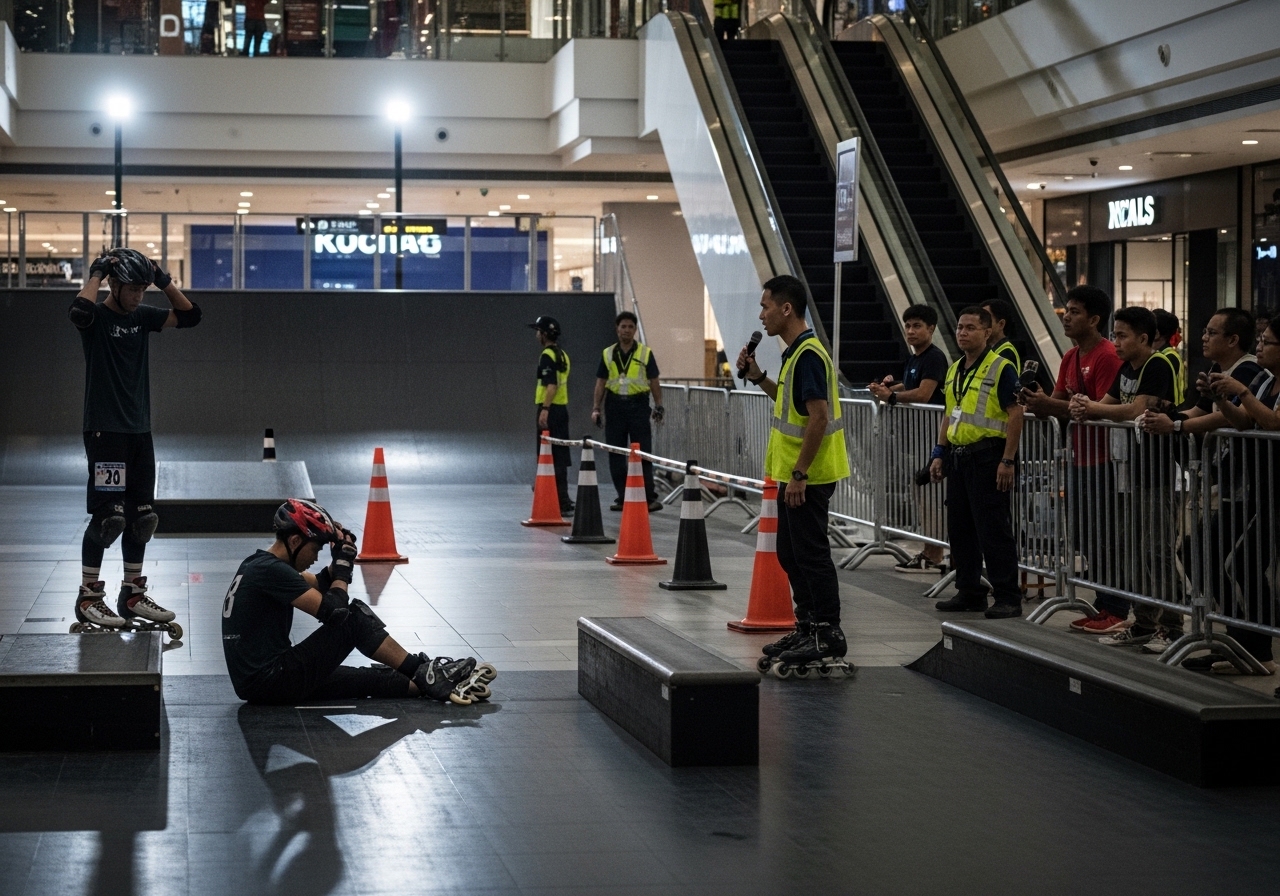
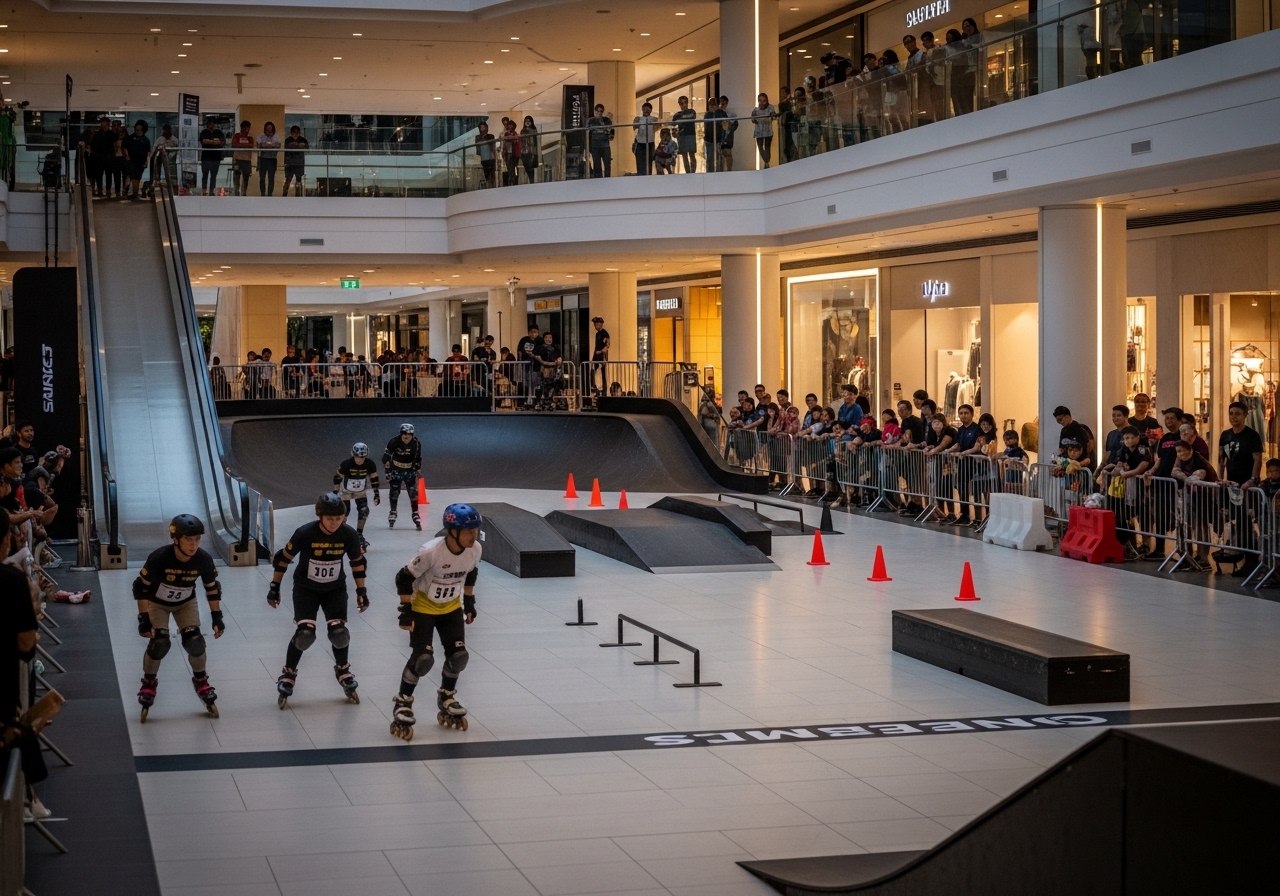
The Singapore mall will host a four-day roller sports event in May, led by a late-night Skatecross Downmall Challenge that sends skaters through ramps, turns and a custom-built escalator slide.
The Seletar Mall is preparing to become something very different from a neighborhood shopping centre this May: an overnight indoor racecourse for inline skaters. From May 7 to 10, the Sengkang mall will host a four-day roller sports takeover, with the main attraction billed as Singapore’s first-ever overnight Skatecross Downmall Challenge.
The headline race is scheduled to run from 10 p.m. on Friday, May 8, to 6 a.m. on Saturday, May 9. Instead of a conventional track, skaters will move through a course built inside the mall, navigating ramps, tight turns, technical sections and a custom-built giant escalator slide. The format turns a familiar retail environment into an after-dark sports venue, blending competition, spectacle and late-night entertainment.
The event has been sanctioned by the Singapore Roller Sports Federation, giving it a formal sporting framework rather than positioning it simply as a promotional stunt. The competition will use a time-trial format, with participants racing against the clock and each other across different categories. Reported categories include Weekend Warrior, Open, Women’s Open, Novice and Advanced, with youth categories aimed at skaters aged 12 to 17.
For The Seletar Mall, the event is part of a broader effort to extend its role beyond shopping and dining. Like many malls in Singapore and elsewhere, it is competing for visitors in an era when retail spaces increasingly need to offer experiences, not only stores. A late-night indoor skatecross race gives the mall a way to attract families, young people, sports enthusiasts and curious spectators at hours when most malls are usually quiet.
The timing is significant. Singapore’s malls have long been central to daily life, serving as air-conditioned public spaces where residents eat, shop, commute, meet friends and spend time with children. But the most successful malls are increasingly those that can reinvent themselves as entertainment hubs. Events such as indoor races, pop-up sports zones and nighttime programmes create a sense of urgency that routine retail cannot always provide.
The Seletar Mall’s programme is designed to reach both serious skaters and casual visitors. During the day from May 7 to 10, the Level 1 Atrium will be turned into an open roller sports playground. Visitors can try inline skating, watch demonstrations and take part in beginner-friendly sessions. Skates will be available for rent, making the event accessible to people who do not own equipment or have prior experience.
That accessibility is important because skatecross remains less familiar to many members of the public than mainstream sports such as football, basketball or running. The discipline combines speed, control, agility and obstacle navigation. In a mall setting, those qualities become more visible to spectators. Tight turns, ramps and sudden descents create a compact form of action that can be watched from close range.
The overnight race is likely to be the strongest draw. The idea of skaters racing through a mall after normal hours carries obvious novelty. It changes how people understand the space: escalator zones, atriums and corridors become part of a competitive route rather than circulation areas for shoppers. For participants, the course offers an unusual technical challenge. For spectators, it offers the rare chance to watch a sporting event unfold inside a building they may know from ordinary errands.
Late-night shopping and dining will support the race environment. Several tenants are expected to extend their operating hours, giving visitors food and entertainment options while the challenge takes place. That matters because an overnight event depends on more than the race itself. Spectators need places to eat, rest and gather. The mall’s ability to keep tenants open late helps turn the competition into a wider social occasion.
The event also fits into Singapore’s broader interest in activating public and semi-public spaces after dark. The city has a dense urban environment, a strong mall culture and a population accustomed to late dining and weekend activities. Turning a mall into a night sports venue aligns with those habits while offering something more physical and participatory than a standard retail promotion.
For families, the four-day format provides a softer entry point. Not every visitor will attend the overnight race or compete in skatecross. Some may come for children’s activities, youth demonstrations or beginner tryouts. Others may watch briefly while shopping or eating. This layered programming allows the event to function as both a sports competition and a community attraction.
For young skaters, the youth categories could be particularly valuable. Competitive environments help develop confidence, technique and visibility for emerging athletes. A sanctioned event inside a mall also places roller sports in front of audiences who may not attend specialized competitions. That exposure can help grow interest in the sport, especially among children and teenagers looking for alternatives to more traditional athletic pathways.
There are practical challenges. Indoor race events require careful planning around safety, crowd management, course design and emergency access. Ramps, technical sections and a large slide must be constructed and managed so that participants can compete at speed while spectators remain protected. The event’s sanctioning by a sports federation suggests those issues are being addressed within a recognized competition structure, but the unusual setting will still demand close coordination.
The mall environment also changes the atmosphere of the sport. Unlike outdoor skate parks or closed racing venues, a shopping centre brings together athletes, casual families, diners, store staff and late-night visitors. That mix can make the event more energetic, but it also requires a balance between spectacle and control. The best version of the event will feel exciting without feeling chaotic.
The Seletar Mall’s Skatecross Downmall Challenge follows earlier efforts to position the mall as a destination for late-night activity. Reports earlier this year described after-hours programming and downmall-style races as part of the centre’s push to keep the venue active beyond conventional retail hours. The May skatecross event appears to build on that strategy by introducing a new sport and a longer four-day format.
The result is a notable experiment in how malls can use sport to reinvent themselves. In the past, shopping centres relied heavily on anchor tenants, seasonal decorations and sales campaigns. Today, they increasingly behave like event venues, staging experiences that can travel across social media and pull visitors into physical space. An overnight skatecross race is a clear example of that shift.
For Singapore’s roller sports community, the event offers something else: a rare public stage. Inline skating has dedicated participants, but it often sits outside the mainstream sports conversation. A high-profile mall race can introduce the sport to new audiences and demonstrate its speed, discipline and entertainment value. If the event is well received, it could encourage more venues to host similar urban sports formats.
The Seletar Mall’s May programme is therefore more than a weekend attraction. It is a test of whether a suburban mall can become a credible late-night sports destination, whether skatecross can attract broad public curiosity, and whether Singapore’s retail spaces can continue to evolve into more flexible civic and entertainment environments.
When the first skaters push off after 10 p.m. on May 8, they will not simply be racing through a course. They will be moving through a transformed version of a familiar city space. For one night, the mall will not be defined by shopfronts, escalators and food outlets, but by speed, balance, risk and the sound of wheels cutting across the floor.