Amanda Cheong and Stanley Cheah’s Hidden Heritage Tours has tapped a growing appetite for stories beyond the city-state’s polished skyline, drawing visitors into forgotten factories, back lanes and overlooked neighbourhoods.
SINGAPORE — In a city better known for glass towers, manicured gardens and tightly planned urban order, Amanda Cheong and Stanley Cheah have built a business around places many residents were taught to ignore: abandoned factories, ageing estates, old industrial sites, wartime remnants and back-of-house corners where Singapore’s rapid transformation left traces behind.
The husband-and-wife team behind Hidden Heritage Tours has attracted renewed attention after leaving careers in banking and finance to run guided experiences through Singapore’s lesser-known spaces. Their story, recently highlighted by CNA Lifestyle, has resonated because it brings together several contemporary themes at once: career reinvention, local tourism, urban memory, family risk and the public’s growing curiosity about what lies behind the city-state’s polished global image.
Cheong, 38, and Cheah, 27, did not begin as conventional tour operators. Their shared interest in urban exploration grew from a fascination with abandoned and overlooked places. According to CNA, the pair met after Cheong came across Cheah’s Instagram account documenting such sites in Singapore. What began as a private obsession became a relationship, then a marriage, and eventually a business built on persuading others that the city’s neglected spaces still had stories worth hearing.
The decision was not an obvious one. Cheong had worked in banking, while Cheah came from finance. Within a year of becoming first-time parents, the couple gave up the security of steady salaries to expand Hidden Heritage from a side project into a full-time venture. CNA reported that Cheong’s father initially questioned whether anyone other than troublemakers would want to visit abandoned places. The concern was understandable. Singapore is not usually marketed through dereliction. Its official tourist image leans toward efficiency, safety, luxury retail, street food, gardens and futuristic architecture.
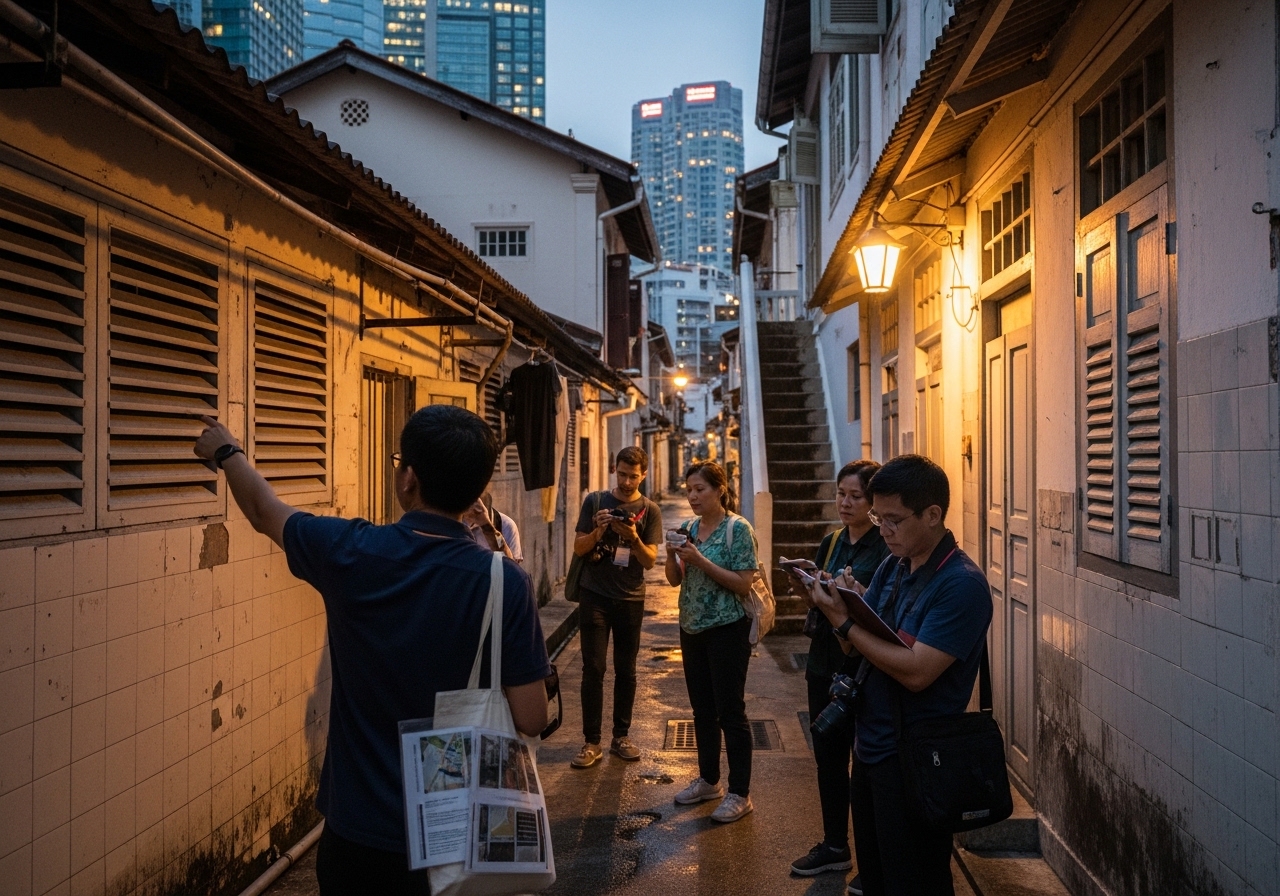
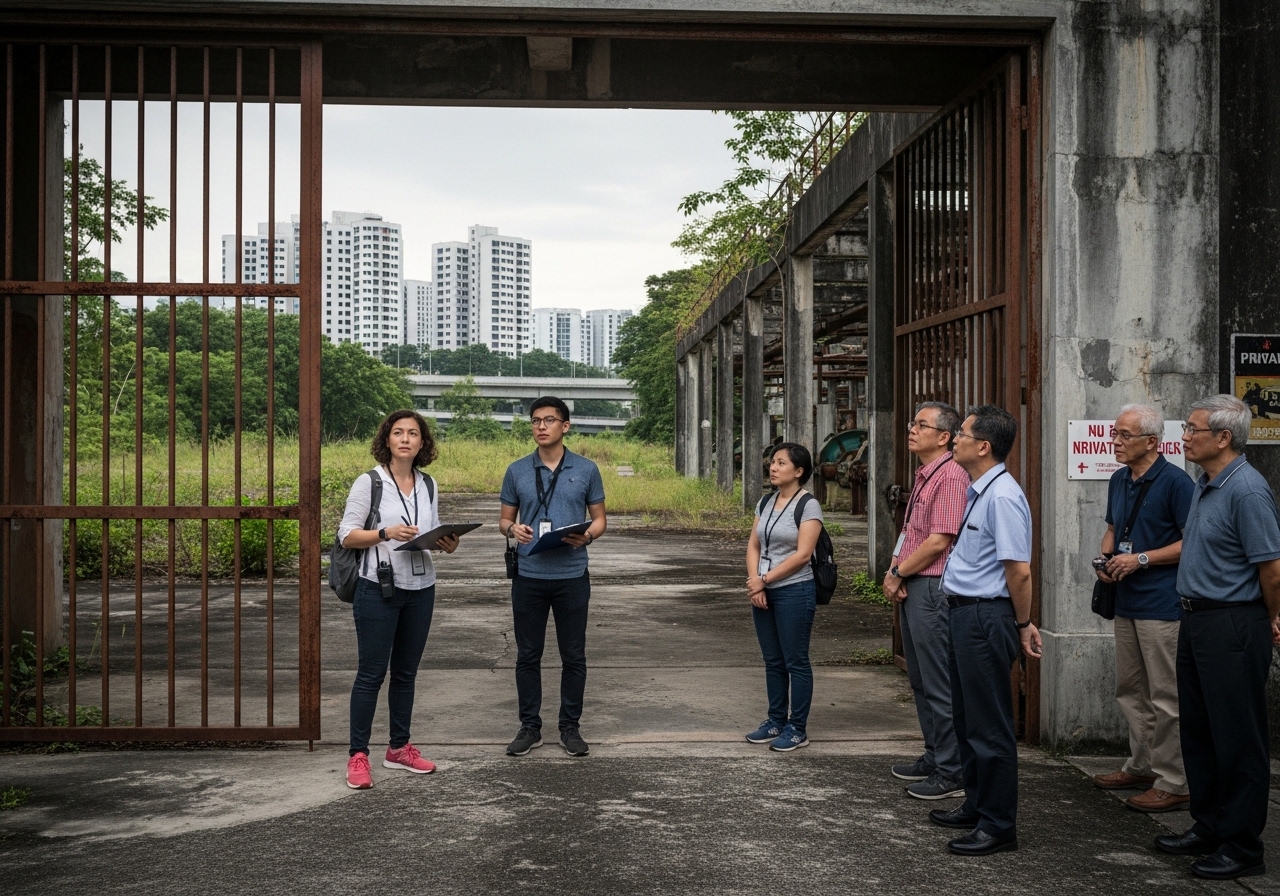
Yet that contrast is precisely what makes Hidden Heritage striking. The company offers “story-driven” tours into lesser-known sides of Singapore, including the former Shell Lubricant Blending Plant in Woodlands and neighbourhood routes through places such as Jalan Besar and Lavender. Its website describes tours focused on Singapore’s hidden past, while its Woodlands factory tour invites participants to explore vintage machinery, old production rooms and structures linked to the country’s industrial development.
The former Shell lubricant plant has become one of the company’s signature locations. Hidden Heritage describes it as a place where remnants of Singapore’s early industrial growth remain visible. Third-party listings describe tours that also connect nearby wartime and social history sites, including air raid shelters and former institutional spaces. These are not the postcard images that dominate tourism brochures. They are fragments of a city that industrialised, urbanised and redeveloped at extraordinary speed.
That speed is central to the story. Singapore’s physical landscape changes quickly. Buildings are conserved, adapted, demolished or replaced as land use priorities shift. The city’s success has often depended on constant reinvention, but reinvention can leave gaps in public memory. An old factory may appear as an eyesore or hazard until someone explains who worked there, what it produced, how it connected to trade, labour and national development, and why its remaining machinery matters.
Hidden Heritage has positioned itself in that gap between urban exploration and historical interpretation. The company is not simply selling the thrill of entering restricted or decaying spaces. Its appeal lies in converting neglect into narrative. Participants are invited to look again at places they might otherwise pass without attention: a rental housing block, a back alley, a forgotten industrial gate, a surviving wartime structure or a business that has operated quietly for decades.
The business also reflects a wider change in travel behaviour. Many residents, especially after the COVID-19 years, began to look at their own cities as destinations. The idea of being a tourist at home moved from temporary necessity to a more durable curiosity. In Singapore, where outbound travel is common and domestic land area is limited, that curiosity requires creativity. Operators must find layers of history inside a compact, familiar environment.
CNA reported that Hidden Heritage now runs around 20 tours a month and has expanded its clientele to include schools, organisations, corporate retreats and consultancy work. That growth suggests the concept has moved beyond novelty. Schools may see such tours as learning journeys; companies may use them for team experiences; residents may join because they want a version of Singapore that feels less rehearsed and more intimate.
The company’s rise has also been helped by social media. Cheah’s skill in content creation, according to CNA, helped translate online interest into bookings. This is a familiar pattern for niche tourism businesses. Visual platforms reward unusual spaces: peeling paint, industrial machinery, quiet corridors, old signs and dramatic contrasts between decay and modernity. But social media alone rarely sustains a tour company. The experience must offer context, safety and access that participants cannot easily arrange on their own.
Access is one of the most important parts of the Hidden Heritage model. Urban exploration can be risky and legally sensitive when people enter abandoned buildings without permission. Hidden Heritage’s tours depend on approvals, risk assessments and safety measures. CNA reported that the couple had to work through layers of red tape before launching the tour at the former Shell site in September 2024. That process matters because it separates guided heritage access from trespassing or thrill-seeking.
Safety and legitimacy also make the tours more acceptable to families, schools and corporate groups. A guided visit to an abandoned industrial site can become educational when the route is planned, hazards are managed and the story is grounded in research. Without that structure, the same location might be dismissed as dangerous or illicit. Hidden Heritage’s commercial success depends partly on making the unfamiliar feel responsible.
The couple’s personal story gives the business a human centre. Their move from finance to heritage tourism fits into a broader regional conversation about professional burnout, purpose and the willingness of younger workers to leave prestigious careers for more meaningful work. But their decision was not a carefree escape. They had a young child and faced the loss of predictable income. CNA reported that Cheong initially took part-time event jobs paying S$12 an hour while the business grew.
That detail complicates the romantic narrative of quitting corporate life. Entrepreneurship is often celebrated only after it works. In the beginning, it can involve anxiety, reduced income and social scepticism. Hidden Heritage’s current momentum does not erase those risks; it shows how unusual the path was. The couple moved from stable, respected sectors into a business whose product many people initially struggled to understand.
Their success also says something about Singapore’s relationship with heritage. The country has invested heavily in museums, conservation districts and national storytelling. Yet residents often hunger for histories that feel smaller, rougher and less official. Micro-histories — the stories of factories, rental blocks, migrant communities, wartime shelters and tradespeople — can make national development feel tangible. They place history not only in monuments, but in the ordinary and the overlooked.
That approach may be especially powerful for younger Singaporeans. A generation raised amid redevelopment may not have direct memory of older industrial or working-class landscapes. A tour through an abandoned plant or older estate can create a physical encounter with histories that textbooks summarize but rarely make sensory: the heat of a factory floor, the scale of machinery, the narrowness of corridors, the traces of past labour and the silence after a place stops functioning.
There are tensions in this kind of tourism. Abandoned and ageing places can be visually compelling, but they are not empty symbols. Some are tied to workers, low-income residents, illness, displacement or state planning decisions. Turning them into experiences requires care. Operators must avoid aestheticising poverty or decay without acknowledging the lives embedded in those spaces. The strongest heritage tours are those that treat overlooked places with dignity rather than using them as backdrops for novelty.
Hidden Heritage’s emphasis on storytelling suggests an awareness of that responsibility. Its tours through areas such as Lavender’s one-room rental estates point to a broader interest in social history, not only industrial ruins. Singapore’s hidden heritage is not limited to abandoned buildings; it includes communities and ways of life that persist alongside redevelopment.
The attention around Cheong and Cheah therefore reflects more than an unusual career change. It points to a market for alternative ways of seeing Singapore. The city’s global success story remains real, but it is not the whole story. Beneath the skyline are layers of labour, infrastructure, migration, wartime anxiety, industrial ambition and neighbourhood adaptation. Hidden Heritage has found a way to package those layers without stripping them entirely of complexity.
For the couple, the gamble appears to have found an audience. For Singapore, their tours raise a broader question: what should be remembered before it disappears? In a place where land is scarce and renewal is constant, the answer may depend not only on official conservation, but on people willing to look at a rusting gate, a silent factory floor or a forgotten back lane and insist that it still has something to say.
Cheong and Cheah’s journey from banking and finance to abandoned-place tours is compelling because it reverses the expected direction of ambition. They left polished offices to walk through peeling walls. They traded financial security for stories hidden in concrete, machinery and memory. In doing so, they have shown that even in one of the world’s most carefully managed cities, discovery can begin where the map seems to end.