
In this fictionalized domestic drama, a celebration built around love and trust collapses when an unexpected guest arrives with a secret that forces one woman to question her marriage, her memories and the life she thought she knew.
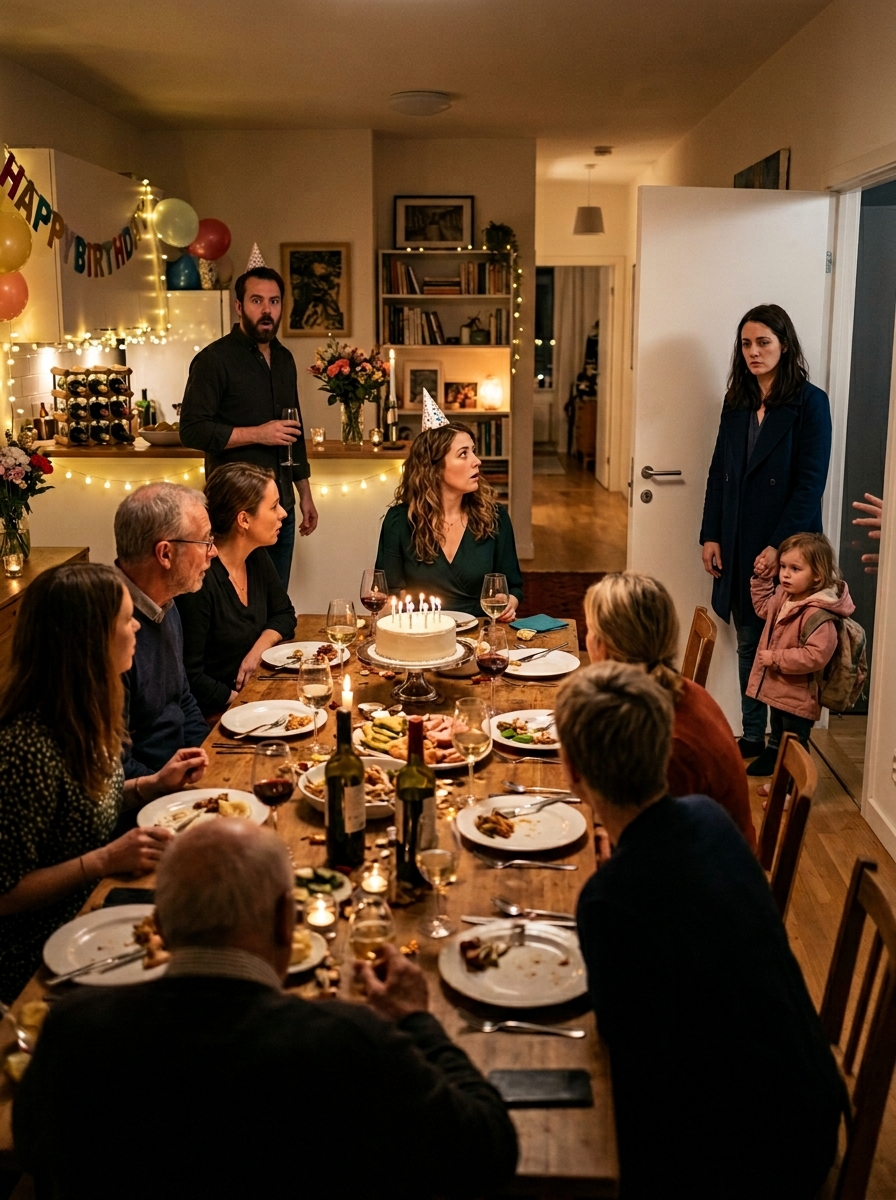
The evening had been planned as a quiet celebration of happiness. A small apartment was filled with balloons, flowers, soft music and the familiar warmth of relatives gathered around a dining table. On the kitchen counter, a birthday cake waited under a glass cover. The candles had not yet been lit. Friends were laughing near the doorway, children were running between chairs, and Lena, the woman at the center of the party, believed the night would become one of those ordinary family memories that people keep for years.
Her husband, Daniel, had spent the afternoon helping arrange the room. He had bought flowers, carried trays from the kitchen and told guests that Lena deserved a beautiful birthday after months of hard work. To those watching, he looked like an attentive husband. He smiled when she smiled. He stood beside her when relatives took photos. He touched her shoulder lightly when someone made a toast. Nothing in his manner suggested that the celebration was about to become a public collapse.
Then the doorbell rang.
At first, no one paid much attention. A late guest was expected. But when Lena opened the door, she found a woman she did not know standing in the hallway, holding the hand of a young boy. The woman’s face was tense, not embarrassed but determined. The child, perhaps four or five years old, looked past Lena into the room and fixed his eyes on Daniel.
“Dad,” the boy said.
The word landed with a force that silenced the room. Conversations stopped. Someone lowered a glass onto the table. The music continued for a few seconds before one of the guests switched it off. Daniel, who had been standing near the cake, did not move. His face lost color. Lena looked from the child to her husband, waiting for confusion, denial or some immediate explanation. None came quickly enough.
The unknown woman stepped inside without raising her voice. She said she had not come to destroy a birthday party, but she could no longer remain hidden. According to her, Daniel was the father of her child. She said the boy had asked for him repeatedly. She said promises had been made, money had been given irregularly and excuses had run out. The details came in fragments, each one more damaging because Daniel’s silence seemed to confirm more than any argument could.
For Lena, the shock was not only the possible existence of another child. It was the setting. Betrayal is devastating in private, but here it unfolded under the gaze of parents, siblings, friends and neighbors. The room that had been decorated for affection became a stage for humiliation. The birthday cake, once a symbol of care, sat untouched as the person it was meant to celebrate tried to understand whether her marriage had been built on a lie.
Daniel finally spoke, but his first words did little to repair the damage. He asked the woman why she had come there. He told Lena they should talk in another room. He told the guests to stay calm. What he did not say immediately was that the claim was false. That omission mattered. In moments of crisis, people often listen less to what is said than to what is missing.
The child remained close to his mother, too young to understand the adult devastation around him. He had not arrived as an accuser. He had come looking for recognition. In that sense, he was the most innocent person in the room, and perhaps the most painful presence. His small voice had exposed a secret that adults had tried to manage, postpone or bury.
Lena’s relatives urged her to sit down. A close friend tried to take her hand. But Lena stood still, looking at Daniel as though she were seeing two versions of him at once: the husband who had brought her flowers that morning and the man now unable to explain why a child had called him father. The distance between those two images was where her trust began to break.
The other woman, named Claire in this fictional account, did not appear triumphant. She looked exhausted. Her arrival was cruel in timing, but her anger seemed rooted in years of being kept outside the official story. She said she had once believed Daniel would take responsibility openly. She said she had waited through excuses about work, money, family pressure and timing. Eventually, she decided that silence protected only him.
The confrontation raised questions that went beyond one marriage. Secrets about children do not remain contained between adults. They shape identity, inheritance, emotional security and family history. A child has a right to know where he comes from. A spouse has a right to honesty. A second family, if one exists, cannot be treated as an administrative problem to be hidden until it becomes inconvenient.
Yet the emotional cruelty of the revelation was also undeniable. Lena had been given no chance to absorb the truth privately. Her birthday became the day her most intimate relationship was placed before witnesses. Every decoration in the room seemed suddenly unbearable. The balloons looked childish. The flowers looked false. The cake became impossible to cut.
As the guests gradually left, the apartment grew quieter but not calmer. Daniel attempted to explain that the relationship with Claire had happened during what he described as a difficult period. He said he had been afraid to tell Lena. He said he did not know how to fix what he had done. But explanations offered after exposure often sound different from confessions made by choice. Lena listened, but listening was not forgiveness.
The night ended without a clear resolution. Claire left with the child. Daniel remained in the apartment. Lena removed the candles from the cake and placed them in a drawer. No one sang. No wish was made. The birthday had become a date that would divide her life into before and after.
In the days that followed, Lena faced the harder work that comes after shock. She had to separate facts from emotion, betrayal from responsibility and public embarrassment from private decision-making. She needed proof, not only apologies. She needed to know whether Daniel was the child’s father, what he had hidden, how long he had hidden it and whether his deception involved money, continued intimacy or a second life.
For any spouse facing a similar revelation, the immediate aftermath can be disorienting. Anger may rise quickly, followed by numbness, shame, grief and practical fear. Legal advice, emotional support and careful documentation may become necessary. Decisions about separation, reconciliation, family obligations and child support cannot be made responsibly while everyone is still reacting to the first explosion.
The story is powerful because it touches a universal fear: that the person closest to us may have a hidden life. Marriage depends not only on affection, but on the assumption that the basic facts are shared. When a secret child appears, the betrayal is not limited to romance. It reaches into time, memory and identity. Every business trip, late message and unexplained absence may be reconsidered. The past becomes unstable.
The tragedy is that all three adults may suffer, but the child remains the person most deserving of protection. He should not become a weapon in a conflict between adults. If Daniel is his father, responsibility cannot be limited to money or occasional visits. Fatherhood, once revealed, demands recognition, consistency and care. The child did not choose secrecy. He should not pay for it.
For Lena, the central question is not only whether she can forgive. It is whether she can rebuild trust with someone who allowed the truth to arrive at her door in the hands of a child. Forgiveness, if it ever comes, would require more than regret. It would require honesty, accountability and a willingness to face consequences without demanding quick absolution.
The birthday party that began with flowers and candles ended as a lesson in how secrets can destroy the spaces meant for love. A home prepared for celebration became a courtroom of emotion, with no judge, no verdict and no easy ending. What remained was the silence after the guests had gone, the untouched cake on the table and one woman standing in the ruins of a life she thought was complete.”””
