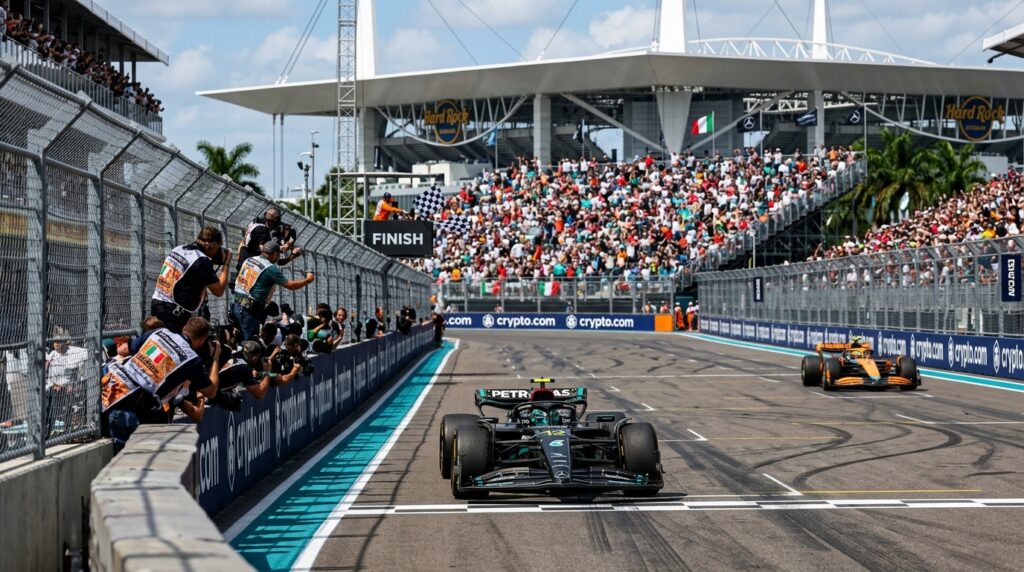
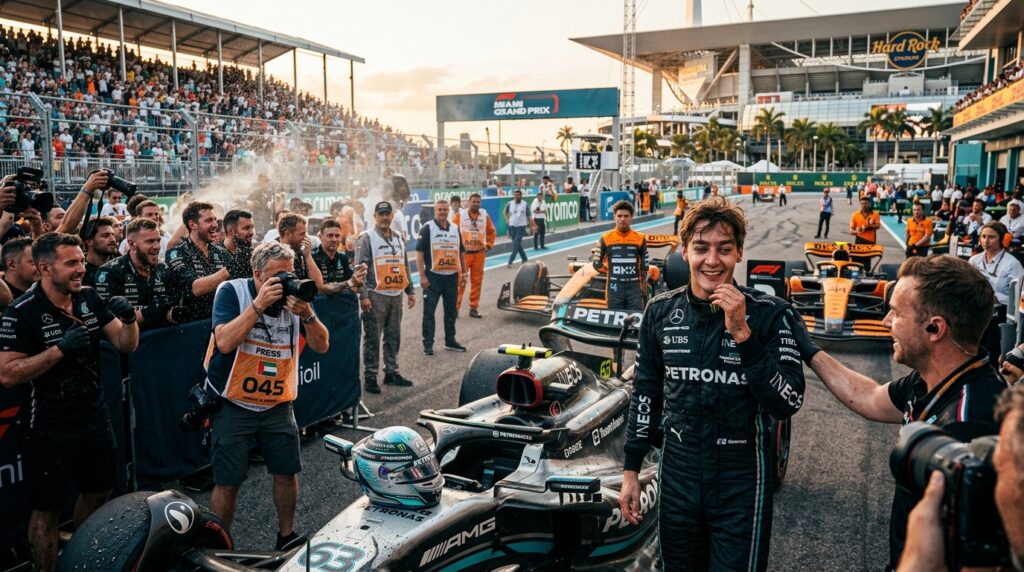
The 19-year-old Mercedes driver held off Lando Norris in a tense race at Miami Gardens, claiming his third consecutive Formula 1 victory and strengthening his championship lead.
MIAMI GARDENS, Florida — Kimi Antonelli crossed the line in Miami with the calm of a veteran and the momentum of a driver rapidly reshaping Formula 1’s competitive order.
The 19-year-old Mercedes driver won the 2026 Miami Grand Prix on Sunday, resisting late pressure from McLaren’s Lando Norris to secure his third consecutive victory of the season. Oscar Piastri finished third for McLaren, with George Russell fourth in the second Mercedes and Max Verstappen fifth for Red Bull after an eventful afternoon at the Miami International Autodrome.
For Antonelli, the result was more than another win. It confirmed that his early-season surge is no longer a promising streak, but a genuine championship campaign. After victories in China and Japan, Miami delivered a different test: changing conditions, a compromised opening lap, an aggressive McLaren challenge and a race that forced him to win through recovery, patience and execution rather than simple car advantage.
Antonelli started from pole, but the opening corner immediately threatened to undo his work. Under pressure from Verstappen and Charles Leclerc, the Mercedes driver locked up and ran wide, while Verstappen spun after contact in the first-corner battle. Leclerc surged into contention, Norris remained close, and the race quickly became less predictable than Mercedes would have wanted.
The early laps were unsettled by incidents and the lingering threat of rain. Drivers attacked aggressively, conscious that conditions could change at any moment. Separate crashes involving Isack Hadjar and Pierre Gasly brought the safety car into play and compressed the field, preventing any early escape and giving rivals time to reset their strategies.
Antonelli’s defining move came not through a spectacular wheel-to-wheel pass at the front, but through the discipline of a well-timed pit strategy. Mercedes brought him in at a crucial point, allowing him to use warmer tyres and cleaner pace to emerge ahead of Norris after the McLaren driver completed his own stop. From there, Antonelli still had work to do, including clearing traffic and managing the gap, but the shape of the race had tilted decisively toward Mercedes.
Norris did not let the contest fade. The reigning world champion kept Antonelli under pressure through the latter stages, matching enough of the Mercedes pace to make the final phase tense. But Antonelli held his line, protected his tyres and gradually created the margin he needed. He finished 3.264 seconds ahead, a narrow but controlled advantage that reflected the maturity of the performance.
The Miami victory extended Antonelli’s remarkable start to the year. Mercedes have now won the opening four races of the 2026 season, with Russell taking the other victory, while Antonelli has converted his first three Grand Prix pole positions into wins. It is the kind of statistical sequence that invites comparison with the sport’s great early-career breakthroughs, but the most striking element may be how quickly Antonelli has made the extraordinary look repeatable.
At 19, he is still learning the rhythms of a full Formula 1 title fight. Yet he has already shown an ability to respond to pressure in different forms. China proved he could deliver from the front. Japan showed his ability to impose pace across a race weekend. Miami demanded that he recover from an imperfect start, absorb pressure from a champion and trust a strategic call in a race shaped by uncertainty.
For Mercedes, the result is a powerful validation of its driver programme and its 2026 package. The team’s decision to pair Russell with Antonelli carried obvious risk: a young driver can bring speed, but also inconsistency. Four rounds into the season, that risk has turned into a competitive advantage. Antonelli leads the drivers’ championship, Russell remains second, and Mercedes have established an early lead in the constructors’ standings.
Toto Wolff’s radio message after the race captured the team’s tone. He praised Antonelli for a performance with little to criticise, a notable compliment from a team principal known for forensic analysis. Antonelli, for his part, was measured afterward, acknowledging the long season ahead and crediting the team behind the car.
That restraint matters. Formula 1 title races are rarely won in May, and the season is still young. Mercedes may be the benchmark now, but Miami also showed that McLaren are closing. Norris won the sprint on Saturday, Piastri finished on the Grand Prix podium, and both McLaren drivers showed enough pace to suggest that the team’s upgraded car could become a more persistent threat in the next phase of the championship.
Norris, in particular, will leave Miami with mixed emotions. Second place was a strong result, but the race may feel like an opportunity narrowly missed. He led at one stage and kept Antonelli within range, but the pit-stop phase proved decisive. Against a rival in current form, small strategic losses can become race-defining moments.
Piastri’s third place underlined McLaren’s progress. He moved onto the podium late after a chaotic final phase that included trouble for Leclerc, who had been in podium contention before losing ground. The Australian’s result gave McLaren a valuable haul and reinforced the impression that the team is beginning to turn raw pace into consistent Sunday returns.
Ferrari’s race was more complicated. Leclerc had the speed to trouble the leaders early, but his afternoon unravelled late, and a post-race penalty further affected his classification. Lewis Hamilton brought a damaged Ferrari home after opening-lap contact, salvaging points but not the kind of result Ferrari needed to cut into Mercedes’ advantage.
Verstappen’s fifth place was another reminder that Red Bull’s current position is less dominant than in previous years. His early spin compromised the race, and while he recovered strongly enough to score, he was not in the victory fight by the closing laps. For a driver accustomed to controlling races, Miami was an exercise in damage limitation.
The broader significance of Antonelli’s win lies in the speed of his arrival as a title contender. Formula 1 has seen teenage prodigies before, but few have moved from promise to command so quickly. The pressure on a young Mercedes driver is unusually intense: every session is measured against history, expectation and the standards set by the team’s previous champions. Antonelli is not only surviving that environment; he is setting the pace inside it.
There will be harder weekends. Rival teams will continue to bring upgrades. Strategy calls will not always fall perfectly. A season that begins with dominance can tighten quickly once development races accelerate. The next rounds will test whether Mercedes can keep its edge and whether Antonelli can sustain his composure when the championship picture becomes more confrontational.
Miami, however, offered strong evidence that he is ready for that challenge. He absorbed a bad start, navigated a chaotic opening sequence, trusted the strategy, defended against Norris and finished like a driver with more experience than his age suggests.
For Mercedes, the race was a statement. For McLaren, it was a warning shot. For Formula 1, it was another sign that the 2026 season may be shaped by a generational shift happening faster than many expected.
Antonelli arrived in Miami as the championship leader. He left with a larger lead, a third straight victory and a growing sense that the future of Formula 1 may already be standing on the top step of the podium.”””