
As AI images, manipulated video and platform-driven rumors spread faster than traditional reporting can respond, audiences are asking a simpler but urgent question: is this real?
The most important question in digital news is no longer only what happened. It is whether the thing millions of people think happened actually happened at all.
A photo appears to show a politician at a secret meeting. A video claims to capture an explosion in a city under attack. A screenshot says a celebrity made an inflammatory post before deleting it. A short clip, stripped of date and location, travels from TikTok to X, from Instagram to Facebook, from a private WhatsApp group to a television panel. By the time reporters begin asking basic questions, the story has already acquired a second life as evidence, outrage and identity.
This is the new fact-checking beat. It is not the old newspaper correction box, and it is not only a political lie detector. It is a real-time forensic service for a public overwhelmed by speed, synthetic media and collapsing context. The audience wants answers in plain language: Is the video old? Is the image AI-generated? Was the quote fabricated? Where did the story begin? Who benefits from spreading it?
The demand is rising because the information environment has changed. The Reuters Institute’s Digital News Report 2025 found that engagement with traditional sources such as television, print and news websites continues to decline, while dependence on social media, video platforms and aggregators grows. In the United States, social and video networks have overtaken both TV news and news websites or apps for weekly news reach. That shift gives rumors a larger runway and gives professional newsrooms less control over the first version of events that audiences see.
The problem is not simply that false information exists. Falsehoods have always circulated during wars, elections, disasters and celebrity scandals. What is different now is the industrial scale of production and distribution. Generative AI can create realistic images, voices and video with minimal skill. Engagement-driven platforms reward emotional certainty over careful uncertainty. Influencers can frame a story before reporters verify it. Aggregators can remove headlines from their original reporting context. Private messaging groups can spread claims beyond public scrutiny.
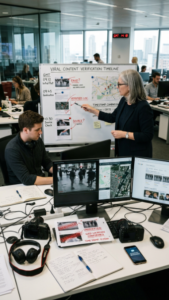
In this environment, fact-checking has become a form of emergency journalism. The best verification teams do not wait for a rumor to reach the evening news. They monitor viral claims, preserve original posts before deletion, search for earlier versions, compare landmarks, analyze shadows, inspect metadata when available, contact people on the ground and ask whether the same image appeared months or years earlier in another country. They do not begin with the question, “Could this be fake?” They begin with a stricter question: “What evidence would prove this is authentic?”
The work often looks technical, but its core remains journalistic. A reverse-image search may reveal that a dramatic flood photo is actually from a different disaster five years earlier. A street sign, mountain line or mosque minaret may geolocate a video. Weather records may show that a clip supposedly filmed during a sunny rally was taken on a day of heavy rain. A court filing may disprove a viral claim about an arrest. A local reporter may confirm that the building in a video is real, but the date and caption are wrong.
AI has made this work harder. Earlier misinformation often depended on miscaptioned real material. Now a viral image can be entirely synthetic, partly edited or generated from a real event but altered to intensify emotion. A detector may say an image is “likely AI,” but such tools are imperfect and can produce false confidence. Professional verification increasingly avoids declaring “AI” based only on visual oddities such as strange hands, warped text or unnatural lighting. Those clues matter, but they are not enough. A reliable conclusion requires a chain of evidence.
That is why provenance systems have become important. Standards such as C2PA and Content Credentials are designed to attach information about a file’s origin and editing history. In theory, a viewer could see whether an image came from a camera, a newsroom, an editing tool or an AI generator. In practice, the system is still incomplete. Metadata can be stripped by platforms, screenshots break the chain, and bad actors have little incentive to label deception. Provenance can help trustworthy publishers prove what they made. It cannot, by itself, make the internet truthful.
The verification gap is also political. Fact-checking now operates in a polarized atmosphere where some audiences treat correction as censorship and others see weak moderation as negligence. Meta’s move in the United States from third-party fact-checking toward a Community Notes model reflected this pressure. Supporters argue that crowdsourced context can reduce institutional bias. Critics say professional fact-checkers are still needed because many viral claims require expertise, source protection and legal accountability. Both arguments point to the same reality: verification is no longer a quiet backroom function. It is part of the public fight over power, speech and trust.
For newsrooms, the opportunity is significant. Fact-checking viral stories can reach audiences that do not habitually visit a homepage or read a full investigative article. A clear “real or fake” format works well on video platforms, podcasts, newsletters and search. It meets users at the moment of uncertainty. It also creates a service relationship with the audience: send us the claim, and we will show you what we found.
But the format carries risks. A sloppy debunk can spread the false claim further. A headline that repeats a hoax too vividly may reinforce it in memory. A fact-check that mocks believers may satisfy one audience while alienating another. The strongest work explains the method, not only the verdict. It shows the first known upload, the original source, the missing context and the reason a claim is misleading. The goal is not to make readers feel foolish. It is to make them harder to manipulate next time.
The most useful fact-checking also avoids a binary trap. Not every viral story is simply true or false. Some are authentic but miscaptioned. Some are based on a real incident but exaggerated. Some are satire that escaped its original setting. Some are unverifiable because the evidence is too thin. In a mature verification culture, “we do not know yet” is not weakness. It is protection against turning journalism into another machine for premature certainty.
Audiences are already looking for help. The Reuters Institute found that more than half of respondents worldwide remain concerned about distinguishing real from false news online. When people want to check questionable information, many still turn first to trusted news outlets, official sources and fact-checkers rather than social media. That is a fragile but important opening for journalism. It suggests that even in a fragmented media world, accuracy still has market value.
The next phase of the beat will be faster, more visual and more collaborative. Newsrooms will need verification desks that understand TikTok grammar, satellite imagery, AI generation tools, public records and local reporting. They will need partnerships with universities, open-source investigators, platform researchers and regional journalists. They will need to publish in the same formats where rumors spread: short video, explainers, live blogs, chat interfaces and searchable archives.
The stakes are larger than reputation management. False viral stories can inflame ethnic violence, distort elections, damage businesses, endanger disaster response and ruin private lives. A fake image can move faster than a denial. A fabricated quote can survive long after deletion. A manipulated video can define a person before evidence catches up. Fact-checking is therefore not a niche product for media literacy enthusiasts. It is part of democratic infrastructure.
The public does not need every journalist to become a forensic analyst. It needs news organizations that can say, quickly and transparently, what is known, what is not known and how they checked. In a media system built to accelerate belief, the most valuable journalism may be the kind that slows the audience down.
The viral question will keep coming: is this real? The answer will increasingly define whether newsrooms remain trusted institutions or become bystanders in a marketplace of synthetic certainty.