
As drivers weigh purchase prices, fuel bills, charging access and long-term maintenance, the right vehicle is less about technology and more about how a household actually drives.
For more than a century, the basic question in a showroom was simple: which gasoline car offers the best balance of price, comfort and reliability? That question has become more complicated. Buyers now face three mainstream choices: a conventional gasoline vehicle, a hybrid that combines an engine with an electric motor, or a fully electric vehicle powered by a battery. Each promises a different answer to the same practical concern: how to move people and goods affordably, reliably and with the least inconvenience.
The first conclusion is also the least dramatic. There is no single best choice for everyone. A gasoline car may still be the most convenient option for drivers who travel long distances through areas with limited charging infrastructure, need the lowest upfront price, or want simple refueling in minutes. A hybrid can be the most balanced option for urban and suburban users who want lower fuel consumption without changing their habits. An electric vehicle can be the strongest choice for drivers with access to home or workplace charging, predictable daily routes and a willingness to think differently about energy, range and resale value.
Gasoline vehicles remain attractive because they are familiar, widely available and supported by a vast repair and refueling network. Their purchase prices are often lower than comparable hybrids or electric models, especially in budget segments and used-car markets. They are also easy to live with for people who park on the street, drive in rural areas, tow frequently or cannot rely on regular charging. Filling a tank takes only a few minutes, and even in remote areas, fuel stations are usually easier to find than fast chargers.
The disadvantages are equally well established. Gasoline cars are exposed to oil-price volatility, and their operating costs can rise quickly when fuel prices increase. They require regular oil changes, filters, spark plugs, belts, exhaust-system checks and, over time, more extensive engine or transmission work. They also produce tailpipe emissions, making them less attractive in cities tightening air-quality rules or in countries moving gradually toward lower-emission transport. For drivers covering high annual mileage in stop-and-go traffic, fuel bills can become the largest recurring expense after depreciation.
Hybrids try to solve part of that problem without asking drivers to change their routines. A conventional hybrid does not need to be plugged in. It uses regenerative braking and a small battery to support the gasoline engine, especially during low-speed driving and acceleration. This makes hybrids particularly efficient in cities, where repeated braking allows the system to recover energy that would otherwise be wasted as heat. The driver still refuels at a normal station, but visits may be less frequent.
That convenience is the hybrid’s biggest advantage. For commuters who face traffic every day, taxi and ride-hailing drivers, families that make many short trips, and buyers who do not have a private charger, a hybrid can deliver meaningful fuel savings without the range concerns that still discourage some electric-car shoppers. Hybrids also tend to have proven reliability records when built by experienced manufacturers, and their batteries are generally smaller and less expensive than those in full electric vehicles.
But hybrids are not magic. They still burn gasoline, still need engine maintenance and still carry more mechanical complexity than either a conventional gasoline car or a pure electric vehicle. A hybrid has an engine, fuel system, exhaust system, electric motor, battery, control electronics and, depending on the design, a specialized transmission. In most cases, this complexity does not make hybrids unreliable, but it does mean repairs can be expensive if major components fail outside warranty. The financial case also depends on the price premium. A hybrid that costs substantially more than a gasoline version may take years to repay the difference through fuel savings, especially for drivers with low annual mileage or mostly highway use.
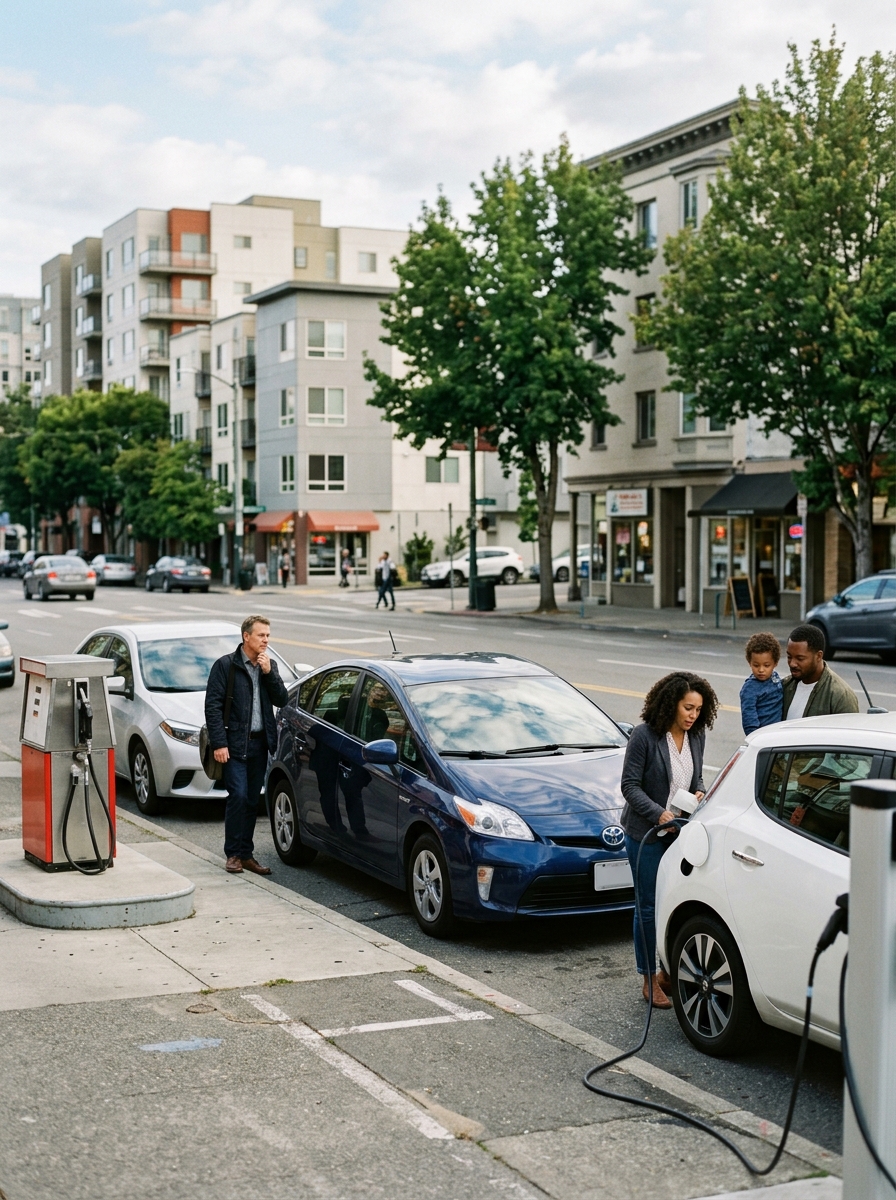
Plug-in hybrids add another layer. They can drive limited distances on electricity and then operate like a hybrid after the battery is depleted. For drivers who charge daily and make mostly short trips, they can sharply reduce fuel use. For owners who rarely plug in, however, they may behave like heavier, more expensive hybrids. The lesson is simple: a plug-in hybrid only makes sense if charging becomes part of the routine.
Electric vehicles offer the most radical break from the gasoline era. They have no tailpipe emissions, fewer moving parts, no oil changes and strong acceleration because electric motors deliver torque instantly. For drivers who can charge at home overnight, the ownership experience can be easier than visiting fuel stations. The car begins most days with a usable charge, and daily commuting may cost significantly less than driving on gasoline, depending on electricity tariffs.
Maintenance is one of the strongest arguments for electric cars. There is no engine oil, no timing belt, no traditional exhaust system and usually less brake wear because regenerative braking slows the vehicle while recovering energy. Tires, cabin filters, coolant, suspension parts and brake fluid still require attention, and EV tires can wear faster on some models because of vehicle weight and instant torque. Still, routine servicing is generally simpler.
The bigger concerns are purchase price, charging, battery confidence and repair costs after a collision. New EVs can cost more upfront than comparable gasoline cars, though the gap has narrowed in many markets and used EV prices have become more competitive. Charging at home is usually the cheapest and most convenient method, but apartment dwellers, renters and drivers without secure parking may depend on public chargers, where costs and reliability vary widely. Fast charging is improving, but it is still not as quick or universal as gasoline refueling.
Range anxiety has also changed rather than disappeared. Many modern EVs offer enough range for several days of commuting, and official ranges of 150 to 400 miles are common in the U.S. market. Yet highway speed, cold weather, heavy loads, hills and aggressive driving can reduce range. Long trips require planning around chargers, and the quality of public charging networks differs sharply by country, city and route. For some households, an EV is ideal as the main daily car but less convenient as the only vehicle for remote travel.
Battery durability is often misunderstood. Most EV batteries are designed to last many years, and many manufacturers provide long warranties. Degradation is real, but catastrophic battery failure is not the normal ownership experience. The bigger practical issue is transparency in the used market. Buyers of second-hand EVs should check battery health, charging history when available, warranty status and real-world range rather than relying only on odometer readings.
Cost comparisons should begin with a household’s actual driving pattern. A driver who travels 10 kilometers a day will not save enough fuel to justify paying a large premium for advanced technology. A ride-hailing driver covering 60,000 kilometers a year may find fuel savings decisive. A suburban family with a garage, rooftop solar or low overnight electricity rates may benefit strongly from an EV. A rural driver who travels long distances in areas with weak charging coverage may be better served by a gasoline or hybrid vehicle for now.
Depreciation is another variable. In some markets, EV resale values have been pressured by rapid technological change, price cuts and uncertainty about battery replacement. In others, high fuel prices and incentives have supported used EV demand. Gasoline cars may hold value where fuel is cheap and charging is scarce, but face long-term policy risk in cities or countries tightening emissions rules. Hybrids often sit between the two, benefiting from low fuel consumption and familiar refueling.
The environmental comparison is clear at the tailpipe but more complex across the life cycle. Gasoline cars emit while they drive. Hybrids emit less when they reduce fuel use. EVs produce no tailpipe emissions, but their full impact depends on electricity generation, battery production and vehicle size. Even so, as power grids add cleaner energy, EVs generally become cleaner over time after purchase, while gasoline cars remain tied to fuel combustion.
For buyers focused on simplicity and lowest initial cost, a gasoline car remains reasonable, especially if annual mileage is low and refueling convenience is critical. For buyers wanting lower fuel bills without charging concerns, a conventional hybrid is often the safest compromise. For buyers with reliable charging, predictable routes and higher mileage, an electric vehicle can offer the lowest running costs and the strongest environmental benefit.
The best decision is not made by asking which technology is most advanced. It is made by answering five practical questions: where will the car sleep, how far will it travel each day, how often will it leave the city, what energy prices apply locally, and how long will the owner keep it? A gasoline car rewards flexibility, a hybrid rewards efficiency without behavioral change, and an electric car rewards planning with lower day-to-day operating costs. The winner is the one that fits the driver’s life, not the one that wins the argument online.”””
