As viewers ask whether viral health trends, supplements and AI advice can be trusted, a growing wave of podcasts and explainers is turning medical fact-checking into mainstream content.
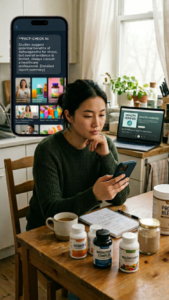
NEW YORK — The modern health question often begins with a scroll. A short video promises that cold plunges can transform metabolism. A supplement ad says a powder can fix fatigue, immunity and brain fog. A podcast clip claims a simple diet hack can reverse years of damage. A chatbot answers a symptom question with instant confidence. For millions of people, the first stop for medical curiosity is no longer a clinic, a government website or even a search engine. It is the feed.
That shift is creating a new kind of health journalism and health entertainment: the fact-checking format built for people who are already surrounded by advice. The audience is not only asking, “What should I do?” It is asking, “Is this real?” “Is this safe?” “Is this worth the money?” “Did AI get this right?” In response, podcasts, newsletters, short videos and explainers are increasingly adopting a “health vs hype” frame, promising to separate evidence from exaggeration in a wellness economy built on speed, fear and personal testimony.
The rise of “Health vs Hype with the American Medical Association” reflects that demand. The podcast, hosted by science communicator Trace Dominguez and distributed by iHeartPodcasts, appears among Apple Podcasts’ Top New Shows in the United States, according to an Associated Press listing dated May 5, 2026. The AMA describes the show as a science-backed series that examines viral wellness trends, DIY medicine and common health myths, with physicians helping listeners understand what is real, what is risky and what is supported by evidence.
Its arrival is part of a larger media moment. Health information has become one of the most emotionally powerful categories of online content because it sits at the intersection of anxiety, aspiration and commerce. People want to sleep better, age more slowly, lose weight, improve focus, prevent disease and regain control over bodies that often feel hard to understand. Social platforms reward confident claims and personal stories. Wellness brands reward conversion. Algorithms reward engagement. Scientific caution, by contrast, rarely fits neatly into a 30-second clip.
That does not mean every viral trend is false. Some advice that travels online is useful: walking more, eating enough protein, reducing ultra-processed foods, improving sleep, cutting excess alcohol, getting vaccinated, managing blood pressure, seeking mental health care. The problem is that helpful advice and unsupported claims often arrive in the same visual language. Both may be delivered by attractive influencers in bright kitchens, confident podcasters with large audiences, or AI systems that make uncertainty sound tidy.
For consumers, the result is a constant triage problem. A claim may be harmless, expensive, misleading or dangerous. A supplement may be unnecessary for most people but useful for a specific deficiency. A fitness trend may be beneficial for some and risky for others. A screening test may detect disease early or lead to false alarms, unnecessary procedures and anxiety. A chatbot may summarize general information accurately, then fail when the question requires clinical judgment, context or urgency.
The public is aware of the gap between convenience and trust. Pew Research Center reported in 2026 that about 36% of U.S. adults get health information from social media at least sometimes, while 22% say the same about AI chatbots. Among people who use social media for health information, only 7% say the information is highly accurate, while 40% say it is highly convenient. For chatbot health information users, 48% say it is highly convenient, but only 18% rate it as highly accurate.
Those findings explain why health fact-checking has audience appeal. People are not necessarily rejecting doctors or science. Many are trying to manage the flood of claims that reaches them long before an appointment is available. A podcast that asks whether a wellness trend is real offers more than information; it offers relief. It gives listeners permission to be skeptical without feeling cynical, curious without being gullible, and health-conscious without buying every product promoted in their feed.
The supplement market is a central testing ground. In the United States, dietary supplements occupy a different regulatory category from prescription and over-the-counter drugs. The FDA can act against adulterated or misbranded supplements after they reach the market, but it generally does not approve supplements for safety and effectiveness before sale. The Federal Trade Commission warns consumers that, unlike drugs, supplements are not evaluated or reviewed by the FDA for safety and effectiveness before marketing, and that “natural” products can still carry risks. The National Center for Complementary and Integrative Health says evidence varies widely, with strong support for some uses and little or conflicting evidence for many others.
That regulatory reality is often poorly understood by consumers. A bottle can look medical, use scientific language and appear beside pharmacy products without having passed the same premarket standard as a drug. A phrase such as “supports immunity” may sound like a clinical promise while remaining far less specific than a disease-treatment claim. Online influencers can further blur the line by combining personal transformation stories, discount codes and selective references to studies.
Medical misinformation also thrives because health is personal. A person who feels dismissed by the health care system may be more open to alternative voices. Someone facing chronic symptoms may search endlessly for answers. A young viewer may trust a creator who looks and talks like them more than an institution that feels distant. Communities built around fitness, fertility, longevity, weight loss or mental health can provide support, but they can also normalize unproven interventions.
AI adds a new layer. Chatbots are attractive because they are available at any hour, explain complex terms in plain language and allow follow-up questions without embarrassment. They can help users prepare for a doctor’s visit, understand general concepts or organize questions. But they can also produce incomplete, outdated or overconfident answers. In health, the danger is not only that AI may be wrong. It is that it may sound calm, fluent and authoritative while missing warning signs that a clinician would recognize.
This is where the “health vs hype” format becomes valuable if it is done responsibly. The best versions do not simply mock trends or reassure audiences that experts know best. They explain the evidence, the uncertainty, the possible benefits, the possible harms and the difference between population-level guidance and individual medical care. They make clear when a claim is unsupported, when evidence is early, when benefits are modest, and when a person should consult a qualified professional.
The challenge is that fact-checking must compete in the same attention economy as the hype it critiques. A careful answer is often less viral than a miracle claim. “It depends” is less clickable than “This changes everything.” Responsible health media must therefore learn to be engaging without becoming sensational, skeptical without being dismissive, and accessible without oversimplifying the science.
For physicians and public health institutions, the lesson is uncomfortable but clear: accuracy alone is not enough. People want credible information that is timely, understandable and emotionally aware. They want someone to explain why a trend is spreading, what part of it may be true, what part is exaggerated and how to make a practical decision. The audience for health fact-checking exists because the old information pipeline is too slow for the speed of modern wellness culture.
The stakes are high. Bad health advice can waste money, delay treatment, cause side effects, deepen anxiety or erode trust in legitimate care. But better health communication can help people ask sharper questions, avoid risky products and understand science as a process rather than a set of slogans. The popularity of formats such as “Health vs Hype” suggests that audiences are not merely hungry for hacks. They are hungry for judgment.
In the next phase of digital health media, the most trusted voices may be those that can stand between the clinic and the feed. They will not replace doctors, regulators or peer-reviewed science. But they may help translate them for a public that encounters medical claims everywhere, all the time. In an age when every symptom has an influencer, every trend has a product and every question has an AI answer, the simplest question may become the most important one: is this health, or is it hype?