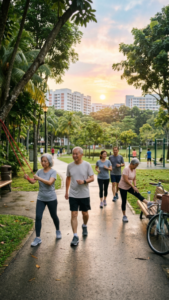
As populations age and chronic disease reshapes the global health agenda, scientists and policymakers are shifting the goal from adding years to life to adding healthier life to years.
For much of the last century, the central promise of modern medicine was simple: help people survive. Vaccines, antibiotics, cleaner water, safer childbirth, better surgery and wider control of infectious disease pushed life expectancy upward in much of the world. Longer lives became one of the great achievements of public health. But a more complicated question now sits at the center of the longevity debate: What is the value of a longer life if many of its final years are marked by frailty, pain, isolation or preventable disease?
That question has given new urgency to the concept of “healthspan,” the period of life spent in good health and functional independence. It is different from lifespan, which measures how long a person lives. Healthspan asks whether those years are lived with mobility, mental clarity, social connection and the capacity to make choices. In clinics, laboratories, city planning offices and family kitchens, the conversation about longevity is moving away from the fantasy of immortality and toward a more practical ambition: compressing illness into a shorter period near the end of life.
The World Health Organization tracks both life expectancy and healthy life expectancy, often called HALE. Its global estimates have repeatedly shown a persistent gap between the number of years people live and the number of years they can expect to live in good health. Before the COVID-19 pandemic reversed some gains, global life expectancy and healthy life expectancy had both risen substantially over two decades. Yet healthy years did not increase as quickly as total years lived. The implication is stark. Humanity has become better at keeping people alive, but not equally good at keeping them well.
This gap is increasingly visible in aging societies. Japan, Singapore, South Korea, parts of Europe and North America are living laboratories for longer life. Many older adults remain active, working, caregiving, volunteering and exercising into their 70s and 80s. At the same time, health systems are under pressure from dementia, diabetes, cardiovascular disease, cancer, osteoporosis and the consequences of sedentary living. The burden is not only medical. It is financial, social and emotional, reaching families who must provide care and governments that must fund pensions, hospitals and long-term support.
The global disease profile is also changing. Major burden-of-disease projections indicate that noncommunicable diseases will continue to account for a large share of illness and death as populations grow older. Heart disease, stroke, diabetes, chronic respiratory disease, cancers and neurodegenerative disorders are now central to the longevity challenge. These conditions are not simply diseases of old age. They often develop over decades, shaped by blood pressure, blood sugar, inflammation, sleep, air quality, diet, stress, physical inactivity and access to preventive care.
This is why many longevity researchers say the most powerful interventions are not exotic. The evidence still points first to movement, food quality, sleep, social ties, mental health, tobacco avoidance, responsible alcohol use and early management of risk factors. The message can sound ordinary, even dull, compared with the billion-dollar industry selling biological age tests, supplements, stem-cell packages and speculative anti-aging treatments. But ordinary does not mean weak. Regular physical activity remains one of the most consistently supported tools for preserving cardiovascular health, muscle strength, balance, insulin sensitivity and mood.
International guidelines generally recommend that adults aim for at least 150 to 300 minutes a week of moderate-intensity aerobic activity, or 75 to 150 minutes of vigorous activity, along with muscle-strengthening work. For older adults, balance training becomes especially important because falls can be life-changing events. A broken hip, a head injury or a fear of falling can rapidly narrow a person’s world. In longevity terms, strength is not vanity. It is infrastructure. Muscle helps people rise from a chair, carry groceries, climb stairs, recover from illness and remain independent.
Diet is another pillar, though it is often distorted by marketing. The most defensible guidance is less about a miracle food and more about dietary pattern. Diets rich in vegetables, fruits, legumes, whole grains, nuts, healthy oils and minimally processed foods are repeatedly associated with better cardiometabolic outcomes. Excess sodium, sugary drinks, ultra-processed foods and heavy intake of processed meats are linked with higher health risks. The goal is not perfection. It is a food environment that makes the healthier choice easier, affordable and culturally acceptable.
Sleep, once treated as a passive state, is now recognized as an active biological process tied to immune function, metabolism, brain health and emotional regulation. Chronic poor sleep can worsen blood pressure, weight control, glucose regulation and mental health. Yet sleep is also shaped by work schedules, housing conditions, caregiving duties, noise, light and stress. A society that talks about longevity while normalizing exhaustion is working against itself.
The same is true of loneliness. A longer life is not automatically a better life if it is lived in social isolation. Researchers and public health officials increasingly identify social connection as a health factor, not merely a personal preference. Community centers, walkable neighborhoods, safe parks, intergenerational housing, accessible transportation and age-friendly workplaces may prove as important to healthy aging as many clinical tools. Longevity is built not only in hospitals but also in sidewalks, schools, markets and homes.
At the high-tech end of the field, the science is moving quickly. Researchers are studying cellular senescence, inflammation, epigenetic clocks, mitochondrial function, the microbiome and drugs that might one day slow aspects of biological aging. Some experimental approaches are promising in animals, and a few are being tested in humans for specific diseases. But experts caution that no widely accepted therapy has yet been proven to safely and broadly slow human aging in the way popular culture often imagines. For now, the strongest case is for rigorous trials, transparent data and protection of consumers from exaggerated claims.
The commercial longevity industry has grown faster than the evidence behind many of its products. Clinics offer biological-age dashboards, supplement stacks, hormone regimens and expensive diagnostics to clients eager to control time. Some tests may be useful for monitoring risk factors, and some future therapies may emerge from today’s research. But the danger is that longevity becomes a luxury brand, available mainly to those already most likely to live long lives. If healthy aging is treated as a boutique product, the healthspan gap could widen between rich and poor, urban and rural, educated and less educated, digitally connected and excluded.
A serious longevity agenda must therefore be public, not only personal. It must include vaccination, cancer screening, blood pressure control, diabetes prevention, cleaner air, safer streets, tobacco control, maternal health, mental health services, dental care and protection from poverty in old age. It must make room for caregivers, who are often women and often unpaid. It must recognize that healthy aging begins long before old age, in childhood nutrition, education, safe housing and opportunities for physical activity.
The most useful shift may be psychological. Longevity should not be understood as a race to reach 100 at any cost. It should be understood as the preservation of capacity: the capacity to move, think, love, contribute, adapt and choose. A person who reaches 82 with strong relationships, manageable illness and daily independence may embody the promise of longevity more fully than someone who reaches 100 after years of severe disability and isolation.
The coming decades will test whether societies can redesign aging before aging overwhelms them. Medical science will matter, and breakthroughs may come. But the deeper measure of progress will be whether longer lives become healthier lives for many, not just for the privileged few. The real prize is not merely more birthdays. It is more mornings when people wake with enough strength, clarity and connection to live the day as their own.