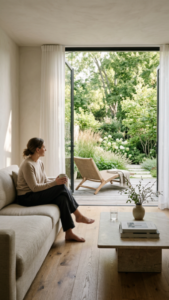
Minimal rooms, neutral palettes, natural light, wood, stone and restorative outdoor spaces are redefining domestic luxury for a generation seeking calm rather than display.
LOS ANGELES — The new luxury home does not announce itself loudly. It does not rely on oversized chandeliers, glossy marble everywhere or rooms arranged mainly to impress visitors. Its power is quieter: filtered sunlight across pale walls, warm wood underfoot, stone that looks hand-finished rather than polished to perfection, linen curtains moving slightly in the afternoon air, a courtyard designed more for breathing than entertaining.
This is the rise of the quiet luxury home, a design language built around restraint, natural materials and emotional recovery. It is appearing in living rooms with low furniture and neutral upholstery, kitchens where wood grain is more important than ornament, bathrooms that borrow from spas without becoming theatrical, and gardens designed as calm outdoor rooms. The goal is not emptiness. It is relief.
For many homeowners, the appeal is practical as much as aesthetic. The home has become office, gym, classroom, recovery space, entertainment center and emotional refuge. After years of digital overload, economic pressure and blurred boundaries between work and private life, a growing number of people want rooms that help them feel settled. In that context, quiet luxury is less about wealth than atmosphere. It sells the feeling of a retreat without requiring the owner to leave home.
Homes & Gardens has described the 2026 outdoor quiet luxury trend through minimalist, natural and restorative spaces. In one recent example, the publication highlighted a Los Angeles poolside retreat defined by raw timber decking, clean lines, restrained furniture and a planting scheme built around greenery, white flowers and sculptural foliage. The article argued that natural materials and simplicity are replacing high-maintenance gardens as a new status symbol, with peace and architectural purity becoming central to outdoor design.
That idea is spreading indoors as well. The quiet luxury home favors spaces that look edited rather than decorated. Furniture is chosen for proportion, comfort and longevity. Accessories are fewer but more deliberate. Color palettes lean toward cream, sand, taupe, warm gray, clay, olive, smoke, bone and soft brown. Instead of visual noise, there is texture: honed limestone, oak, walnut, plaster, wool, linen, rattan, leather, travertine, handmade tile and matte metal.
The movement is often confused with minimalism, but it is not the cold minimalism of empty white boxes. Designers increasingly describe the preferred look as warm minimalism: fewer objects, but richer surfaces; cleaner rooms, but softer edges; modern lines, but natural finishes. Homes & Gardens reported that outdoor design is moving away from stark black accents toward sun-bleached wood, limewashed finishes, sand-toned stone, terracotta, warm gray and weathered steel. The same logic applies inside the home. The luxury is in restraint, but the restraint must still feel human.
Houzz’s 2026 home design coverage points in the same direction. The platform says homeowners are rethinking design with a focus on intention and ease, prioritizing warmth, longevity and well-being over novelty. Its trend forecast highlights rich materials, wellness-focused spaces and homes that support real life. It also notes growing interest in natural stone slabs that create “quiet elegance” through soft veining and organic warmth rather than harsh contrast.
The trend also reflects a broader desire for homes that reduce stimulation. Open shelves crowded with objects are giving way to closed storage. Bright white lighting is being softened by layered lamps, sconces and daylight. Hard surfaces are being balanced by rugs, textiles and acoustic comfort. A quiet luxury room is often designed to lower the pulse: fewer sharp transitions, fewer competing patterns, fewer screens at the center of attention.
Zillow’s 2026 home trends show how the desire for private calm is appearing in the housing market. The company said reading nooks are appearing 48% more often in listings, reflecting demand for quiet corners where residents can put down the phone and recharge. Zillow also reported that wellness features rose 33% and spa-inspired bathrooms appeared 22% more often. These details suggest that the retreat-at-home idea is no longer limited to high-end design magazines. It is becoming part of how homes are marketed and valued.
The bathroom may be the clearest expression of the shift. In the quiet luxury home, it is not only a place to get ready. It is a decompression room. The design language includes stone floors, plaster walls, warm lighting, deep tubs, walk-in showers, wood vanities and uncluttered counters. The best examples feel calm rather than clinical. They borrow from hotels and spas but keep a domestic softness, creating a daily ritual from ordinary routines.
Kitchens are changing too. For years, luxury kitchens often signaled status through size, shine and visible appliances. Quiet luxury takes a different approach. It favors integrated storage, natural stone with subtle movement, warm wood cabinetry, simple hardware, concealed clutter and materials that age gracefully. The kitchen remains a social center, but it is less performative. It becomes a room that works hard while appearing composed.
Outdoor space is where the trend becomes most emotional. A small patio, balcony or backyard can be arranged as a personal sanctuary through a limited palette of plants, comfortable seating, shade, water, stone and soft lighting. The new outdoor retreat does not need to be extravagant. A bench under a tree, a gravel path, a low cedar fence, a limewashed wall or a few large planters can create the same feeling of separation from the world. The key is coherence: fewer elements, chosen carefully.
This is why “garden rooms” are gaining attention. Houzz says homeowners are increasingly approaching yards as collections of outdoor zones with defined purposes, such as dining patios, fire lounges, play lawns and quiet reading nooks surrounded by greenery. The quiet luxury version of this idea is especially restrained. It uses hedges, planters, trellises and pathways to create privacy without heaviness, and it treats the garden as part of the home’s emotional architecture.
Natural light is another central feature. It is free, but it must be designed around. Quiet luxury homes often maximize daylight through sheer curtains, lighter walls, reflective natural surfaces and furniture placed to preserve views. The goal is not merely brightness. It is a sense of rhythm: morning light in the kitchen, afternoon shade in the living room, evening warmth on a terrace. A home that changes gently with the day can feel more alive than one dominated by artificial lighting.
There is also a sustainability argument, though it is not always stated directly. A home built around timeless materials and fewer trend-driven purchases may age better than one redesigned every few years. Wood, stone, linen and plaster are not automatically sustainable; sourcing, durability and maintenance matter. But the quiet luxury ideal encourages longevity, repair and quality over disposable decoration. In that sense, it offers a softer critique of fast interiors and social-media-driven home makeovers.
The risk is that quiet luxury becomes another expensive aesthetic sold as moral clarity. A room can be neutral, minimal and full of natural materials while still being inaccessible to many households. The language of calm can mask high costs, from custom millwork to stone slabs and landscape design. For renters or families in smaller spaces, the trend may feel aspirational rather than attainable.
Yet its core ideas can be adapted. Decluttering does not require wealth. Better light, fewer visual distractions, natural textures, secondhand wood furniture, soft textiles, plants and thoughtful storage can change the feeling of a room without a full renovation. The most democratic version of quiet luxury is not about buying the most expensive sofa. It is about choosing what deserves space.
The trend’s staying power will depend on whether it remains connected to how people actually live. A beautiful retreat that cannot handle children, pets, cooking, work calls or daily mess is only a photograph. The best quiet luxury homes are not fragile. They are calm because they function well. They have places to put things away, surfaces that can be used, materials that age honestly and rooms that support rest without demanding perfection.
In 2026, the quiet home has become a counterpoint to the loud world. It offers privacy without isolation, simplicity without sterility and luxury without spectacle. Its promise is not that life will become effortless. It is that the place where life happens can feel less chaotic. For a growing number of Americans, that may be the most valuable design feature of all.