
In a fictional family drama about loyalty and inheritance, a wealthy father stages his own financial ruin and discovers that only the child he had underestimated is willing to stay.
For years, Daniel Whitmore believed he understood his children. He knew their habits, their ambitions and the exact tone each one used when asking for something. He knew which child remembered his birthday because a reminder appeared on a phone, which one called only before business decisions, and which one smiled most warmly when the conversation turned to property, shares or the family estate. What he did not know, until he decided to test them, was whether any of them loved him without the protection of his wealth.
Daniel was a self-made businessman, the kind of man whose name appeared on buildings, charity programs and carefully printed invitations. He had built a logistics company from a single warehouse and turned it into a national enterprise. His home was large, his staff discreet and his children accustomed to comfort. They grew up with private schools, foreign holidays and the quiet confidence that money would always arrive before difficulty did.
He had four children. Adrian, the eldest, was polished, ambitious and already acting like the future head of the family business. Vanessa, his second child, had married into another wealthy circle and measured life by appearances. Marcus, the third, was charming, careless and always short of money despite never lacking opportunity. The youngest, Lily, was different. She had been treated as the least promising member of the family: too quiet for business, too plain for society, too gentle for a world built on negotiation and display.
Lily was the one people forgot to introduce at formal dinners. She was the one relatives praised with faint kindness, saying she had “a good heart” when they could find nothing more impressive to say. She worked as a teacher at a modest community school, lived in a small apartment and rarely asked her father for help. Some in the family mistook that independence for failure. Daniel, too, had often underestimated her.
The idea for the test came after a private medical scare. Daniel recovered, but the hospital room changed him. Lying alone at night, listening to machines and footsteps in the corridor, he realized how little he knew about what would happen if his money disappeared before he did. His children visited, but their conversations circled the same subjects: company control, legal documents, investment exposure, the house, the will. They asked how he felt, but their eyes moved toward the briefcase beside his bed.
After his recovery, Daniel called his lawyer and closest financial adviser. Together, they created the appearance of collapse. A false announcement would not be made publicly, but documents, conversations and carefully leaked concerns would suggest that a failed overseas investment had destroyed most of his fortune. The company would appear endangered. The estate would be mortgaged. Creditors would be described as impatient. Daniel would tell his children he had lost nearly everything.
The test was morally dangerous, and his lawyer warned him as much. Deception can reveal truth, but it can also damage what remains. Daniel listened, then continued. He told himself he was not being cruel; he was protecting the future. He wanted to know who would stand beside him when there was nothing left to gain.
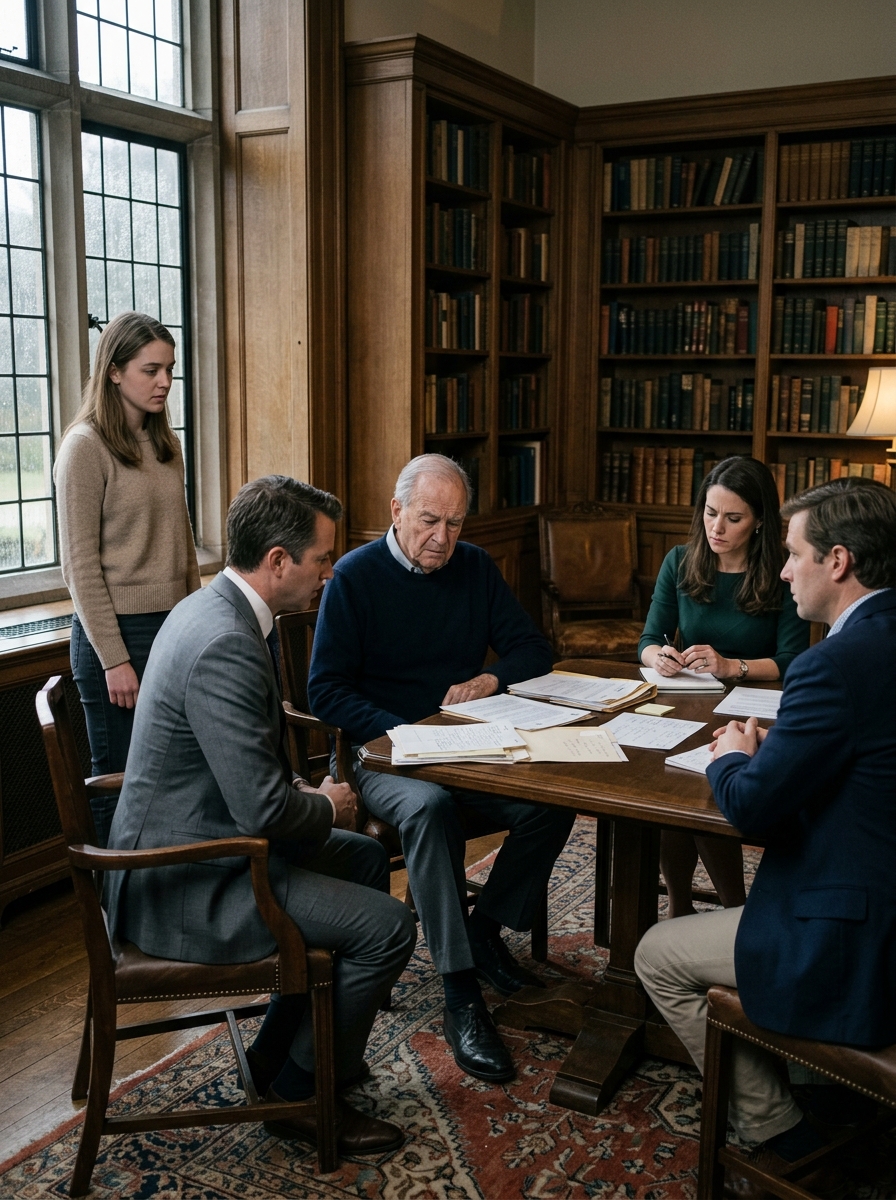
The family meeting took place on a rainy Sunday afternoon in the library, a room where the children had once played under shelves of leather-bound books they never read. Daniel sat at the head of the table without his usual tailored confidence. He wore an old sweater and let his hands tremble slightly as he spoke. The losses, he said, were catastrophic. The house might be sold. The company might pass to creditors. There would be no inheritance in the way they had imagined. He might need to move into a smaller place and reduce his expenses immediately.
For several seconds, no one spoke. Adrian was the first to recover. He asked for documents, numbers and names. His face was not sad but irritated, as if his father had made an avoidable management error that now inconvenienced him. Vanessa asked whether the news would become public. She was worried about reputation, her husband’s family and the social consequences of being connected to scandal. Marcus leaned back in his chair and said very little, but his expression hardened when he realized there would be no emergency funds for his latest business idea.
Only Lily asked whether Daniel had eaten.
The days that followed revealed more than the meeting. Adrian stopped visiting and began calling company contacts behind his father’s back, trying to protect his own position. Vanessa sent polite messages but avoided the house, explaining that stress was bad for her children. Marcus arrived once, not to comfort his father, but to ask whether any personal accounts remained untouched. When Daniel said no, Marcus left before dinner.
Lily stayed.
She did not move into the mansion out of sentimentality. She moved in because she believed her father was frightened and alone. She cooked simple meals when the staff was supposedly dismissed. She sorted medication, answered calls, drove him to medical appointments and sat with him through long evenings when he pretended to stare at unpaid bills. She did not ask about the will. She did not ask whether her siblings would return. She did not ask what would be left for her.
Daniel watched her with growing shame. For years, he had rewarded confidence, noise and ambition. He had praised Adrian’s command, Vanessa’s elegance and Marcus’s charm. Lily’s loyalty had been quiet, and because it was quiet, he had failed to value it. Now, when he had supposedly become useless to the others, she was the only one who treated him as a father rather than a failing institution.
The cruelty of the older children became sharper over time. Adrian eventually suggested that Daniel sell the house quickly before its value fell, though he made clear he could not offer him a room. Vanessa sent a list of assisted-living facilities, none of which she had visited. Marcus accused Daniel of ruining the family’s future and said a father had a duty to leave something behind. Their words were not shouted in public. They were delivered in the polished language of people who believed selfishness could be made respectable if spoken calmly.
Lily heard some of it. Daniel saw the pain cross her face, but she did not answer with anger. She told her siblings that their father was still alive, still listening and still worthy of care. Adrian called her naïve. Vanessa said Lily had always enjoyed playing the victim. Marcus laughed and said she stayed only because she had nothing better to do.
That night, Daniel almost ended the test. He stood outside Lily’s door and heard her crying softly. The sound unsettled him more than any business loss ever had. He had created the trial to measure his children, but it had also measured him. A father who needed to pretend to be poor to discover love had already failed to see what was in front of him.
The truth emerged at a second family meeting one month later. Daniel invited all four children back to the library. Adrian arrived with legal questions. Vanessa arrived with reluctance. Marcus arrived because he believed there might be one final asset to discuss. Lily came because she was worried her father looked tired.
Daniel placed a file on the table. Inside were the real financial statements, trust documents and company reports. There had been no bankruptcy. No creditors were coming. The estate was secure. The company remained profitable. The ruin had been staged.
The room changed instantly. Adrian’s face lost color. Vanessa looked from the papers to her father as if searching for a way to turn outrage into innocence. Marcus stood up, then sat down again. Lily did not speak. She looked hurt, not relieved.
Daniel told them he had wanted to know what remained when money disappeared. He said he had received his answer. The inheritance would be restructured. Adrian, Vanessa and Marcus would receive smaller fixed settlements, enough to live comfortably but not enough to control the family wealth. The controlling trust, the house and the charitable foundation would pass to Lily, not because she had asked for them, but because she had shown responsibility when no reward was promised.
The older children protested. They called the test unfair, manipulative and humiliating. In some ways, they were right. Daniel did not deny it. But he also reminded them that their choices had been made freely. No one had forced them to abandon him. No one had prevented them from calling, visiting or offering help. They had not been punished for failing a puzzle. They had revealed a pattern.
Lily’s response was the quietest and the most difficult. She told her father she had not cared for him to win a prize. She also told him that trust, once tested through deception, did not return automatically. Daniel accepted that. For the first time in years, he did not try to control the outcome.
In the months that followed, Lily did not become a triumphant heir in the way others imagined. She kept teaching. She moved slowly into her role at the family foundation and redirected its money toward elder care, scholarships and community clinics. She visited Daniel often, but their relationship healed gradually, through ordinary meals and honest apologies rather than grand declarations.
The lesson of Daniel Whitmore’s test was not that wealth is evil or poverty noble. It was simpler and more uncomfortable. Money can attract attention that looks like love. Loss can reveal indifference that once hid behind manners. And sometimes the child dismissed as weak is the only one strong enough to stay when staying appears to offer nothing in return.”””
