Teachers and students are already using artificial intelligence, but education systems are still struggling to decide what should be automated, what should be protected and how learning should be measured.
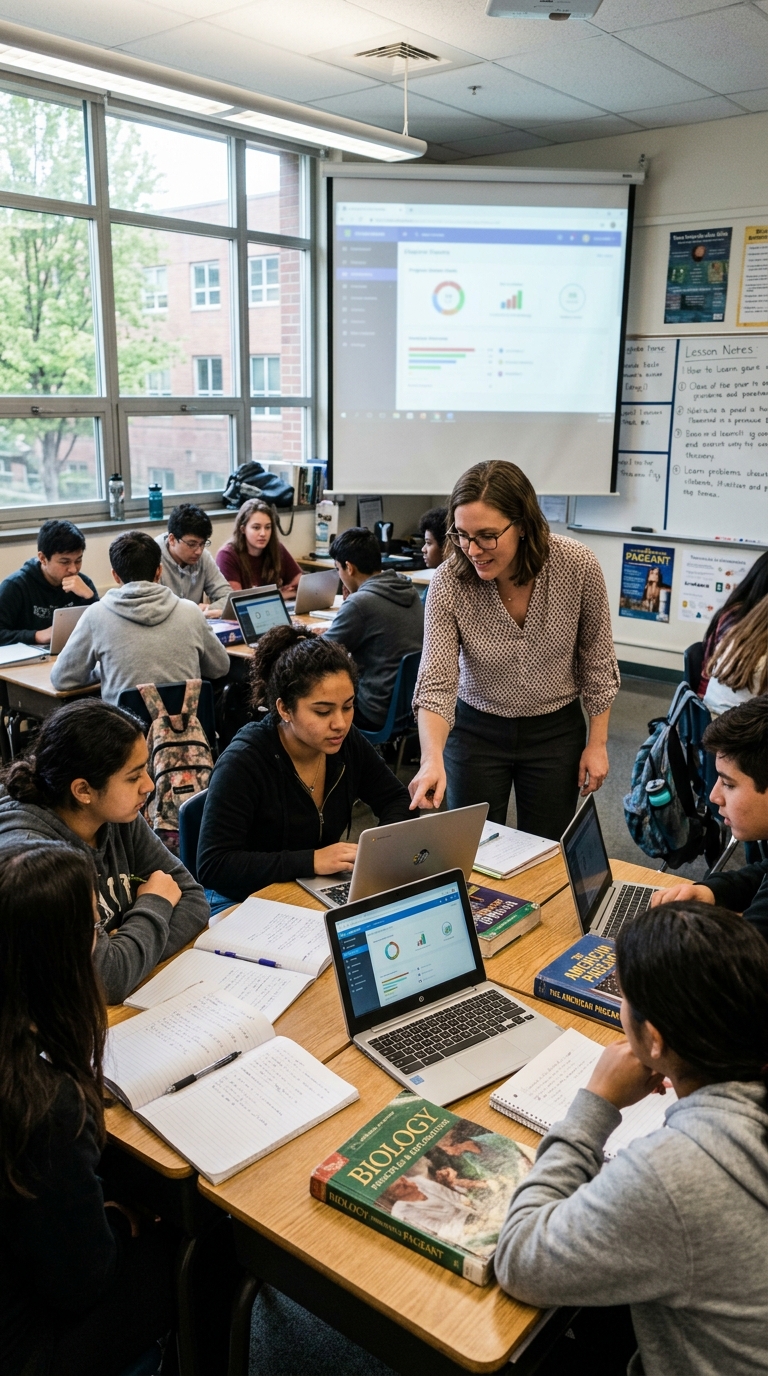
Artificial intelligence has entered education faster than most school systems can adapt. Students use chatbots to draft essays, explain math problems, translate texts and prepare for exams. Teachers use AI to create lesson plans, summarize materials, design quizzes and provide feedback. Administrators use data systems to track attendance, performance and risk.
The transformation is real, but uneven. UNESCO has urged human-centered, inclusive and ethical approaches to AI in education, including competency frameworks for teachers and students. The Stanford AI Index 2026 describes rapid AI adoption across society, with organizations increasingly using generative AI in business functions. Education is part of that broader shift, but its stakes are distinctive because schools shape children, citizenship and social mobility.
The first public debate focused heavily on cheating. Teachers worried that students would submit AI-written essays and avoid learning. Those concerns were valid, but they were also too narrow. AI challenges not only assessment but the structure of instruction itself. If a tool can produce a fluent paragraph, summarize a chapter or solve a homework problem, educators must ask what assignments are meant to measure.
Some schools initially banned generative AI. Many later discovered that bans were difficult to enforce and potentially inequitable. Students with private devices, better connectivity or more knowledge could use tools anyway. Others were left behind. A ban may protect old assessments temporarily, but it does not teach students how to use AI responsibly in a world where employers will expect some AI literacy.
Teachers face a difficult transition. AI can reduce workload by generating first drafts of worksheets, adapting reading levels or suggesting feedback. But it can also create pressure to do more with fewer resources. If administrators see AI as a substitute for teachers rather than support, education quality could suffer.
The best uses of AI in classrooms may be assistive rather than replacement-oriented. A teacher might use AI to prepare differentiated materials for students at different levels. A language learner might practice conversation with a tool before speaking in class. A student with disabilities might use AI for transcription, organization or alternative formats. These uses can expand access when guided well.
The risks are serious. AI systems can produce false information confidently. They can reflect bias in training data. They may not understand local curriculum, culture or language nuances. They can collect sensitive student data. They may encourage students to accept answers without developing judgment.
Assessment is the hardest problem. Traditional homework completed at home is now less reliable as evidence of individual skill. Schools may need more in-class writing, oral defense, project-based learning, process documentation and assignments that require personal observation or local context. This is labor-intensive. It demands smaller classes, teacher training and time.
There is also a risk of widening inequality. Wealthy schools can buy premium tools, train teachers and build policies. Underfunded schools may rely on free tools with weaker privacy protections or no AI access at all. Students in elite systems may learn to use AI as a thinking partner, while others are punished for using it or excluded from it.
Data privacy is central. Children’s learning records, writing samples, speech, behavior and disabilities are sensitive. Schools must understand where data goes, how long it is stored, whether it trains models and who can access it. Many education systems lack procurement expertise to evaluate AI vendors properly.
Teachers need professional development, not only tool demonstrations. They need to understand AI limitations, bias, prompt design, verification, classroom ethics and assessment redesign. They also need time to discuss what learning means when machines can generate answers. A teacher cannot become an AI governance expert overnight.
Students need AI literacy as a basic skill. That means knowing how to ask good questions, verify outputs, recognize hallucinations, protect privacy, cite assistance and understand when not to use AI. It also means understanding that AI systems are built by companies, trained on data and shaped by incentives.
The relationship between AI and creativity is complicated. Some fear that students will stop writing, drawing or solving problems independently. Others argue that AI can help students overcome blank-page anxiety and explore ideas. The difference depends on pedagogy. If AI replaces effort, learning weakens. If it supports revision, reflection and exploration, it can help.
Language access is one of AI’s strongest promises. Translation, speech recognition and reading-level adaptation can help multilingual classrooms. But low-resource languages may receive weaker support. Cultural context can be lost. Education systems must ensure that AI does not push students toward dominant languages at the expense of local identity.
Higher education faces its own disruption. Universities must rethink admissions essays, take-home exams, coding assignments and research training. Scientific writing, literature review and data analysis can all be accelerated by AI, but academic integrity rules must adapt. The line between acceptable assistance and misrepresentation must be clarified.
The labor market adds urgency. Students graduating into AI-transformed workplaces will need to collaborate with machines, not merely avoid them. Schools that ignore AI may fail to prepare students. Schools that adopt it uncritically may fail to protect learning. The middle path is harder but necessary.
Parents are often uncertain. Some see AI as tutoring support. Others worry about dependence, screen time and privacy. Clear school policies can help families understand when tools are allowed and why. Without transparency, mistrust grows.
Public education systems must also consider vendor dependence. If schools build curricula around proprietary AI tools, they may become locked into platforms whose prices, policies or models change. Open standards, public-interest tools and government procurement rules will matter.
The role of human teachers may become more important, not less. As information becomes easier to generate, students need adults who can guide judgment, ethics, curiosity and resilience. A chatbot can explain a concept, but it cannot fully understand a child’s emotional state, family context or long-term growth.
AI should force schools to value deeper learning. Memorization and formulaic writing are easier to automate. Discussion, experimentation, collaboration, civic reasoning and original inquiry are harder. Education systems may use this moment to redesign learning around skills that matter more in an AI-rich world.
But redesign requires investment. It is unfair to demand that teachers transform assessment, protect privacy, detect misuse, learn new tools and personalize instruction without support. The AI classroom cannot be built on teacher exhaustion.
The technology is already here. The question is whether education systems will shape it according to public values or simply absorb whatever companies release next. AI can help learning, but only if schools remain clear about the purpose of education: not producing answers, but developing people capable of understanding, questioning and using them wisely.
“””
