
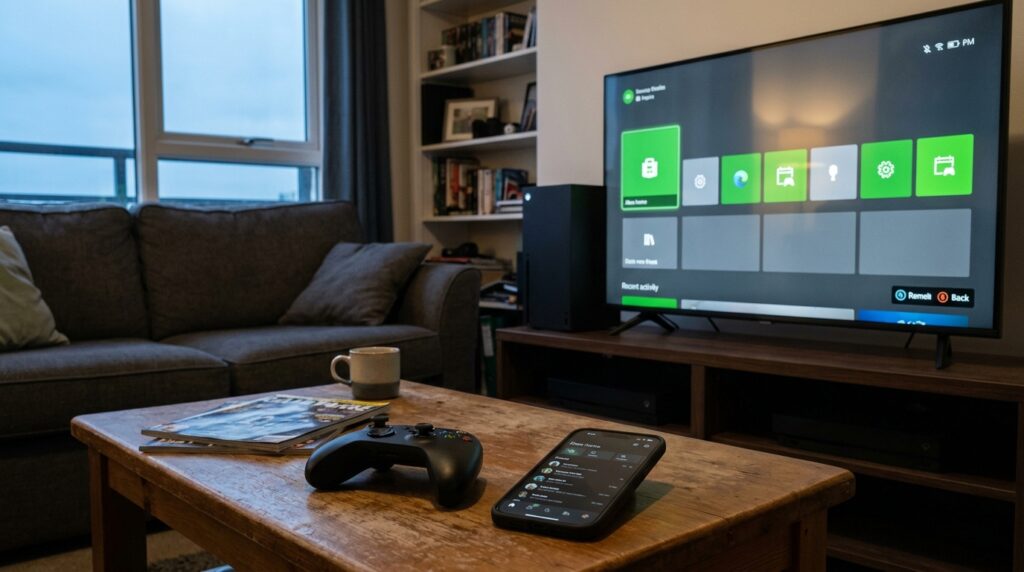
The decision to wind down Copilot on mobile and halt console development marks a reset for Xbox’s approach to artificial intelligence after months of testing and internal reorganization.
Microsoft is retreating from one of its most visible artificial intelligence experiments in gaming, saying it will wind down Xbox Copilot on mobile devices and stop developing the assistant for consoles, a move that underscores a broader recalibration of how the company wants to bring AI into play.
The decision, announced by Xbox chief Asha Sharma as part of a wider platform shake-up, ends the planned expansion of Gaming Copilot to living-room hardware before the feature reached a full console launch. It also signals that Microsoft, despite its aggressive investment in AI across cloud, productivity software and developer tools, is becoming more selective about where AI belongs in its gaming ecosystem.
Gaming Copilot was introduced as a personal assistant for players, designed to provide recommendations, answer questions, offer help when users became stuck, and draw on a player’s Xbox activity to make responses more relevant. The concept was pitched as a way to reduce friction: less time searching for guides, installing games or remembering where a player left off, and more time actually playing. In early previews, Microsoft emphasized that the assistant was meant to remain optional and out of the way, not a replacement for player control.
That framing now appears to have been overtaken by a sharper internal judgment: not every Copilot-branded feature automatically fits Xbox’s future. Sharma said Xbox would begin retiring features that do not align with where the business is headed, adding that Copilot on mobile would be wound down and development on console would stop. The message was blunt by the standards of major platform announcements, especially for a company that has spent the past several years making Copilot one of its most important product brands.
The reversal is notable because Gaming Copilot had been moving through a gradual rollout. Microsoft began testing the assistant on mobile in 2025, later expanding availability through the Xbox mobile app and PC Game Bar. It was marketed as a “sidekick” that could understand what game a user was playing, respond to voice or text prompts, help with achievements and play history, and eventually offer richer, real-time assistance. In November, Microsoft said Gaming Copilot was available in the Xbox mobile app, accessible through its own tab.
The console version, however, represented the most sensitive test. An AI helper on a second screen is one thing; an assistant integrated into the console experience is another. Consoles are built around speed, simplicity and immersion, and any feature that interrupts the flow of play risks being treated as clutter rather than convenience. Microsoft had planned to bring Gaming Copilot to current-generation Xbox consoles, but Sharma’s announcement makes clear that rollout will not proceed.
The move does not mean Microsoft is abandoning AI in gaming. Rather, it suggests the company is drawing a line between AI that feels like a visible chatbot bolted onto the user experience and AI that operates more quietly inside the platform. Sharma has pointed to areas such as real-time graphics, discovery, personalization, developer tooling and platform infrastructure as places where AI could solve practical problems. That emphasis reflects a more utilitarian approach: AI as a layer that improves performance, content discovery or production workflows, rather than as a branded assistant asking players to talk to it.
The timing is important. Xbox is undergoing one of its most consequential transitions in years. Sharma, who took over Microsoft’s gaming business in February, inherited a division with enormous content assets but persistent questions about hardware momentum, Game Pass growth and the long-term role of consoles in Microsoft’s strategy. Microsoft owns some of the largest franchises in gaming after its acquisitions of ZeniMax and Activision Blizzard, yet the Xbox hardware business has faced pressure as players increasingly move across console, PC, cloud and mobile.
Microsoft’s latest quarterly figures highlight both the company’s strength and the gaming unit’s challenge. Overall, Microsoft remains powered by cloud and AI growth, with revenue rising strongly in its fiscal third quarter. But gaming revenue fell, and Xbox content and services also declined from the prior year period. On the earnings call, Microsoft said Xbox reached records for monthly active users and game streaming hours, a reminder that engagement can rise even while some revenue lines soften. That tension helps explain why Xbox is focusing on features that can keep players active, reduce frustration and make the platform feel more responsive.
The Copilot retreat also comes amid a wider leadership reshuffle inside Xbox. Sharma has brought in executives with technical, design, growth and data experience, including people from Microsoft’s CoreAI organization. At the same time, some longtime Xbox leaders are departing or moving into advisory roles. The leadership changes suggest a platform-first reset: fewer disconnected experiments, more focus on infrastructure, player feedback and developer needs.
For players, the practical effect is likely to be limited in the short term. Copilot on mobile was still a beta-style feature for many users, and the console version had not become a mainstream part of the Xbox experience. But symbolically, the move matters. Microsoft had presented Gaming Copilot as an example of how generative AI could fit into entertainment. Pulling it back shows that the company is willing to cancel AI features when they do not meet the bar for usefulness or alignment with the product.
It may also reflect a broader reality for the games industry. Players are not automatically opposed to AI, but they tend to judge it by whether it improves the experience without weakening the craft of games or disrupting play. An AI feature that helps developers test builds, improves accessibility, enhances graphics or finds the right game in a crowded library may face less resistance than a chatbot that appears during gameplay. For many users, the best AI in games may be the kind they never have to think about.
Gaming companies are also navigating sensitive questions around data, attribution and creative labor. A game assistant that answers questions by drawing on public web sources, player activity and in-game context can be useful, but it also raises expectations around accuracy, privacy and transparency. If an assistant gives bad advice, spoils a story, misreads a player’s intent or summarizes third-party guide content without clear credit, the feature can quickly become a trust problem. Microsoft’s decision to step back from the consumer-facing assistant may give Xbox more room to refine these issues before placing AI deeper into core experiences.
For developers, the pivot could be more consequential. Xbox has repeatedly said it wants to reduce friction for game makers, and AI tools could play a role in debugging, certification, performance optimization, localization, player support and analytics. Those uses are less flashy than a branded Copilot companion, but they may deliver clearer value. A faster development pipeline or better platform tools can affect every game on the system, while a chatbot must persuade each player that it deserves attention.
The decision also highlights a branding challenge. Copilot has become a broad umbrella across Microsoft’s products, from Microsoft 365 and Windows to GitHub and cloud services. That scale gives the brand recognition, but it also creates risk when users feel Copilot is being inserted everywhere by default. Xbox is a consumer entertainment platform with a passionate community, and its audience is often quick to reject features perceived as corporate priorities rather than player benefits. By retiring Copilot where it does not fit, Microsoft may be trying to show that Xbox will not simply import the company’s enterprise AI strategy into gaming unchanged.
For now, Xbox’s AI future looks less like a talking assistant and more like a set of invisible systems behind the screen. The company still has strong incentives to use AI: cloud infrastructure, personalization, content discovery and developer efficiency all match Microsoft’s broader strengths. But the Copilot reversal shows that AI in gaming will be judged by a tougher standard than novelty. It must make games easier to start, better to play and more rewarding to return to.
Microsoft’s retreat from Xbox Copilot is therefore not a rejection of AI. It is a course correction. The company is acknowledging that the path to useful AI in games may be narrower, quieter and more player-led than its first consumer-facing experiment suggested. For Xbox, the next test will be whether that restraint can produce tools that feel less like a mandate from the broader Microsoft machine and more like improvements designed for the people holding the controller.