The partnership to build OpenAI-designed AI accelerators marks a new phase in the battle for computing power behind large artificial intelligence systems.
OpenAI’s move to design custom artificial intelligence accelerators with Broadcom is more than another technology supply agreement. It is a signal that the companies building the most powerful AI models now see computing infrastructure as a strategic asset that must be shaped from the chip level upward.
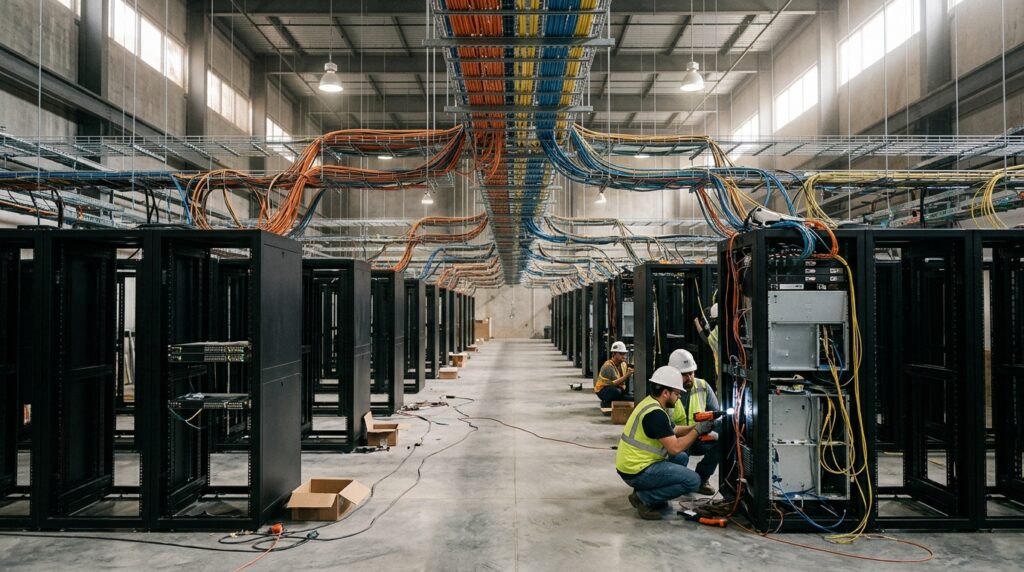
The collaboration, announced by OpenAI and Broadcom in October 2025, calls for the development and deployment of 10 gigawatts of OpenAI-designed AI accelerators and related network systems. Broadcom is expected to help develop and deploy racks of accelerator and networking equipment, with the rollout targeted to begin in the second half of 2026 and continue through the end of 2029.
For OpenAI, the partnership reflects a basic reality of the generative AI boom: advanced models are constrained not only by algorithms and data, but also by the availability, cost and efficiency of the hardware used to train and run them. The company behind ChatGPT has grown into one of the world’s most visible AI developers, and its products require enormous amounts of computing capacity to serve users, improve models and support new services.
AI accelerators are specialized chips designed to handle the mathematical workloads that power machine learning systems. Unlike general-purpose central processing units, accelerators are optimized for operations such as matrix multiplication, parallel processing and high-throughput data movement. Those features make them essential for training large AI models and for running inference, the process in which a model responds to user prompts.
OpenAI has said it will design both the accelerators and the systems around them, while Broadcom will bring experience in custom silicon, networking and large-scale deployment. The systems are expected to use Broadcom’s Ethernet and other connectivity technologies to link chips and servers across large AI clusters. That networking layer is critical because modern AI infrastructure is not defined by a single chip, but by the ability of thousands or even millions of processors to work together efficiently.
The agreement also shows how the AI supply chain is changing. For years, Nvidia’s graphics processing units have dominated the market for AI training and inference. Demand for those chips has surged as companies race to build larger models and deploy AI tools across search, software, finance, healthcare, media and defense. That demand has created supply bottlenecks, high costs and intense competition for access to the most advanced systems.
Custom silicon offers AI companies another path. By designing chips around their own model architectures and workloads, companies such as OpenAI can potentially improve performance, reduce power consumption and gain more control over their infrastructure roadmap. The trade-off is complexity. Designing chips requires long development cycles, deep engineering expertise and close coordination with manufacturing, packaging, memory and networking suppliers.
Broadcom is one of the few companies positioned to help at that scale. It has built a large business around custom chips, networking components and connectivity systems for hyperscale customers. Its role in the OpenAI project underscores the importance of moving data quickly and reliably inside AI data centers. In the largest model-training systems, slow communication between processors can become a major bottleneck, limiting the benefits of adding more chips.
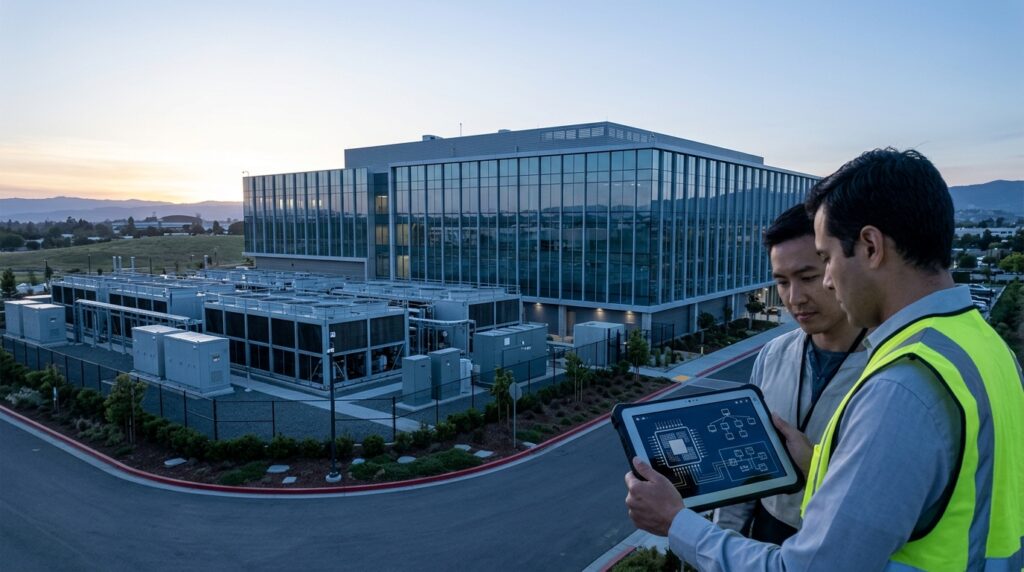
The scale of the planned deployment is striking. Ten gigawatts is a power figure usually associated with national energy systems, not a single technology partnership. While that number refers to the targeted computing infrastructure capacity rather than a simple description of one facility’s electricity draw, it highlights the massive physical footprint now required by frontier AI. Data centers need land, power contracts, cooling systems, substations, fiber connections and a workforce capable of operating highly specialized equipment.
That physical buildout will test more than engineering ambition. It will put pressure on energy markets, local permitting systems and environmental planning. AI companies argue that more efficient hardware can help reduce the power needed for each unit of computation, but total electricity demand can still rise if usage grows faster than efficiency improves. The industry’s challenge is therefore not only to make chips faster, but to make large-scale AI deployment economically and environmentally sustainable.
OpenAI’s partnership with Broadcom fits into a broader infrastructure strategy. The company has pursued multiple arrangements with cloud providers, chipmakers and data center partners to secure the compute needed for future models. This approach reduces dependence on any single supplier, but it also creates a complex web of financial and operational commitments. For investors and analysts, the central question is whether demand for AI services will grow enough to justify the scale of planned spending.
The timing of the Broadcom rollout is important. A target start in the second half of 2026 means the first systems would arrive as the AI market enters a more mature and competitive phase. Early enthusiasm for chatbots and generative tools has already given way to a tougher focus on reliability, cost, enterprise adoption and measurable productivity gains. By the time OpenAI-designed accelerators begin deployment, customers may expect AI systems that are faster, cheaper and more deeply integrated into everyday software.
The partnership may also reshape competition among chip suppliers. Nvidia is unlikely to be displaced quickly, given its strong software ecosystem, hardware roadmap and deep relationships with AI developers. But custom accelerators could gradually change the economics of AI computing, especially for companies with workloads large enough to justify dedicated silicon. Google has long used its own Tensor Processing Units, while other major technology companies have invested in internal AI chips or semi-custom designs.
For Broadcom, the OpenAI collaboration strengthens its position in the AI infrastructure race. The company is not trying to replicate Nvidia’s full stack in the same way. Instead, it is leaning into custom design and networking, two areas where large customers may want tailored systems rather than off-the-shelf components. As AI clusters grow, the value of networking, switching and system integration may rise alongside the value of the accelerator itself.
For OpenAI, the benefits could be strategic as much as technical. A successful chip program would allow the company to align hardware more closely with its software and model-development plans. That could mean designing accelerators for specific inference patterns, memory requirements or training techniques. It could also give OpenAI more leverage in negotiations with other suppliers by proving that it has credible alternatives.
Still, execution risks are considerable. Chip programs can face delays, cost overruns and performance gaps between laboratory targets and real-world deployment. Manufacturing capacity for advanced semiconductors remains concentrated among a small number of suppliers, and the most advanced packaging and memory components are in high demand. Even after chips are produced, deploying them at data center scale requires extensive testing, cooling, power management and software optimization.
The software challenge should not be underestimated. AI hardware is only as useful as the tools that allow developers to run models efficiently on it. Nvidia’s advantage has been reinforced by years of software investment. Any OpenAI-Broadcom system will need compilers, libraries, scheduling tools and reliability systems that can support demanding AI workloads. The closer OpenAI can integrate those tools with its model pipelines, the more value it can extract from custom silicon.
The deal also illustrates a broader industrial shift: AI is becoming an infrastructure business. The early public face of generative AI was a simple chat box, but behind it is an increasingly capital-intensive system of chips, cables, power plants, cooling towers and global supply chains. The companies that control these layers may shape not only the cost of AI, but also who can build the most capable models.
Governments are watching closely. AI infrastructure is now linked to economic competitiveness, energy security and national technology policy. Large-scale chip deployments raise questions about export controls, supply-chain resilience and access to advanced computing. As private companies invest at unprecedented scale, policymakers are likely to scrutinize where these systems are built, how they are powered and who benefits from their capabilities.
The OpenAI-Broadcom partnership does not guarantee that OpenAI will achieve cheaper or more abundant compute. But it does show that the company is trying to move from being primarily a buyer of AI infrastructure to becoming a designer of it. That transition could define the next phase of the AI race.
If the deployment begins on schedule in late 2026, the first OpenAI-designed accelerators will arrive at a moment when the industry is asking whether generative AI can deliver durable economic value. The answer may depend not only on smarter models, but on whether companies can build the hardware foundations to run them at global scale.”””