
As the Commonwealth Games returns in a leaner, more digital form, organizers are betting that shorter formats, streaming platforms, community engagement and event technology can keep multi-sport spectacles relevant.
GLASGOW — The Commonwealth Games has long sold itself as a gathering of nations, flags and athletes. In 2026, it will also be a test of something more urgent: whether a major sports event can reinvent how it reaches people who no longer experience sport only through a stadium seat or a television broadcast.
Glasgow 2026 is not being built as a traditional mega-event. It will run from July 23 to August 2 across four existing venues in a compact corridor of the city, with 10 sports, six integrated Para sports and around 3,000 athletes from 74 nations and territories. Instead of constructing new landmarks or spreading competition across a vast region, organizers are presenting a leaner model designed around access, broadcast efficiency and lower financial risk.
That change matters beyond Scotland. Around the world, sports organizers are facing a similar challenge. Audiences are fragmented. Younger fans consume highlights before they watch full matches. Broadcasters want more content across more platforms. Cities are less willing to finance expensive venues that may sit underused after closing ceremonies. Fans expect live statistics, mobile ticketing, behind-the-scenes video, accessible venues and a sense that an event belongs to them before they ever enter the arena.
Glasgow 2026 has become a laboratory for that shift.
The Games were rescued after the Australian state of Victoria withdrew as host, citing rising costs. Glasgow stepped in with a smaller plan that relies on existing infrastructure, hotel accommodation and a compressed city footprint. The result is not merely a cheaper Commonwealth Games. It is a different kind of product: easier to broadcast, easier to move around, easier to market in daily digital packages, and potentially easier for fans to understand.
The sports program reflects that logic. A smaller schedule can disappoint federations and athletes whose disciplines were left out, but it also creates a more concentrated viewing proposition. With 215 gold medals across 133 sessions, including more than 50 medal sessions, organizers can build each competition day around clear peaks of drama. For broadcasters and social media teams, that matters. The modern sports audience does not simply ask what is happening. It asks what must be watched now.
That question is shaping the media strategy. Warner Bros. Discovery secured the exclusive UK live broadcast and digital media rights, with TNT Sports set to provide a dedicated linear channel and more than 600 hours of coverage, while every sport and event is due to stream on HBO Max in the UK. The deal signals a broader turn in major-event coverage: from a single national broadcast window to a hybrid model built around linear television, streaming choice, on-demand highlights and athlete storytelling.
For fans, this can be powerful. A swimming final, a Para powerlifting opener, a netball rivalry or a track cycling sprint can each find its own audience. Viewers who once waited for a broadcaster to choose their event can increasingly choose it themselves. For athletes in less globally dominant sports, streaming can offer visibility that traditional schedules often denied them.
But the shift also creates tension. Moving more live sport into subscription environments may expand coverage hours while narrowing free access for some households. The question for Glasgow 2026 is therefore not only how much content will be available, but who can afford to see it. That debate is becoming central to the future of major events. Organizers need broadcast revenue, but they also need shared public moments. A Games that reaches every device but not every household has only partly solved the audience problem.
Video strategy is now about more than live competition. Major sports events are increasingly built around short-form clips, training-room footage, athlete diaries, explainers, vertical video and personality-led storytelling. The audience arrives before the opening ceremony and stays after the final medal through content that turns athletes into recognizable characters. Glasgow 2026’s official digital presence already emphasizes news, video, newsletters, social platforms and mascot-driven outreach. That ecosystem is not decorative. It is how the event builds emotional investment before competition begins.
The Games’ community programs show another side of audience change. The “All In” campaign invites schools, clubs, businesses, cultural organizations and local communities across Scotland to create their own Games-related activities using official branding and digital toolkits. The schools and youth engagement program offers learning resources, athlete visits and a schools baton relay. The Glasgow 2026 Festival, running from May 23 to August 9, is designed to turn the city into a cultural stage before, during and after the sport.
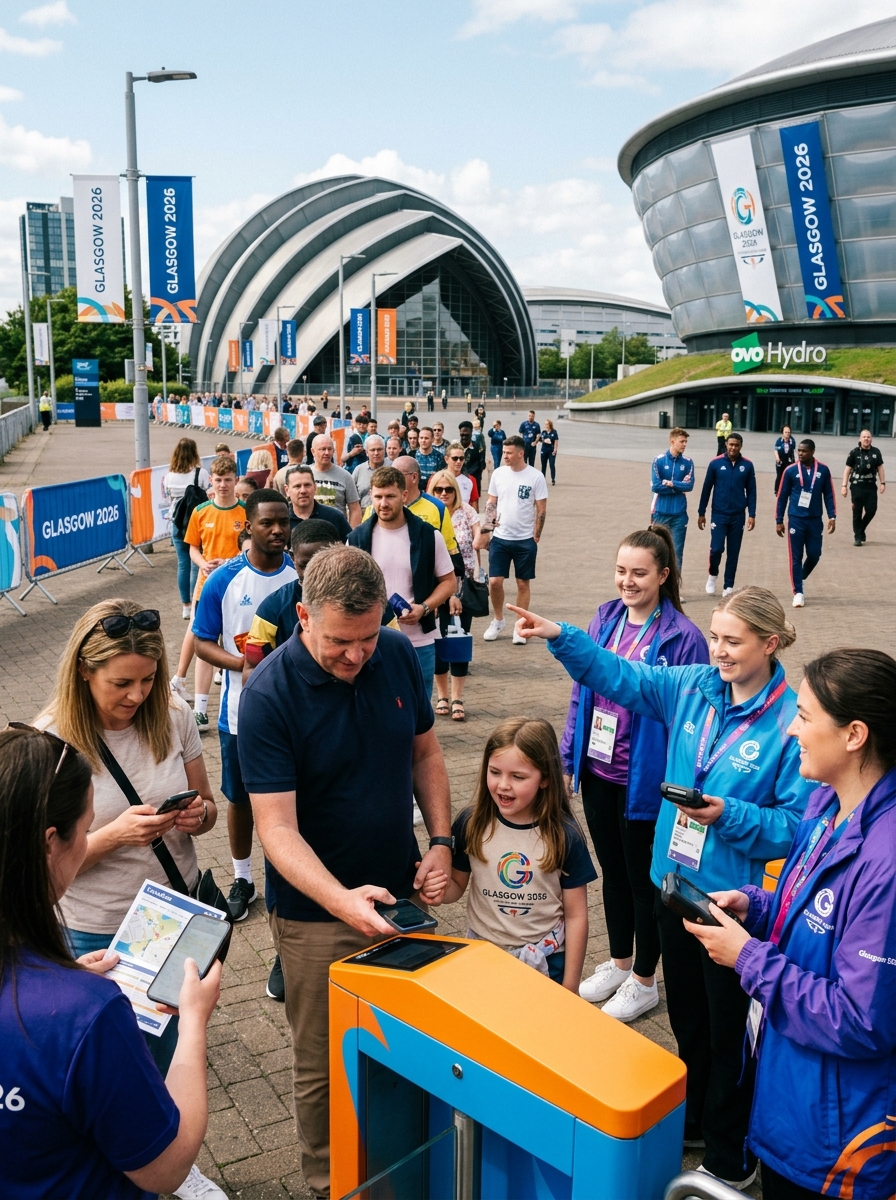
This is audience development in a broader sense. A spectator is no longer only someone who buys a ticket. A spectator may be a child following a baton relay at school, a family attending a cultural event, a volunteer guiding visitors, a local business decorating a shopfront, or a fan watching clips on a phone thousands of miles away. Major events increasingly need all of these people because ticket sales alone cannot define relevance.
Technology is also moving from backstage to center stage. Glasgow 2026 has named Ideagen as its Official AI Technology Principal Partner, a sponsorship that places artificial intelligence, compliance and operational reliability inside the public story of the Games. The announcement did not turn the event into a technology expo, but it reflected a wider reality: modern sports organization depends on invisible systems. Accreditation, safeguarding, venue readiness, medical planning, transport coordination, data security, incident reporting and fan services all depend on technology working under pressure.
The best event technology is often unnoticed. A ticket scans quickly. A volunteer receives the right instruction. A security queue moves safely. Accessibility information is easy to find. A schedule update reaches fans before they leave home. When these systems fail, the failure becomes the story. When they work, the sport remains the story.
Accessibility is part of that same transformation. Glasgow 2026 is promoting an integrated Para sport program and has unveiled medals with Braille and tactile elements, presenting inclusion not only as a message but as a physical experience. For major events, inclusion can no longer be confined to ceremonial language. It must appear in venue design, broadcast production, digital information, medal presentation, transport planning and how stories are told.
The compact venue plan may help. Concentrating events within an eight-mile corridor can reduce travel complexity for spectators, media, officials and athletes. It can also create a denser festival atmosphere, where the city feels animated without building an entirely new urban district. But compactness brings its own test: transport, crowd flow and local services must perform consistently when pressure is concentrated in fewer places.
Glasgow’s approach may appeal to future hosts because it lowers the threshold for staging a major event. The old mega-event model often promised transformation through construction. The new model promises sustainability through reuse, broadcast value and community activation. That may be less spectacular on a skyline, but more realistic for cities worried about cost overruns and public skepticism.
Still, reinvention carries risk. A leaner Games must not feel diminished. A digital Games must not become inaccessible. A community Games must produce lasting benefits, not only promotional moments. A technology-driven Games must protect privacy and reliability. If organizers reduce scale without increasing quality, the audience will notice.
The broader lesson from Glasgow 2026 is that the future of sports events is not simply bigger stadiums or faster streams. It is integration. Live competition, video content, city experience, inclusion, technology and community participation must work together. Fans want convenience, but they also want meaning. They want highlights, but also atmosphere. They want choice, but also shared moments that feel larger than a screen.
For the Commonwealth Games, the stakes are especially high. The event is trying to prove that it can remain relevant after uncertainty over hosting costs and questions about its place in the modern sporting calendar. Glasgow 2026 will not answer every question, but it will provide a visible test of whether a leaner and more audience-focused model can still feel like a major global occasion.
If it succeeds, the legacy may not be a new stadium or a rebuilt district. It may be a new operating manual for multi-sport events: smaller footprint, richer media, stronger community ties, smarter technology and a clearer understanding that the modern audience is not waiting in one place.
The crowd is in the arena, on the street, in the classroom, on the train, on the phone and across the world. The next generation of major sports events will be judged by how well they reach all of them.”””
