
From its modest beginnings in Uruguay to its expanding future in North America, the tournament continues to unite nations, elevate heroes and reshape the business and culture of global sport.
For one month every four years, the world’s most familiar borders are redrawn in color, noise and hope. Streets become watch parties. Offices pause for penalties. Families gather around screens before dawn or deep into the night. Flags hang from balconies, cars and market stalls. The FIFA World Cup is not merely a football tournament; it is a global ritual in which identity, memory and ambition meet on a field of grass.
Its power comes from a rare combination of simplicity and scale. The game itself needs little explanation. A ball, two goals and 90 minutes can carry the dreams of nations large and small. Yet the World Cup surrounds that simplicity with enormous consequence: history, politics, commerce, migration, celebrity, heartbreak and collective joy. No other single-sport event turns so many ordinary people into emotional witnesses of the same drama.
The tournament began in 1930 in Uruguay, a far smaller event than the spectacle the world knows today. Thirteen teams competed in Montevideo, and the host nation defeated Argentina 4-2 in the final. What began as an ambitious international experiment soon became football’s central stage, growing through war, recovery, decolonization, television, satellite broadcasting and the digital age.
Each era has given the World Cup its own mythology. Uruguay’s first triumph gave the tournament a founding legend. Italy’s victories in the 1930s showed how football could become entangled with national image and power. Brazil’s rise in 1958, led by a teenage Pelé, transformed the sport’s imagination and introduced a style associated with rhythm, daring and beauty. England’s 1966 victory remains a national reference point. Argentina’s 1986 campaign, defined by Diego Maradona’s genius and controversy, became one of the most studied performances in sporting history.
The modern tournament has expanded both in geography and meaning. African, Asian, North American and Middle Eastern teams no longer arrive as distant participants in a European-South American contest. They arrive with professional players, tactical sophistication and millions of supporters expecting more than symbolic victories. Morocco’s run to the semifinals in 2022 became a landmark for African and Arab football. Japan, South Korea, Senegal, the United States, Australia and others have shown how the competitive map has widened.
Still, certain names remain central to the World Cup imagination. Brazil carries the weight of five stars and an unmatched association with football artistry. Germany represents resilience, tournament discipline and four championships. Italy, also a four-time winner, embodies defensive culture, tactical intelligence and dramatic reinvention. Argentina combines street football romance with fierce national expectation, from Maradona to Lionel Messi. France has become a modern powerhouse, blending elite academies, immigrant heritage and world-class athleticism. Spain’s 2010 triumph gave international football one of its clearest examples of possession as control and patience as power.
These teams matter not only because they win, but because they give the tournament recurring characters. Every World Cup needs favorites, challengers and outsiders. It needs the pressure on Brazil when the game turns tight, the suspicion that Germany may survive longer than form suggests, the fear of facing France in transition, the emotional gravity that follows Argentina, and the expectation that a smaller nation somewhere will refuse to behave like a guest.
The emotional appeal of the World Cup lies in that uncertainty. Club football may be richer, faster and more tactically polished, but the World Cup offers something different: national compression. Teams have little time to prepare. Players who spend most of the year as club rivals must quickly become brothers. A goalkeeper can become immortal in a shootout. A substitute can change the history of a country. A single mistake can follow a player for life.
For fans, the tournament is often less about analysis than memory. People remember where they were when a goal went in, who they hugged, who cried, what street erupted, what silence followed defeat. In many countries, World Cup matches become generational markers. Parents tell children about tournaments they watched decades earlier. Old clips circulate before new games. The past is never far from the present.
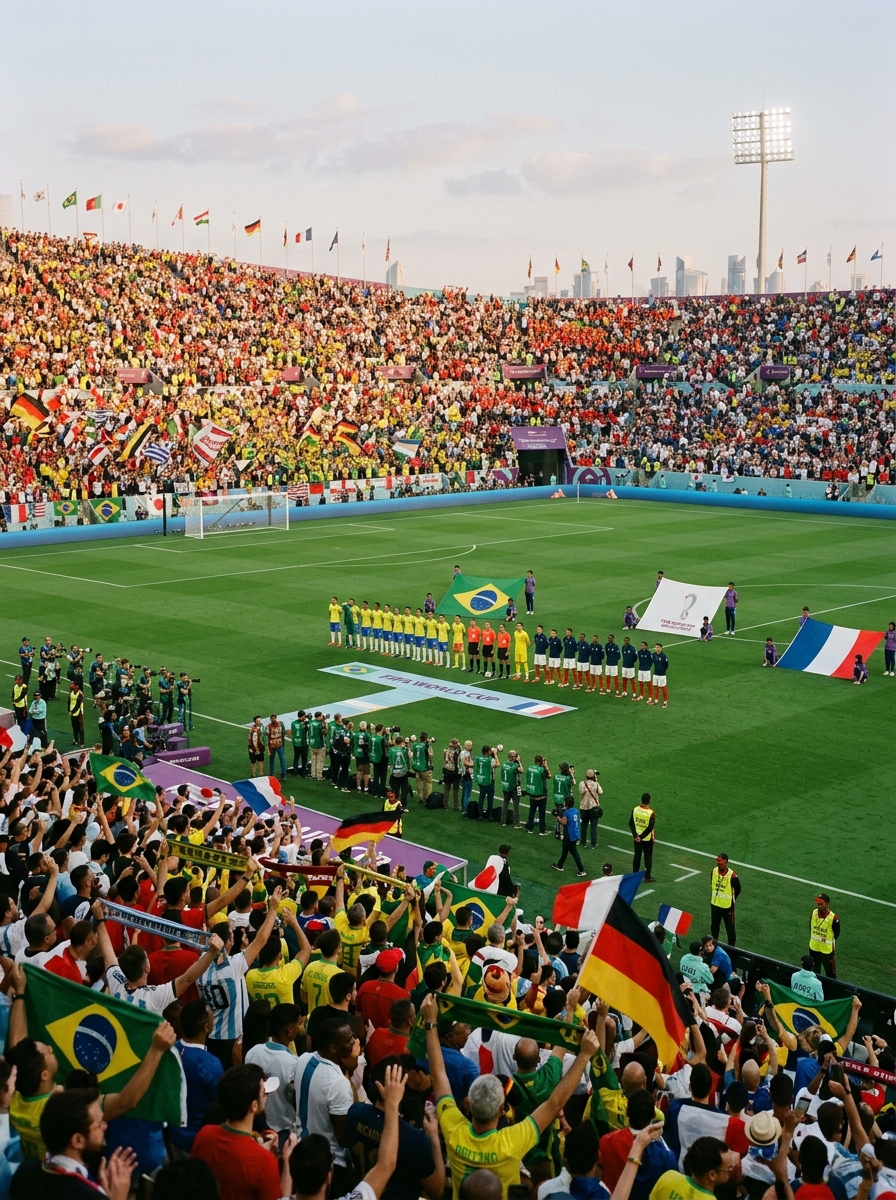
This emotional force explains why the World Cup can affect societies beyond sport. It can briefly unite divided publics, offer diasporas a renewed connection to home, and give small nations visibility they rarely receive on the world stage. A team’s run can change how a country sees itself and how others see it. For players from immigrant families, the tournament can also express layered identities, showing how modern national teams often reflect global movement as much as national tradition.
The World Cup is also a vast economic machine. Host nations spend years preparing stadiums, transport systems, security operations, fan zones and tourism campaigns. Broadcasters, sponsors, airlines, hotels and digital platforms build strategies around the event. FIFA reported that the 2022 tournament in Qatar engaged about five billion people across media and digital platforms, a measure of how far the competition now extends beyond stadium attendance.
That scale brings scrutiny. Every host faces questions about cost, labor, human rights, environmental impact and long-term legacy. Stadiums can become symbols of ambition or waste. Infrastructure can serve citizens for decades or stand as a monument to overspending. The World Cup’s appeal does not erase these debates; it intensifies them because the tournament is so visible. The same global spotlight that celebrates football also exposes political and social choices.
The next edition, in 2026, will push the tournament into another phase. Hosted by Canada, Mexico and the United States, it will feature 48 teams and 104 matches, the largest World Cup in history. The expansion promises broader representation and new opportunities for countries that have struggled to qualify under older formats. It also raises concerns about competitive balance, player workload, travel demands and whether bigger always means better.
For football’s global authorities, the logic is clear: more countries, more matches, more markets and more fans. For supporters in emerging football nations, expansion can mean inclusion and pride. For traditionalists, it risks diluting a tournament whose intensity came partly from scarcity. The 2026 World Cup will test whether the event can grow without losing the sense that every match matters.
Yet the World Cup has survived constant change because its core remains intact. The details evolve: formations, broadcast technology, video review, commercial models and tournament formats. But the central image endures: 11 players in national colors walking into a stadium while millions hold their breath. The game begins, and for a while, the world accepts the same clock.
Its greatest contribution to global sport may be the belief that football belongs everywhere. A child in Lagos, Buenos Aires, Hanoi, Casablanca, Tokyo or Toronto can watch the same tournament and imagine a place inside it. The World Cup turns local dreams into global language. It reminds wealthy football nations that history does not guarantee victory, and smaller nations that one night can alter reputation forever.
That is why the tournament remains more than a championship. It is football’s archive of emotion, a stage for national storytelling and a mirror of a changing world. It produces champions, but also images that outlive results: tears during an anthem, a goalkeeper’s leap, a crowd praying before a penalty, a captain lifting the trophy into falling lights.
As the World Cup moves toward its biggest edition, the challenge is to protect what made it irresistible in the first place. The tournament can expand, commercialize and modernize, but it must still make room for the fragile drama at its heart: a ball crossing a line, a nation erupting, and millions of strangers feeling, for one instant, that football has made the planet smaller.
