
From artificial intelligence and home robots to electric vehicles, smart appliances and new displays, the Las Vegas showcase offers a concentrated view of how consumer technology imagines the future.
LAS VEGAS — Before a device reaches a living room, a car showroom, a hospital, a factory floor or a teenager’s pocket, it often appears first under the bright lights of CES. The annual technology gathering in Las Vegas has become more than a trade show. It is a preview of the near future, a place where companies test not only products but also public appetite, investor confidence and the language that will define the next wave of consumer life.
CES began in 1967 in New York as a consumer electronics exhibition for radios, televisions and audio equipment. Nearly six decades later, it has expanded into a vast map of modern technology. Artificial intelligence, robotics, mobility, health tech, gaming, chips, smart homes, screens, sustainability and digital entertainment now share the same citywide stage. The result is a rare event where a refrigerator, a robotaxi, a transparent television, a wearable health sensor and a generative AI assistant can all represent the same broader story: technology is moving deeper into ordinary life.
That breadth is what makes CES unusual. Other technology events may focus on software, mobile phones, cars or enterprise computing. CES attempts to gather the entire consumer technology landscape in one place. It is not always elegant. The show floor can be overwhelming, crowded and uneven. Some products are polished and ready for market. Others are prototypes designed to attract headlines. But together they reveal where companies believe demand, investment and imagination are heading.
In recent editions, one theme has dominated nearly every category: artificial intelligence. AI is no longer presented only as software inside a computer. It is being embedded into televisions, laptops, cars, headphones, cameras, kitchen appliances, exercise equipment, medical devices and household robots. The promise is that products will become more adaptive, conversational and predictive. A washing machine may learn fabric patterns. A car may anticipate traffic behavior. A television may adjust images in real time. A personal device may summarize messages, translate speech or help organize a day.
The rise of AI has changed the tone of CES. In earlier decades, innovation was often visible through hardware: thinner screens, faster processors, smaller cameras or more powerful speakers. Now, much of the promised magic is invisible, hidden in models, sensors and cloud systems. The product on display may look familiar, but companies say it can understand context, respond naturally and automate tasks. The question for consumers is whether that intelligence creates genuine usefulness or merely adds another layer of complexity.
Robots have become one of the clearest examples of that tension. CES has long displayed robots that dance, wave, deliver drinks or pose for cameras. Today, the ambition is more serious. Companies are showing domestic robots that can clean, carry, monitor, communicate and assist. Humanoid machines and mobile assistants are being pitched for homes, warehouses, hotels, hospitals and elder care. Some remain far from mass adoption, but the direction is clear: robotics is moving from novelty toward service.
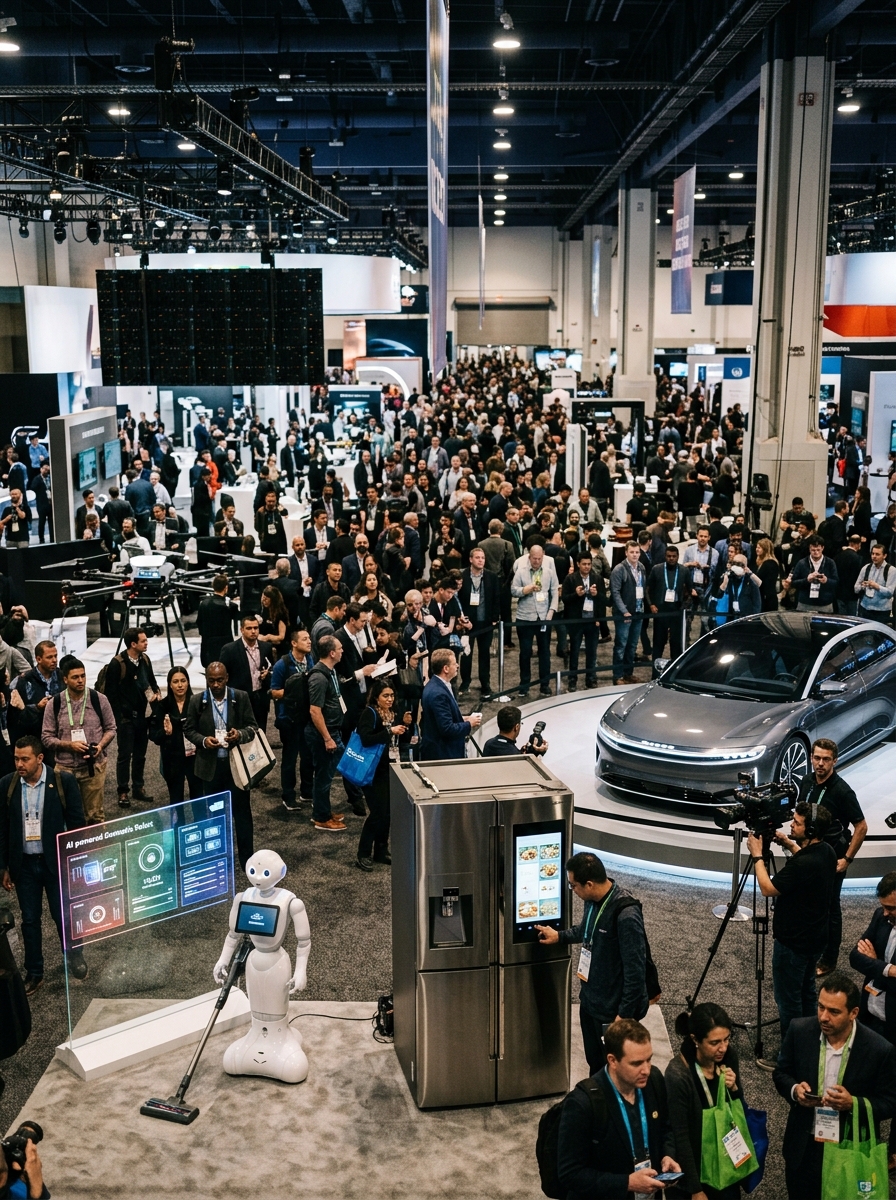
The most convincing robots at CES are often not the most humanlike. A stair-climbing vacuum, an autonomous mobility chair, a delivery bot or a factory assistant may matter more than a machine that resembles a person. The practical question is whether the robot solves a real problem safely and affordably. Can it move through cluttered homes? Can it recognize children, pets and stairs? Can it work reliably without constant human rescue? CES gives companies a stage to answer those questions in public, even if the final answer may come years later.
Smart home technology remains another major pillar. For years, connected homes promised convenience but often delivered fragmented apps, incompatible ecosystems and privacy concerns. The latest generation is trying to become more unified. Companies now speak of homes that can coordinate lighting, security, climate, appliances and energy use through a single intelligent layer. The smart refrigerator, once a symbol of unnecessary excess, is being reimagined as part of a broader domestic system that tracks food, reduces waste and interacts with cooking devices.
Appliances are becoming less passive. Ovens suggest recipes. Air conditioners monitor occupancy and energy demand. Doorbells recognize visitors. Washing machines adjust cycles automatically. Home batteries and solar systems connect with electric vehicles. The home is no longer just a place where gadgets sit; it is becoming a network. That shift creates convenience, but it also raises questions about data. A smart home knows when people sleep, cook, leave, return and consume energy. The more useful it becomes, the more intimate its knowledge becomes.
Electric vehicles and mobility technologies have also transformed CES. What was once primarily an electronics show now functions partly as an auto technology stage. Automakers, chip companies, battery suppliers, mapping firms and autonomous driving startups use the event to present vehicles as rolling computers. The car is no longer just an engine, wheels and seats. It is a software platform, entertainment system, sensor array and data center on the road.
At CES, electric vehicles are displayed not only for range and design, but for intelligence. Companies emphasize driver assistance, cabin screens, voice control, battery efficiency, autonomous systems and over-the-air updates. Robotaxis, delivery vehicles, e-bikes, mobility chairs and drones widen the definition of transportation. The future of mobility shown in Las Vegas is not only about replacing gasoline with batteries. It is about changing how people and goods move through cities.
Displays remain one of CES’s most visually powerful categories. The show has introduced generations of television and screen technology, and the race continues. Ultra-thin OLED panels, transparent displays, rollable screens, high-brightness Mini LED systems, advanced projectors and immersive gaming monitors compete for attention. The display is still the most immediate way for consumers to feel technological progress. A brighter screen, a disappearing bezel or a wall-sized image can communicate innovation faster than a technical specification.
Yet even screens now reflect a broader shift. They are becoming flexible, ambient and integrated into architecture. A display may be a television, a dashboard, a mirror, a window or a workplace surface. In cars, screens define the cabin. In homes, they blend entertainment with communication and control. In wearable devices, they shrink into glasses or disappear entirely behind voice and AI interfaces. CES shows that the screen is not vanishing; it is multiplying into new forms.
The show’s appeal also comes from uncertainty. Not every dazzling product becomes a success. CES history is filled with inventions that arrived too early, solved problems few people had, or collapsed under price, regulation or consumer indifference. The event is a launchpad, not a guarantee. For every technology that shapes the decade, many others remain curiosities in photo galleries and archived press releases.
That uncertainty is part of the value. CES exposes the gap between possibility and adoption. A robot may impress journalists but fail in a crowded kitchen. A smart appliance may offer useful features but cost too much. A new electric vehicle may look ready for the future but face manufacturing delays. An AI assistant may sound helpful until users worry about surveillance. The show is where optimism meets the first hard questions.
For startups, CES can be transformational. A small company in Eureka Park can find investors, distributors, journalists and partners in a matter of days. A booth can turn an obscure prototype into a global headline. But the pressure is intense. Startups must explain why their invention matters in seconds, often beside larger competitors with enormous marketing budgets. The event rewards clarity as much as engineering.
For major corporations, CES is a statement of direction. A keynote or booth is not only about a product line; it signals strategy. A chipmaker may show how AI will run on devices instead of only in data centers. A car company may position itself as a software company. A television manufacturer may become a smart home platform. A home appliance brand may present itself as a robotics company. CES reveals how industries are blurring.
For consumers watching from afar, the practical lesson is caution mixed with curiosity. The future on display in Las Vegas rarely arrives all at once. It arrives unevenly, through cheaper sensors, better chips, stronger batteries, improved software and changing habits. Today’s strange prototype can become tomorrow’s normal household object. But the reverse is also true: not every futuristic product deserves a place in daily life.
The deeper story of CES is not gadgets alone. It is the changing relationship between people and technology. Devices are becoming more personal, more predictive and more connected. Cars are becoming computers. Homes are becoming data environments. Robots are entering spaces once reserved for humans. Screens are surrounding work, travel and entertainment. AI is becoming the invisible layer beneath it all.
That future brings promise. Technology can assist the elderly, reduce energy waste, improve mobility, detect health risks, translate languages and make daily tasks easier. It also brings risk: surveillance, dependency, electronic waste, cybersecurity threats and widening inequality between those who can access advanced tools and those who cannot.
CES endures because it concentrates those hopes and doubts in one place. It is a showroom, marketplace, theater, laboratory and warning sign. Walking through its halls, one sees not a single future but many competing futures, each asking to be believed.
The most important products at CES are not always the flashiest. They are the ones that survive beyond the booth, solve real problems and earn a place in ordinary routines. The event’s true power lies in that moment before adoption, when technology first steps into public view and the world begins deciding whether it belongs.
