
At the 2026 edition of the world’s largest connectivity gathering, mobile technology moved beyond faster devices and into a new era shaped by AI, 5G-Advanced, early 6G research, wearables, satellite links and smarter telecom infrastructure.
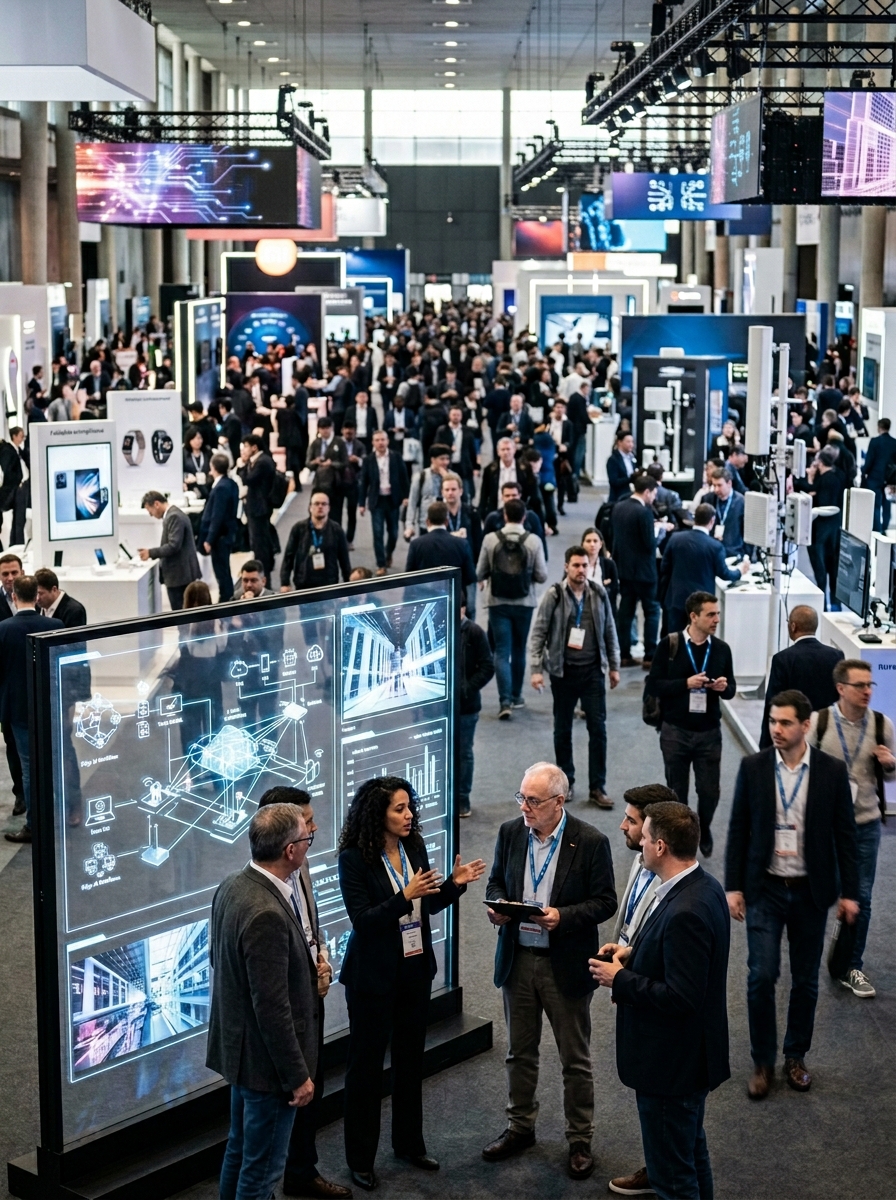
BARCELONA — At MWC Barcelona 2026, the smartphone was still everywhere: folded behind glass, tested under bright exhibition lights, held up by executives, photographed by analysts and handled by visitors moving through the halls of Fira Gran Via. But the larger story of the event was no longer only about the next handset. It was about what the handset connects to, what intelligence it carries, and how the network around it is being rebuilt.
Held from March 2 to 5, 2026, MWC Barcelona gathered the global mobile industry at a moment when connectivity is becoming less visible but more central to daily life. Phones, watches, glasses, cars, factories, satellites, data centers and artificial intelligence systems are increasingly part of the same technological conversation. The old question was whether a device could connect. The new question is what it can understand, decide and coordinate once connected.
The GSMA framed this year’s event around “The IQ Era,” a phrase that captured the industry’s shift from bandwidth to intelligence. For more than a decade, mobile conferences were dominated by the race from 3G to 4G and from 4G to 5G. In 2026, the debate became more layered. Operators and equipment makers still spoke about speed, capacity and spectrum, but they also spoke about automation, security, edge computing, private networks, digital twins, satellite integration and AI-native infrastructure.
The smartphone remains the public face of this transformation. Manufacturers used the Barcelona stage to show slimmer foldables, brighter displays, better sensors, longer-lasting batteries and cameras increasingly supported by on-device AI. The most important upgrades, however, were not always visible from the outside. New chips promised faster neural processing. Software assistants were presented as more personal, more predictive and more capable of performing tasks across apps. The phone was being redesigned as a pocket computer that does not merely respond to commands, but anticipates context.
That change carries both opportunity and concern. AI on the phone can summarize messages, translate conversations, organize images, generate text, improve accessibility and process some sensitive data without sending everything to the cloud. For users, this could mean faster responses and greater privacy. For companies, it creates a new competitive arena in which hardware, operating systems, cloud services and AI models must work together. But it also raises questions about consent, accuracy, manipulation and who controls the personal data that makes such systems useful.
Wearables added another dimension. Smartwatches, health bands, rings, glasses and hearable devices are no longer accessories in the narrow sense. They are becoming continuous sensors for the human body and environment. At MWC, the wearable category reflected the industry’s growing interest in health monitoring, spatial computing, fitness analytics, payment authentication and hands-free communication. The smaller the device, the more intimate the data it collects. That makes trust as important as design.
The rise of AI glasses and lightweight connected devices also suggested that the phone may not always remain the only screen at the center of mobile life. Instead, the smartphone may become a hub, coordinating nearby devices that listen, see, measure and respond. This is the broader meaning of smart connectivity: intelligence distributed across many objects, but linked through mobile networks and cloud-edge infrastructure.
For telecom operators, that future depends on completing the unfinished work of 5G. Many consumers experience 5G mainly as faster mobile broadband, but the industry’s more ambitious vision requires standalone 5G networks, network slicing, low latency, stronger uplink performance and programmable interfaces. Without those capabilities, advanced services such as industrial automation, real-time remote control, immersive media and guaranteed enterprise connectivity remain harder to scale.
That is why 5G-Advanced occupied such an important place in Barcelona. It is not a marketing bridge to 6G, but a practical attempt to make current networks smarter and more efficient. Operators are looking for ways to monetize 5G beyond ordinary data plans. Enterprises want reliable private networks for factories, ports, mines, campuses and logistics centers. Governments want resilient infrastructure. Consumers want coverage that works not only in city centers, but also in trains, stadiums, basements and rural areas.
The next step, 6G, was present mostly as research, prototypes and strategic language rather than commercial reality. But it already shaped the conversation. The industry’s early 6G vision includes AI-native networks, integrated sensing and communication, energy efficiency, higher frequencies, digital twins and tighter links between terrestrial networks and satellites. If 5G connected people and machines more densely, 6G is being imagined as a system that can also sense the physical world and adapt to it.
Satellite connectivity was one of the clearest signs that the boundary of mobile networks is expanding. Non-terrestrial networks, direct-to-device links and low-Earth-orbit satellite services are becoming part of mainstream telecom planning. The goal is not to replace ground networks, but to fill gaps where towers are unavailable or damaged: oceans, mountains, remote communities, disaster zones and logistics routes. In Barcelona, satellite was not presented as a distant niche. It was part of the future coverage map.
The telecom network itself is also being transformed by AI. Operators face rising data demand, energy costs, cybersecurity threats and pressure to deliver more specialized services. AI can help plan radio networks, predict failures, optimize energy use, detect fraud, manage traffic and automate customer support. But an AI-native network is not simply a network with a chatbot attached. It requires data governance, explainable systems, secure interfaces and human oversight.
The security challenge was never far from the exhibition floor. As more devices connect and more decisions are automated, the attack surface expands. Connected cars, smart homes, industrial sensors, health wearables and mobile payment systems all depend on trust. A compromised network is no longer just a communications problem. It can become a safety, financial or public infrastructure problem. That is why digital safety, identity, fraud prevention and secure AI moved from specialist panels into the center of the mobile industry’s agenda.
MWC also showed how mobile technology now reaches far beyond mobile companies. Automotive groups, cloud providers, chipmakers, banks, health technology firms, media companies, robotics startups and public officials all had reasons to be in Barcelona. Connectivity has become a layer beneath nearly every industry. A factory wants private 5G. A hospital wants secure remote monitoring. A city wants smart traffic systems. An airport wants biometric identity, autonomous logistics and real-time passenger flow data. A sports venue wants immersive fan experiences and reliable networks under peak demand.
Startups brought a different kind of energy. At 4YFN, the startup platform co-located with MWC, founders presented ideas in AI services, enterprise software, fintech, health technology, robotics, climate tools and next-generation devices. Their presence reflected a central truth of the modern mobile economy: innovation no longer flows only from large telecom vendors to consumers. It also comes from smaller companies building applications on top of networks, APIs and AI platforms.
The commercial mood in Barcelona was therefore both optimistic and cautious. The industry sees enormous opportunity in AI and intelligent connectivity, but it also faces capital constraints, regulatory debates and uneven consumer willingness to pay. Building smarter networks is expensive. Making AI trustworthy is difficult. Turning technical capability into sustainable revenue remains one of the hardest problems in telecom.
For the average user, many of the ideas shown at MWC will arrive quietly. A future phone may hold signal better in a crowded station, translate a call more naturally, summarize a day of messages, connect through satellite in an emergency, monitor health signs through a wearable and interact with vehicles, homes and offices without obvious friction. The user may not know whether the improvement came from a chip, a modem, an AI model, a 5G-Advanced feature, a cloud edge node or a new telecom API. The best connectivity often disappears into reliability.
That is the paradox of MWC Barcelona. It is a loud, crowded, highly visible event devoted to technologies that become most valuable when they feel invisible. The booths are bright, the announcements are polished, and the competition is intense. But the real ambition is quieter: to build a world in which people, machines and services can communicate instantly, safely and intelligently almost anywhere.
By the time the halls emptied on the final day, the message of MWC 2026 was clear. The mobile industry is no longer defined only by the phone in the hand. It is defined by the intelligence around that phone: the network that supports it, the AI that interprets it, the satellites that extend it, the wearables that surround it, and the services that turn connection into action.
Barcelona once again served as the meeting point for that future. The next era of mobility will not be measured only in download speeds. It will be measured in trust, resilience, autonomy, accessibility and the ability of connected technology to solve real problems without becoming another source of complexity. At MWC, the race was not just to make the world faster. It was to make it smarter.
