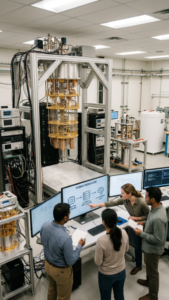
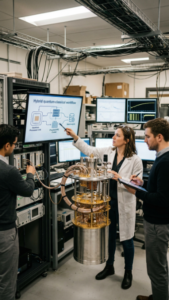
Once treated as a distant scientific bet, quantum computing is entering a more practical phase as researchers target materials, medicine, optimization, security and complex simulations.
Quantum computing has spent years living between two extremes. To enthusiasts, it is the machine that could transform chemistry, medicine, finance and cybersecurity. To skeptics, it is a fragile laboratory technology whose promises have often run ahead of its performance. In 2026, the truth is beginning to look more complicated and more interesting: quantum computing is not yet a general-purpose replacement for classical computers, but it is moving closer to solving specific problems that ordinary machines struggle to handle.
The shift is not about quantum laptops or consumer devices. It is about specialized systems that work alongside supercomputers, artificial intelligence tools and classical processors. IBM calls this direction quantum-centric supercomputing, a model in which quantum computers handle parts of a problem that are naturally quantum or mathematically difficult, while conventional high-performance computers process data, manage workflows and correct errors. The result is not a single magic machine, but a hybrid computing stack designed for scientific and industrial problems.
IBM has publicly said that 2026 could bring the first examples of quantum advantage, the point at which a quantum computer solves a problem better than the best classical-only methods. The company’s roadmap describes IBM Quantum Nighthawk as a platform for exploring that goal before large-scale fault-tolerant quantum computing arrives. Its 2026 plans include deeper integration between quantum and classical resources, better tools for monitoring and debugging hybrid workloads, and continued work on error mitigation and real-time error correction.
That language matters because it is more careful than earlier waves of quantum hype. The near-term claim is not that quantum computers will instantly break every code, discover every drug or replace every supercomputer. The claim is narrower: certain workloads may soon show measurable value when quantum processors are combined with classical systems. In a field where error rates, scaling and verification remain difficult, that distinction is essential.
The strongest case for quantum computing begins with nature itself. Molecules, atoms and materials already obey quantum rules. Classical computers can approximate those rules, but the calculations become extremely difficult as systems grow larger and interactions become more complex. This is why materials science and chemistry remain central to the quantum story. Better simulations could help researchers design improved batteries, catalysts, superconductors, fertilizers, semiconductors and industrial chemicals.
Drug discovery is another major target. Developing a medicine can take more than a decade and cost billions of dollars, with many candidates failing before approval. Quantum computing may eventually help simulate molecular interactions more accurately, identify promising compounds earlier, improve protein modeling and optimize clinical trial design. Recent research in quantum-assisted drug discovery points to the potential of combining quantum methods with machine learning and classical simulation across the pharmaceutical pipeline.
The promise is especially attractive because artificial intelligence, despite its recent breakthroughs, still depends heavily on data. AI can detect patterns, predict properties and accelerate screening, but it may struggle when training data are limited or when the key behavior depends on quantum-level interactions. Quantum computers, if scaled and corrected, could offer a different strength: calculating physical behavior from first principles. In the best future version, AI helps guide the search, classical computers handle large-scale processing, and quantum processors solve the hardest molecular pieces.
Optimization is a third area of interest. Airlines, ports, factories, energy grids, financial firms and logistics companies constantly face problems involving many possible combinations. Which route saves fuel? Which portfolio balances risk? Which factory schedule reduces delays? Which supply chain plan survives disruption? Classical algorithms already do much of this work well, and many so-called quantum optimization claims remain experimental. But the possibility that quantum or quantum-inspired methods could improve certain complex decisions keeps governments and companies investing.
Security gives quantum computing its most urgent public relevance. A sufficiently powerful fault-tolerant quantum computer could threaten widely used public-key encryption systems. Such machines are not known to exist today, but the risk is serious enough that security agencies and standards bodies are already acting. The concern is not only future hacking. It is also “harvest now, decrypt later,” in which attackers collect encrypted data today and wait for future quantum machines to decode it.
That is why post-quantum cryptography has moved from theory into implementation. In 2024, the U.S. National Institute of Standards and Technology released its first finalized post-quantum encryption standards, designed to protect digital information against future quantum attacks. For banks, governments, hospitals, cloud companies and telecom providers, the migration will take years because cryptography is deeply embedded in software, hardware, identity systems and long-lived data archives.
This security race shows a paradox at the heart of quantum computing. The technology does not have to be commercially mature to force real-world change. Even the credible possibility of future quantum attacks is already changing cybersecurity planning. Enterprises that wait until a cryptographically relevant quantum computer is announced may find that migration takes longer than the warning period available.
Still, the field faces hard engineering problems. Qubits are delicate. They lose information through noise, heat, vibration and unwanted interactions with their environment. Error correction requires many physical qubits to create more reliable logical qubits. Scaling from impressive laboratory demonstrations to dependable industrial systems will require better hardware, better fabrication, faster control electronics, improved algorithms and rigorous verification against classical methods.
This is why 2026 should be seen as a transition year rather than a finish line. The industry is moving from “Can quantum computers do anything interesting?” toward “Which problems can they improve, under what conditions, and how can results be verified?” The answer will likely vary by field. Some chemistry and physics simulations may show value earlier than broad business optimization. Cybersecurity preparation is already practical. Large-scale fault-tolerant machines remain a longer-term goal.
For the public, the best way to understand quantum computing is not as faster computing, but as different computing. A quantum computer is not simply a supercomputer with more speed. It uses qubits, superposition and entanglement to represent and manipulate information in ways that can be powerful for some problems and useless for others. It will not make email faster or spreadsheets better. It may, however, help answer questions about molecules, materials and mathematical structures that overwhelm classical approaches.
The business implications are becoming clearer. Pharmaceutical companies, chemical manufacturers, automakers, banks, aerospace firms and national laboratories do not need to own quantum computers immediately to begin preparing. They can identify problems that might benefit from quantum methods, train developers, test cloud-based quantum systems, build partnerships and begin post-quantum security migration. The winners may not be those who make the boldest predictions, but those who learn early where quantum fits into real workflows.
For video creators and educators, quantum computing is a rare technology story that combines mystery with practical stakes. The subject can be explained through everyday consequences: better batteries, faster drug research, safer encryption, smarter logistics and more accurate simulation of the natural world. But responsible storytelling must also explain what is not here yet. Quantum computers remain specialized, error-prone and expensive. The most credible message is not that quantum will change everything tomorrow, but that the foundations for useful quantum systems are becoming more concrete.
The field’s next phase will likely be defined by proof, not promise. Researchers will need to show where quantum systems outperform classical alternatives, how those results can be repeated, and whether the advantage matters outside a benchmark. Companies will need to separate scientific milestones from marketing. Governments will need to support research while preparing security infrastructure. Universities will need to train a workforce that understands physics, computer science, engineering and applied mathematics.
Quantum computing is moving closer to reality because the conversation is becoming more specific. The focus is shifting from science-fiction claims to measurable workloads, hybrid systems, error correction, cryptographic migration and industry pilots. That does not make the challenge smaller. It makes the path more visible.
The most realistic future is not a world where quantum computers replace classical computers. It is a world where quantum processors become part of a larger computing ecosystem, used when the problem demands the strange rules of quantum mechanics. If 2026 delivers even the first verified examples of that advantage, the technology will no longer be only a promise. It will become a new tool for solving some of the hardest problems in science and industry.