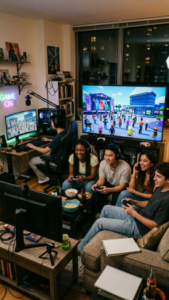
As games evolve into social networks, concert venues, creator economies and brand platforms, the industry is redefining what it means to gather online.
The next entertainment hub may not look like a television channel, a movie studio or a social media feed. It may look like a game lobby, where friends talk before a match, a virtual concert opens after sunset, a creator launches a new island, and a brand tests a story world before it appears on screen.
Gaming has moved far beyond the old image of a solitary player facing a console. It is becoming a social infrastructure for entertainment, especially among younger audiences who treat games not only as competitions but as places to meet, watch, build, shop and perform identity. The shift is visible in Roblox, Fortnite, Minecraft, Discord-connected communities, live-streaming platforms and mobile multiplayer spaces where the boundary between game, social network and media channel is increasingly difficult to draw.
The business case is clear. Newzoo estimated that the global games market would reach about $189 billion in 2025, a figure that places gaming among the world’s central entertainment industries. But revenue alone does not explain the cultural change. The more important development is that games are absorbing behaviors once associated with separate platforms: messaging, video viewing, fandom, user-generated content, virtual events, influencer marketing and digital commerce.
For media companies, that makes games less like a content category and more like a destination layer. A film can become an in-game event. A music release can become a playable world. A sports brand can become an avatar item. A television franchise can become a persistent social space. In this model, the game is not only something audiences consume. It is where audiences assemble.
Deloitte’s 2025 Digital Media Trends report described a broader entertainment market disrupted by social platforms, creators, user-generated content and more advanced recommendation systems. Gaming sits at the intersection of those forces. It is interactive by design, social by habit and increasingly dependent on creator communities that produce a constant stream of new experiences. Where traditional entertainment often asks viewers to sit back, games ask users to participate.
Roblox is one of the clearest examples. The company has described its platform as a place that brings people together through shared experiences, and its scale shows why media brands pay attention. In Q3 2025, Roblox reported 151.5 million daily active users, 39.6 billion hours engaged, 3.5 million developers creating immersive content and hundreds of millions of dollars in quarterly developer exchange distributions. Those numbers suggest a platform that functions less like a single game and more like a social operating system for play.
Yet Roblox also illustrates the risks of becoming a social hub. In Q1 2026, the company reported 132 million daily active users, with growth pressured by safety measures including age verification and communication restrictions. The slowdown showed that gaming platforms face many of the same governance questions as social networks: how to protect minors, verify age, moderate user-generated content, prevent exploitation and preserve trust without damaging engagement.
Fortnite has followed a different but related path. What began as a battle royale phenomenon has become a broader entertainment ecosystem, combining competitive play, user-created islands, Lego experiences, music events and major brand collaborations. Disney and Epic Games have framed their partnership as an effort to build a new kind of digital entertainment universe, one in which fans can play, watch, create and connect. The language matters because it points to a future in which entertainment franchises are not simply released to audiences but inhabited by them.
The Star Wars collaborations inside Fortnite show how this model works. A franchise once distributed through films, television, toys and theme parks can now appear as playable missions, character skins, virtual watch parties and creator-built islands. For fans, the experience is not limited to watching a story unfold. They can move through it with friends, perform within it as avatars and share clips that circulate on social media. That loop turns gaming into both a destination and a distribution engine.
Live streaming deepens the transformation. YouTube Gaming reached a reported 8.8 billion hours watched in 2025, according to Stream Hatchet, while Twitch, TikTok and other platforms continue to turn game play into mass entertainment. The viewer of a game stream may not be playing at all. They may be watching a creator, chatting with a community, following an esports event or treating the stream like background television. Gaming therefore competes not only with other games but with Netflix, YouTube, sports broadcasts and social media.
This is why advertisers and entertainment companies increasingly view games as culture-building environments. In a traditional ad campaign, a brand buys attention around content. In a game world, the brand can become part of the content itself. A sneaker can become an avatar item. A movie premiere can become a quest. A theme park can become a limited-time experience. A musician can appear as a virtual performer whose concert is also a social gathering and a shareable event.
For players, the appeal is often social first. The Entertainment Software Association’s 2025 data showed video games are played across generations, with more than 205 million Americans playing and many using games to connect with family and friends. This challenges the older assumption that gaming is separate from social life. For many players, especially teenagers and young adults, the game is where social life happens.
The change is especially important because social media itself is under pressure. Concerns over mental health, misinformation, algorithmic addiction and child safety have made platforms such as Instagram, TikTok and Snapchat more politically sensitive. Games are not free from those concerns, but they offer a different social architecture. Communication is often built around shared activity rather than passive scrolling. Friends do not only exchange messages; they complete missions, build environments, compete, cooperate and perform together.
That does not make games safer by default. Harassment, scams, grooming, toxic speech, gambling-like mechanics, dark patterns and excessive monetization remain serious concerns. As gaming becomes more social, regulators are likely to treat major platforms more like online services with obligations around safety, transparency and age-appropriate design. The same qualities that make gaming powerful as entertainment — immersion, persistence, identity and peer connection — can also make harms more intense.
Creator economies add another layer of complexity. Platforms such as Roblox and Fortnite increasingly depend on independent developers who build games within games. That expands variety and keeps users engaged, but it raises questions about labor, revenue sharing, discoverability and platform power. A successful creator can build a business inside a game ecosystem, but the rules of that business are controlled by the platform owner. Changes to algorithms, payout formulas or moderation policies can alter livelihoods quickly.
For Hollywood, gaming’s rise as an entertainment hub offers both opportunity and threat. Studios have long treated games as licensing extensions, often tied to blockbuster releases. That approach is becoming outdated. Younger audiences may encounter a franchise first through a game world, a streamer or a creator-built experience rather than a film or television episode. Intellectual property is becoming spatial, social and interactive. The strongest franchises may be those that can live across screens, controllers and communities without losing their identity.
Music faces a similar shift. Games can host concerts, launch tracks, sell virtual merchandise and extend fan communities beyond streaming platforms. A song can become part of a dance emote, a world theme, a creator challenge or a live event. For artists, that creates new exposure and revenue opportunities. It also changes the meaning of performance, making it less tied to physical venues and more tied to digital presence.
The next phase of gaming will likely be shaped by artificial intelligence, cloud infrastructure and cross-platform identity. AI can help generate dialogue, environments, moderation tools and personalized missions. Cloud systems can make high-end experiences available across more devices. Persistent avatars and interoperable commerce may allow users to carry identity across different spaces, though true interoperability remains more ambition than reality.
The central question is whether gaming can become a healthier social network than the platforms that preceded it. The answer will depend on design choices, business incentives and regulation. If engagement is pursued at any cost, games may reproduce the worst problems of social media in more immersive form. If safety, creativity and fair economics are built into the foundation, games could become one of the most important cultural gathering places of the next decade.
Gaming is no longer merely competing for leisure time. It is competing to become the place where entertainment happens. In that shift, the game is not just the product. It is the stage, the mall, the club, the cinema, the playground and the social network, all compressed into a world that players can enter together.