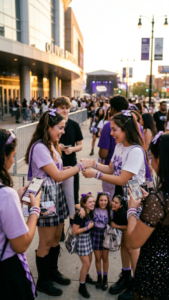
From outfit tracking to fan accounts, merch drops and meetups, modern fandom has become an everyday social ecosystem — and Olivia Rodrigo’s fans show how pop culture now doubles as community infrastructure.
The old image of a fan was simple: someone bought a record, watched a film, wore a T-shirt, maybe waited outside a venue. Today, fandom is no longer a side activity attached to entertainment. For millions of young people, it is a daily rhythm, a social identity and, increasingly, a lifestyle.
A fan does not merely listen to a song. She studies the lyrics for clues, compares stage outfits, decodes music video imagery, saves screenshots, joins group chats, edits TikToks, runs an update account, buys limited merch, plans a concert outfit and meets strangers who may quickly become friends. What used to be private admiration has become a visible, participatory culture — part media literacy, part emotional support network, part fashion movement, part volunteer newsroom.
This shift is especially clear in pop music, where the relationship between artist and audience now extends far beyond an album cycle. Olivia Rodrigo’s fans, widely known as Livies, offer a recent example of how a fandom can operate as a space of emotional recognition and community building. Rodrigo’s songs about heartbreak, insecurity, anger and growing up have attracted listeners who often describe the music not only as entertainment, but as a vocabulary for feelings they were already carrying.
Around that music, fans have built an ecosystem. Some track Rodrigo’s outfits with the precision of fashion archivists, identifying dresses, shoes, bags and jewelry from paparazzi photos, red carpet appearances and tour performances. Others run update accounts that collect announcements, clips, chart news, charity efforts and fan projects. Some make lyric edits, friendship bracelets and handmade posters. Others organize listening parties, watch parties and meetups around concerts or streaming events.
The result is a fandom that behaves less like a passive audience and more like a decentralized community. Its members create information, circulate style cues, preserve memories and establish rituals. A purple outfit at a concert, a carefully chosen lyric caption, or a piece of merch becomes more than consumer behavior. It becomes a signal: I am part of this emotional world, and I recognize you as part of it too.
Digital platforms have accelerated that transformation. TikTok, Instagram, X, YouTube and Discord allow fans to gather without waiting for a magazine cover, television interview or official press release. Every public appearance can become an event. Every lyric can become a theory. Every color palette can become a dress code. In this environment, fandom is not confined to the moment a song is playing. It continues through scrolling, posting, commenting, saving, editing and sharing.
That constant participation helps explain why fan accounts have become important cultural actors. Many are run by young people with no formal media training, yet they perform work that resembles journalism, archiving, branding and community management. They verify images, credit photographers, translate news, explain references and direct followers toward official releases. In fast-moving fandoms, a well-run fan account can become a trusted hub, especially for international fans who may not have easy access to events in Los Angeles, London or New York.
There is also an emotional economy at work. Pop fandoms thrive when fans feel seen — by the artist, by the music and by one another. Rodrigo’s songwriting has been particularly effective in this respect because it often treats adolescent and early adult emotions as serious rather than disposable. Songs such as “drivers license,” “traitor,” “vampire” and “teenage dream” invite listeners into feelings of betrayal, longing, rage and uncertainty without smoothing them into easy lessons. That emotional directness gives fans material to process their own lives collectively.
This is where fandom becomes lifestyle. It shapes how fans dress, speak, decorate rooms, spend weekends, form friendships and understand themselves. A concert is not just a concert. It is the endpoint of months of preparation: saving money, studying the set list, planning an outfit, arranging transport, making bracelets, coordinating with online friends and documenting the night in real time. For those who cannot attend, the experience may be recreated through livestream clips, concert films, fan videos and watch parties.
Rodrigo’s GUTS World Tour sharpened this pattern. The tour became not only a live music event but a visual and social template. Fans arrived in purple, glitter, bows, boots, plaid skirts, homemade tops and lyrics turned into wearable slogans. The style echoed Rodrigo’s own mixture of pop-punk references, Y2K nostalgia and teenage diary aesthetics. For many fans, dressing for the show was not imitation alone. It was participation in a shared visual language.
Merchandise plays a complicated role in that language. On one level, merch is commerce: hoodies, vinyl, posters, tote bags, charms and limited items that turn fandom into revenue. On another level, it functions as belonging. A tour shirt can mark attendance, but it can also become a portable memory, a conversation starter and a badge of identity. In fan communities, objects are rarely just objects. They carry stories about where they were bought, who stood in line, who helped secure them and what era of the artist’s life they represent.
The same is true of easter eggs and theories. Artists and marketing teams now understand that fans enjoy decoding. A date, color, symbol, font, accessory or caption can produce hours of speculation. This can be playful, but it also changes the labor of fandom. Fans become analysts of branding, narrative and timing. They learn to read pop culture as a puzzle. In return, they receive the pleasure of discovery and the status that comes from noticing something first.
Yet fandom as lifestyle is not without pressure. The same systems that create connection can create exhaustion. Fans may feel compelled to stay online so they do not miss an announcement or inside joke. Update accounts can become unpaid, high-stress operations. Younger fans may face pressure to buy merch, attend multiple shows or prove devotion through constant posting. Algorithms reward speed, intensity and emotional performance, which can turn joy into obligation.
There are also risks of conflict. Online fandoms can become defensive, competitive or hostile, especially when chart positions, award campaigns, dating rumors or perceived criticism are involved. The closeness fans feel to an artist can blur boundaries. A healthy fandom offers community; an unhealthy one can demand loyalty tests. For artists, the challenge is to benefit from fan energy without encouraging surveillance, overconsumption or harassment.
Still, the durability of modern fandom suggests that it meets real social needs. In an era when many young people experience loneliness, economic uncertainty and fragmented public life, fandom offers structure. It gives people scheduled moments to anticipate: release nights, tour dates, livestreams, interviews, anniversaries and fan projects. It provides roles: editor, translator, organizer, stylist, collector, theorist, photographer, meme maker. It allows fans to contribute according to their skills and be recognized for doing so.
Rodrigo’s fandom is notable because much of its energy is grounded in emotional identification rather than spectacle alone. The community forms around the feeling that private confusion can be made public without shame. Fans may arrive because they love a chorus, but they often stay because they find people who understand why the chorus matters.
This does not mean fandom should be romanticized as pure solidarity. It remains tied to corporate platforms, music industry marketing and consumer culture. The fan who finds comfort in a song is also being addressed as a customer. The fan who builds community on social media is also producing engagement for platforms. The fan who tracks an outfit may be celebrating style while feeding an attention economy that rarely turns off.
But dismissing fandom as irrational devotion misses the larger story. Contemporary fandom is one of the clearest examples of how culture is lived now: collectively, visually, digitally and emotionally. It is where young people practice identity, creativity, interpretation and belonging. It is where music becomes fashion, where lyrics become social language, where merchandise becomes memory and where strangers become community.
For Livies and many other fan groups, the artist is only the starting point. The deeper attachment is often to the world fans build around the artist — the group chats, accounts, inside jokes, rituals, shared aesthetics and mutual care. The song may last three minutes. The lifestyle around it can last years.