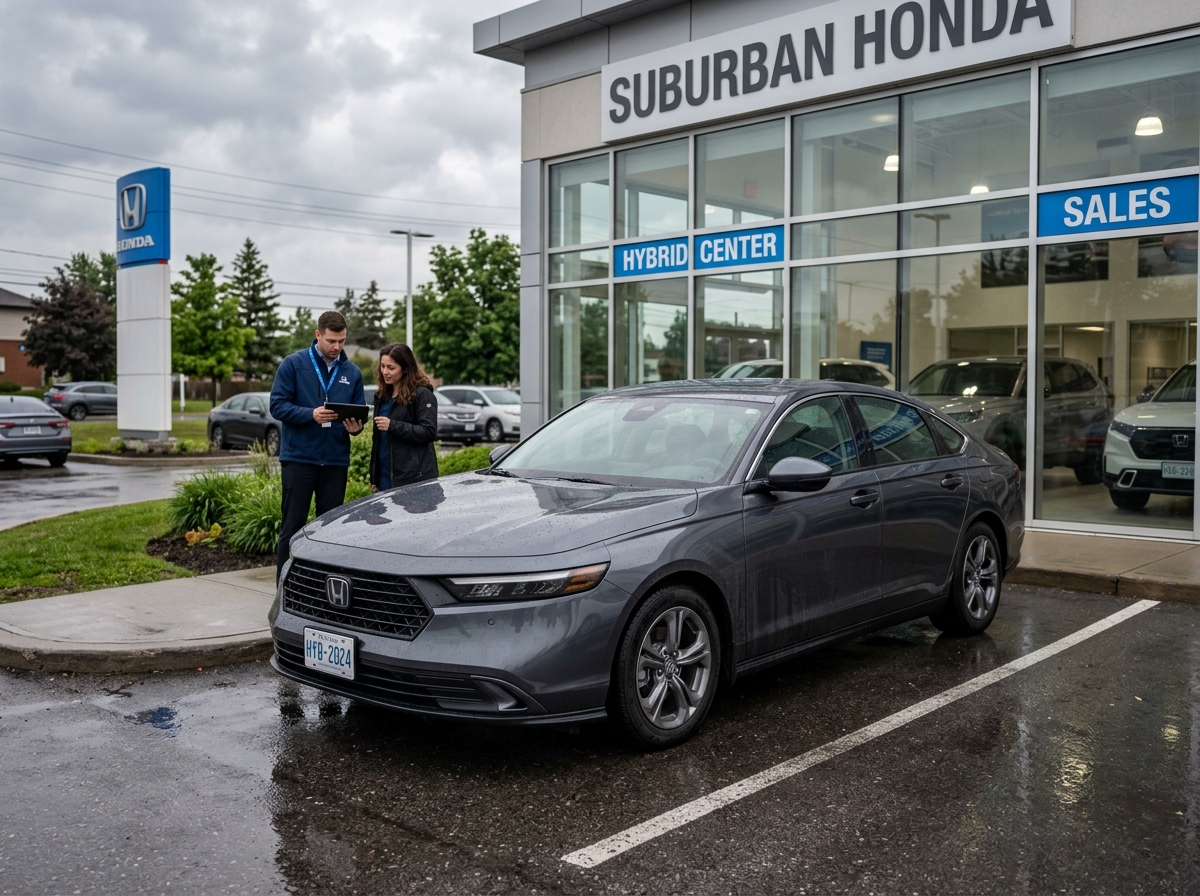

A reported delay to the next-generation Accord suggests Honda could follow Toyota’s Camry strategy, using hybrids as the bridge between gasoline cars and a slower-than-expected electric future.
Honda may be preparing to take one of its most important nameplates into a new phase: a next-generation Accord sold only with hybrid power.
The possibility has emerged as part of a wider reported delay in Honda’s future product schedule. A supplier memo reviewed by Automotive News and reported by Car and Driver indicates that Honda has pushed several major Honda and Acura redesigns into the 2030s, including the Accord, Odyssey, HR-V, Acura MDX and Acura Integra. The Accord, now in its 11th generation after a 2023 redesign, reportedly has no next-generation replacement listed in the supplier document before the early 2030s. Automotive News has suggested that when the next Accord does arrive, it could shift to a hybrid-only lineup, mirroring the strategy Toyota adopted with the latest Camry.
Honda has not confirmed that the Accord will become hybrid-only, and the company generally does not comment on future product plans. But such a move would fit the direction Honda has already outlined publicly. In May 2025, the automaker said it would realign its electrification strategy because of slower growth in electric vehicle demand, changing regulations and shifting trade policies. Honda said its global EV sales ratio in 2030 was now expected to fall below its previous 30 percent target, while hybrid-electric vehicles would play a key role during the transition period toward broader EV adoption.
The Accord is already moving in that direction. In the current U.S. lineup, Honda has positioned hybrid versions as central to the sedan’s identity rather than as niche fuel-saving variants. The Accord Hybrid is not merely an efficiency model; it is sold as the more powerful and more premium choice in much of the range. That gives Honda a clear pathway to remove the conventional gasoline-only powertrain from the next generation without dramatically changing how many customers already perceive the car.
A hybrid-only Accord would also reflect the competitive pressure from Toyota. The redesigned Toyota Camry, one of the Accord’s oldest and most direct rivals, is now sold exclusively as a hybrid in the United States. Toyota’s decision was significant because the Camry is not a low-volume experiment or a technology showcase. It is a mainstream family sedan, and Toyota’s confidence in making it hybrid-only sent a message to the rest of the industry: hybrid technology has become mature enough, affordable enough and familiar enough for mass-market buyers.
For Honda, the Accord carries similar weight. Since its arrival in the American market in the 1970s, the Accord has helped define Honda’s reputation for practical engineering, efficient packaging and long-term dependability. It has survived the rise of SUVs better than many sedans, even as the overall midsize car segment has contracted. While crossovers now dominate family-vehicle sales, the Accord remains a symbolic and commercial anchor for Honda, particularly among buyers who still value lower seating positions, strong fuel economy and refined road manners.
The business case for a hybrid-only Accord is increasingly clear. Hybrids allow Honda to improve fuel economy and reduce emissions without asking customers to rely on charging infrastructure. They also avoid some of the pricing challenges that have slowed EV adoption among mainstream buyers. Battery-electric vehicles remain important to Honda’s long-term carbon-neutrality goals, but they require larger batteries, more complex supply chains and consumer confidence in charging access. Hybrids, by contrast, can be sold through existing dealer networks with little change in customer behavior.
Honda has said it plans to launch 13 next-generation hybrid models globally over a four-year span starting in 2027. The company is targeting 2.2 million hybrid sales by 2030 and has described hybrid models as central to its automobile business during the transition to EVs. Honda also said it aims to improve the fuel economy of next-generation e:HEV models by more than 10 percent and reduce the cost of its next-generation hybrid system significantly compared with earlier systems.
Those targets suggest Honda is not treating hybrids as a temporary fallback. Instead, the company appears to be building a more durable hybrid strategy that can support sales, profits and regulatory compliance while the EV market develops at an uneven pace. A hybrid-only Accord would be one of the clearest expressions of that strategy in North America.
The timing also matters. If the next Accord is delayed until around 2030, Honda will have several years to prepare a new-generation hybrid platform, integrate more advanced driver-assistance technology and reduce component costs. By then, the company may have a better view of battery prices, emissions rules, charging infrastructure and consumer demand. A hybrid-only Accord could arrive as a carefully calculated product rather than a rushed reaction to market uncertainty.
Still, the strategy carries risks. Stretching the current Accord’s life cycle could make the model feel older against rivals, especially if competitors update interiors, infotainment systems and safety technology more quickly. The sedan market may be smaller than it once was, but remaining buyers are often highly informed and comparison-driven. Honda will need to keep the current Accord competitive through software updates, trim adjustments, pricing discipline and possibly mid-cycle styling changes.
There is also a brand risk. Honda built part of its identity on offering efficient gasoline engines that were simple, durable and engaging. A hybrid-only Accord would be a logical evolution, but some traditional buyers may still prefer the lower purchase price or perceived simplicity of a gasoline-only model. Honda would need to ensure that the hybrid system feels natural, reliable and affordable enough that customers do not see the change as a forced compromise.
The larger industry context may help Honda. Hybrids have gained renewed momentum as automakers confront a more complicated EV transition than many had predicted. High interest rates, uncertain incentives, uneven charging access and political debate over emissions rules have made consumers more cautious. At the same time, hybrids offer a visible benefit at every fill-up and do not require a home charger. That combination has made them attractive to buyers who want lower fuel consumption but are not ready to move fully electric.
For dealers, a hybrid-only Accord could be easier to sell than a sudden EV replacement. Sales staff would not need to explain charging networks, battery degradation concerns or home installation costs. Customers could test-drive the car and experience the same basic ownership pattern they know, with better mileage and smoother low-speed operation. That practical simplicity may be Honda’s strongest argument.
For suppliers, however, a delayed Accord replacement and a potential hybrid-only strategy mean a changed investment timeline. Parts makers tied to engines, transmissions, batteries, electric motors and control systems will have to align with Honda’s revised product cadence. A longer model cycle can reduce immediate tooling pressure, but it can also postpone revenue from new programs.
The reported Accord shift also shows how Honda is positioning itself against Toyota. Toyota spent years defending hybrids while other automakers promoted aggressive EV targets. Now, with EV demand growing more slowly in some markets, Toyota’s hybrid-heavy approach looks increasingly influential. Honda appears to be moving toward a similar middle path: keep developing EVs for the long term, but rely more heavily on hybrids through the late 2020s and early 2030s.
That does not mean the Accord’s future is guaranteed. Sedans remain under pressure from compact and midsize SUVs, and Honda must decide how much investment the segment deserves. But if Honda does commit to another Accord generation, making it hybrid-only may be the most realistic way to preserve the nameplate’s relevance.
The Accord has always adapted to its era. It moved from compact efficiency car to family sedan, from carburetors to fuel injection, from four-cylinder simplicity to turbocharging and hybridization. A hybrid-only next generation would be another adaptation, not a break with history.
For now, the key word is “could.” Honda has not announced a hybrid-only Accord, and the reported supplier memo does not amount to a public product confirmation. But the direction is increasingly visible. Honda is slowing some EV ambitions, investing more confidence in hybrids and extending key model cycles into the 2030s. In that environment, a hybrid-only Accord would not be surprising. It may be the most Honda-like answer to an uncertain market: cautious, practical and engineered for the long road between gasoline and electric.