Lower-cost models from BYD, MG, Chery and other Chinese brands are forcing Europe’s carmakers to defend market share as electric adoption accelerates and tariffs fail to fully slow the advance.
BRUSSELS, May 6 — Europe’s electric vehicle market is expanding again, but the recovery is coming with a sharper competitive edge: Chinese automakers are no longer peripheral challengers. They are becoming central players in a price battle that is testing the continent’s industrial policy, its legacy car brands and its ability to make electric mobility affordable without hollowing out domestic manufacturing.
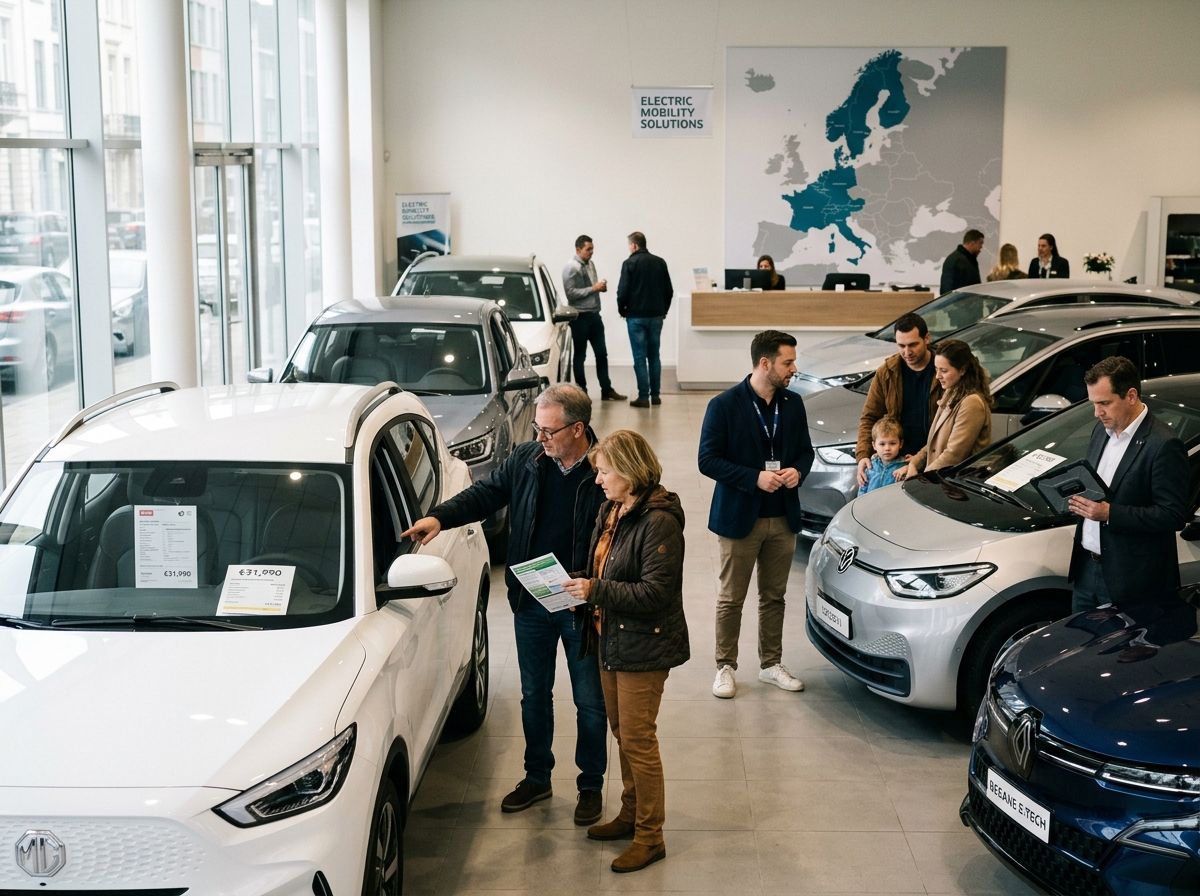
The pressure is visible across showrooms from London to Madrid and from Paris to Warsaw. Chinese-owned brands such as BYD, MG, Omoda, Jaecoo, Geely-linked marques and Leapmotor-backed models are moving into segments long dominated by Volkswagen, Renault, Stellantis, BMW and Hyundai-Kia. Their proposition is simple and difficult for rivals to ignore: more equipment, competitive driving range, modern software and prices that often sit below comparable European models.
The shift comes as battery-electric vehicles are gaining ground across the European Union. According to the European Automobile Manufacturers’ Association, battery-electric cars accounted for 19.4% of EU new car registrations in the first quarter of 2026, up from 15.2% a year earlier. BEV registrations reached 546,937 units in the quarter, supported by strong growth in Germany, France and Italy. Hybrids remained the largest electrified category, while petrol and diesel continued to lose share.
That growth should be good news for Europe’s climate targets and for carmakers that have spent years investing in electric platforms. Instead, it has intensified a strategic dilemma. The faster the market electrifies, the more exposed European manufacturers become to Chinese companies with scale advantages, deep battery supply chains and experience from the world’s most competitive EV market.
China’s domestic car market has been transformed by fierce price wars, rapid model cycles and a consumer base accustomed to advanced digital features. Brands that survive there often arrive in Europe with lean cost structures and aggressive product planning. BYD, which began as a battery manufacturer before becoming one of the world’s largest EV producers, has used its vertical integration to compete on cost. SAIC’s MG has used familiar British branding and accessible pricing to win buyers who might otherwise have considered a Volkswagen ID.3, Renault Megane E-Tech or Peugeot e-308.
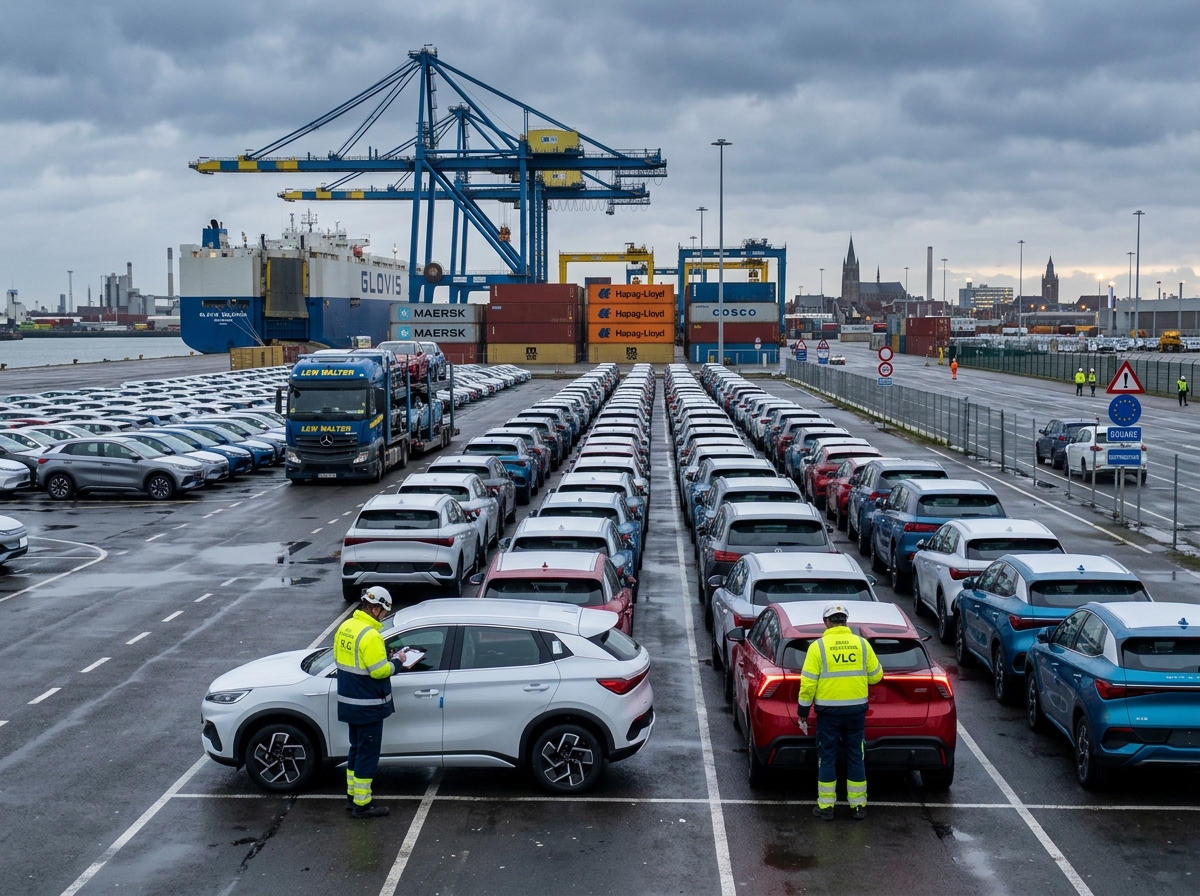
European policymakers tried to slow the momentum. The European Commission imposed definitive countervailing duties on battery-electric vehicles made in China after concluding that Chinese producers benefited from unfair state subsidies that threatened economic injury to EU manufacturers. The duties, applicable from Oct. 30, 2024, include 17.0% for BYD, 18.8% for Geely, 35.3% for SAIC, 7.8% for Tesla’s Shanghai operation and 20.7% for other cooperating companies, on top of the EU’s standard import duty.
But tariffs have not ended the competitive challenge. They have changed its shape. Chinese manufacturers are adjusting pricing, expanding plug-in hybrid offerings, accelerating local production plans and building distribution networks. Plug-in hybrids, which have not faced the same tariff scrutiny as BEVs, have become an important bridge for brands seeking to preserve momentum in Europe. JATO Dynamics reported that Chinese-made plug-in hybrid volumes rose sharply in Europe in 2025 as manufacturers diversified beyond pure electric models.
The strategy is working in part because European consumers remain highly price-sensitive. EV adoption has been constrained by high purchase prices, uneven charging infrastructure and uncertainty over residual values. A lower-cost electric hatchback or compact SUV can shift the calculation for households that support electrification in principle but cannot justify premium pricing. In that environment, a vehicle that offers competitive range, a large screen, a long warranty and a lower monthly finance payment becomes difficult to dismiss.
The UK, although outside the EU, has become one of the clearest laboratories for this trend. MG built early credibility with the MG4, while BYD expanded from niche presence to mainstream recognition. Chery’s Omoda and Jaecoo brands have also gained traction with SUV-style models priced to challenge established rivals. The pattern mirrors the wider European market: Chinese brands are no longer relying solely on low prices, but low prices remain the entry point.
European manufacturers are responding with their own affordable EV push. Renault is betting on the revived Renault 5 and future smaller models. Stellantis has launched lower-cost electric cars through Citroën, Fiat and Opel/Vauxhall. Volkswagen is preparing a more affordable generation of ID models as it tries to defend scale in the mass market. Skoda’s Elroq, Volkswagen’s ID.7 and Renault’s Scenic show that European brands can still deliver strong products, but the cost battle is narrowing their margin for error.
The issue is not only vehicle price. Chinese brands are challenging Europe on speed. Model cycles in China can be far shorter than in Europe, software updates arrive quickly and interiors are designed around digital expectations that appeal to younger buyers. Legacy European manufacturers still have advantages in brand trust, dealer networks, financing, safety reputation and aftersales support. But those advantages are most powerful when price gaps are manageable. If the gap widens too far, loyalty becomes harder to defend.
The stakes are industrial as much as commercial. Europe’s auto sector supports millions of jobs and remains a pillar of manufacturing in Germany, France, Italy, Spain, the Czech Republic, Slovakia and beyond. The EV transition already requires fewer moving parts than combustion-engine production, putting some traditional supplier jobs at risk. A surge in imported vehicles would add another layer of pressure, especially if high-value battery and software components are produced outside Europe.
That is why local production has become central to the next phase of competition. BYD is building manufacturing capacity in Hungary, a move that could reduce tariff exposure and strengthen its claim to be a European producer, not merely a Chinese exporter. Chery has pursued European assembly plans, including activity in Spain, while other Chinese groups are assessing partnerships, distribution deals and manufacturing options. If Chinese brands build in Europe, the political debate becomes more complicated: the threat to incumbent manufacturers remains, but the employment and investment argument changes.
For Brussels, the policy balance is delicate. The EU wants affordable EVs to meet emissions targets and support consumers. It also wants to prevent what officials see as subsidized imports from damaging domestic producers before they can scale. Too much protection risks raising prices and slowing adoption. Too little protection risks weakening the companies Europe needs for its industrial transition.
Consumers may be the short-term winners. Greater competition is bringing down prices, improving equipment levels and forcing established brands to move faster. Fleet operators, rental companies and private buyers are gaining more choice in small cars, family hatchbacks and compact SUVs. For a market long criticized for offering too many expensive EVs and too few affordable ones, Chinese competition is helping close a gap.
The longer-term outcome is less certain. If Chinese brands localize production, invest in European supply chains and compete under the same regulatory conditions, they could become a permanent part of the region’s automotive landscape, much as Japanese and Korean manufacturers did in previous decades. If the competition remains heavily shaped by state support, trade tensions may deepen, with tariffs, minimum-price negotiations and retaliatory measures affecting both sides.
What is clear is that Europe’s EV market is entering a new phase. The first phase was about proving that electric cars could move beyond early adopters. The second is about making them affordable at scale. In that contest, Chinese automakers have arrived with prices that Europe’s legacy manufacturers cannot ignore.
For the European auto industry, the message is blunt. The electric transition will not be won only by regulation, heritage or premium branding. It will be won by companies that can deliver desirable vehicles at prices ordinary drivers can afford. Chinese automakers are testing whether Europe’s champions can do that quickly enough.