
A planned Las Vegas competition allowing performance-enhancing drugs under medical supervision has reignited a global debate over athlete safety, fair play and the limits of the human body.
LAS VEGAS — For decades, the central scandal of modern sport was the athlete who doped in secret. The Enhanced Games proposes something more provocative: an event where enhancement is not hidden, denied or punished, but openly marketed as the main attraction.
The competition, planned for Memorial Day Weekend 2026 at Resorts World Las Vegas, is being promoted by its organizers as a radical alternative to Olympic sport. Athletes will compete in events including sprinting, swimming and weightlifting, with performance-enhancing substances permitted under what the organizers describe as medical supervision and scientific oversight. The message is direct: stop pretending doping does not exist, bring it into the open, and see what the human body can do when traditional restrictions are removed.
That proposition has made the Enhanced Games one of the most divisive sporting projects in the world. Supporters portray it as transparent, athlete-centered and financially honest. Critics call it dangerous, exploitative and corrosive to the values that make sport meaningful. Between those positions lies a more difficult question: in an age of biotechnology, elite medicine and billion-dollar sports entertainment, where should society draw the line between training and enhancement?
The event arrives at a time when elite sport is already shaped by science. Athletes use altitude camps, nutrition labs, biomechanical analysis, recovery chambers, sleep monitoring, surgery, wearable sensors and data-driven coaching. Swimmers wear technologically advanced suits. Runners compete on high-performance tracks in shoes engineered for speed. The boundary between natural ability and scientific assistance has never been simple.
The Enhanced Games argues that the existing anti-doping system is hypocritical because it accepts some forms of enhancement while banning others. Its backers say adult athletes should be allowed to make informed choices about their own bodies, particularly if drugs are legal, prescribed and monitored by doctors. They also argue that a regulated environment may be safer than underground doping, where athletes often use substances without reliable medical oversight.
That argument has found an audience among some athletes, especially those who believe traditional sport has failed to compensate them fairly. Enhanced Games organizers have offered major financial incentives, including large event prizes and bonuses for record-breaking performances. For athletes who spent years training under strict rules while earning modest incomes, the appeal is clear. The competition offers visibility, money and a chance to test physical limits outside the anti-doping regime.
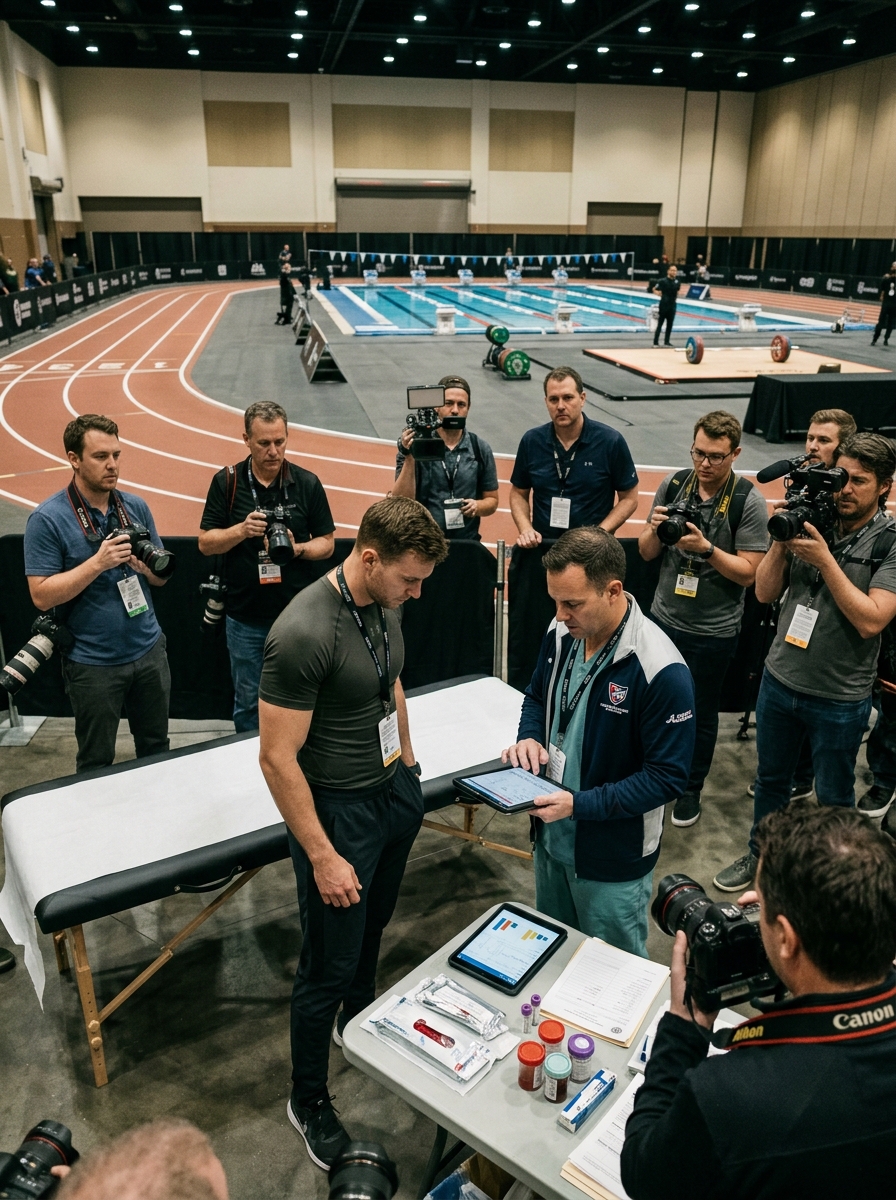
The roster has added recognizable names from international sport, including Olympic and world-level competitors. Their involvement has shifted the Enhanced Games from a fringe concept into a real challenge to established federations. It is no longer merely a thought experiment debated by biohackers, investors and sports ethicists. It is becoming a commercial event with athletes, venues, media strategy and a global audience waiting to see whether controversy can become spectacle.
Anti-doping authorities have responded with alarm. The World Anti-Doping Agency has condemned the project as dangerous and irresponsible, warning that athletes and support personnel connected to sports governed by the World Anti-Doping Code could risk violations if they participate. World Aquatics has taken an even harder line, adopting rules that can exclude people involved in competitions that permit prohibited substances or methods.
The concern is not only fairness. It is health. Performance-enhancing drugs can include anabolic steroids, testosterone, growth hormone, EPO, stimulants and other substances that may affect the cardiovascular system, endocrine function, fertility, mood, metabolism and long-term organ health. The risks vary depending on the drug, dosage, duration, medical history and individual response. But they do not disappear simply because the use is declared openly.
Medical supervision may reduce some risks. It may ensure testing, dosage tracking and emergency care. But critics say supervision cannot eliminate the deeper incentive problem. When prize money, records and public attention are tied to extreme performance, athletes may feel pressure to escalate. A competition built around enhancement could reward those willing to accept the greatest medical uncertainty.
This is why the debate reaches beyond the athletes who choose to compete. The Enhanced Games could influence young athletes, amateur bodybuilders, fitness influencers and recreational competitors who see enhanced performance without fully understanding the dangers. A televised race or record-breaking lift may appear clean, controlled and glamorous. The long-term consequences, if they come years later, will not be broadcast with the same intensity.
The history of doping gives that warning weight. Past scandals have shown how athletes can be pushed by coaches, states, sponsors or their own ambition into choices that damage their health and reputations. Anti-doping systems were created not only to protect the result, but to protect athletes from coercive environments in which the body becomes a tool for medals, money and national prestige. The Enhanced Games reverses that logic by making chemical enhancement a feature rather than a violation.
There is also the question of records. Sport depends on comparison across time. A world record is meaningful because it belongs to a shared tradition of rules, measurement and legitimacy. If an athlete runs faster than Usain Bolt’s 100-meter record or swims faster than the official 50-meter freestyle mark while using substances banned elsewhere, what exactly has been achieved? A human performance record? A laboratory-assisted entertainment milestone? A commercial benchmark for biotechnology?
Organizers appear to understand that legitimacy is essential. They have emphasized science, safety, transparency and athlete care. They have also connected the project to a broader vision of human optimization, sometimes comparing the event to Formula One, where elite competition accelerates technological progress. The analogy is useful for marketing, but ethically incomplete. Race cars are machines built for risk. Athletes are people whose bodies may carry the consequences long after the applause ends.
The connection to the growing biohacking and longevity economy makes the Enhanced Games even more significant. Around the world, wealthy consumers are increasingly interested in hormone optimization, peptides, anti-aging clinics, metabolic drugs and personalized medicine. By placing enhanced athletes on a major stage, the competition could help normalize interventions that were once confined to doping scandals, underground gyms or experimental health communities.
That raises a conflict between autonomy and influence. Adults may argue they have the right to take risks with their own bodies. But sport is not private self-experimentation. It is public performance. The athlete’s choice becomes a product, a message and a model for others. When that choice is financed by investors and packaged as entertainment, the line between freedom and exploitation becomes harder to see.
Traditional sport also faces its own uncomfortable questions. Many Olympic athletes train under intense scrutiny, comply with invasive testing rules and sacrifice years of earning potential, yet receive limited financial reward. The Enhanced Games is exploiting a real weakness in the existing system: clean sport often asks athletes for discipline and purity without guaranteeing economic security. Condemning the new event may be necessary, but it will not solve the frustration that makes some athletes willing to leave the old structure behind.
The Las Vegas event, if it proceeds as planned, will therefore be watched for far more than race times and lifts. Anti-doping bodies will monitor whether participants try to return to sanctioned competition. Medical experts will look for signs of harm or inadequate oversight. Sponsors and broadcasters will measure whether public outrage can be converted into attention. Athletes in conventional sport will watch the money. Young fans will watch the spectacle.
The Enhanced Games may fail, dismissed as a controversial stunt that generated headlines but little lasting authority. Or it may succeed, creating a parallel marketplace for enhanced performance outside the Olympic system. Either outcome will leave a mark, because the project has forced sport to confront questions it has long tried to contain: how much science is too much, how much risk is acceptable, and whether fairness can survive when the body itself becomes the arena for technological competition.
At its core, the Enhanced Games is not only about doping. It is about the meaning of human limits. Traditional sport has celebrated the athlete who trains within shared rules and wins by discipline, talent and resilience. The new model asks whether audiences are ready to applaud the optimized body, medically assisted and commercially rewarded, even when the achievement no longer belongs to sport as the world has known it.
The answer may determine more than the future of one event in Las Vegas. It may shape the next chapter of global sport, where the contest is no longer only between athletes, but between competing visions of what a human body should be allowed, encouraged and paid to become.
