
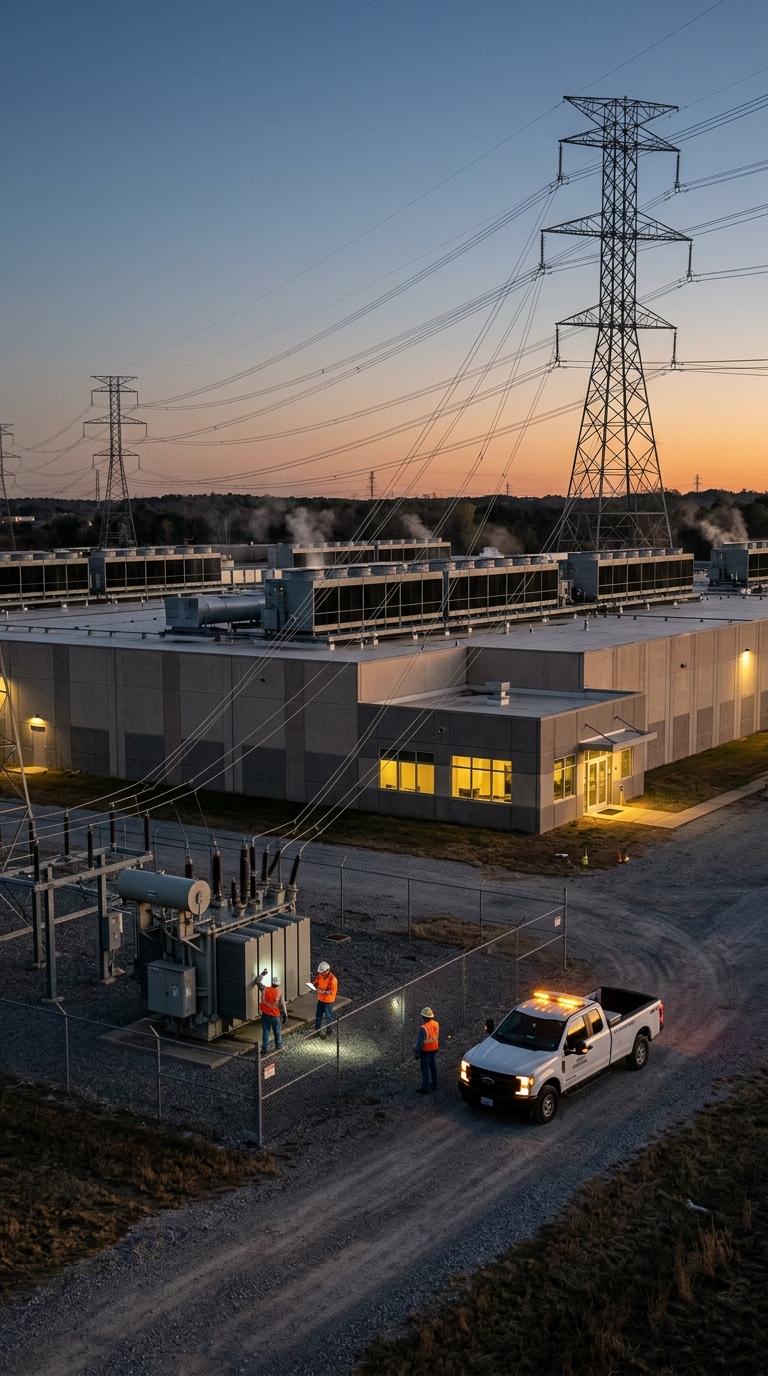
The artificial intelligence boom is forcing technology companies, utilities and governments to confront the physical limits behind a business often described as virtual.
Artificial intelligence is commonly sold as weightless: a cloud service, a model, a chatbot, an invisible assistant answering questions from nowhere. But the infrastructure behind AI is concrete, steel, silicon, water and electricity.
The rise of generative AI has turned data centers into one of the defining energy questions of the decade. Every training run, search query, image generation request and enterprise AI workflow depends on servers housed in facilities that operate around the clock. Those facilities need reliable power, cooling systems, land, grid connections, backup generation and specialized chips.
The International Energy Agency has warned that AI and data centers are becoming major factors in electricity planning. Its analysis looks not only at how much power AI may consume, but at where demand will appear, what sources will supply it and how power systems can manage the load. The issue has moved beyond technology circles into energy ministries, utility commissions and local planning boards.
The tension is obvious. Governments want AI investment because it promises productivity growth, scientific research, national competitiveness and high-value jobs. Local communities may welcome construction and tax revenue. But electricity systems cannot expand instantly. Transmission lines take years to permit and build. Power plants require financing and approval. Grid operators must keep supply and demand balanced every second.
Data centers are attractive customers for utilities because they sign large contracts and consume predictable volumes of power. They are also difficult customers because their scale can overwhelm local planning assumptions. A cluster of AI facilities near a city may require more electricity than expected when a regional grid was designed years earlier.
The AI industry argues that it is improving efficiency quickly. Chips are becoming more powerful per watt. Cooling technology is advancing. Software companies are optimizing models to perform more tasks with less computation. Some firms are signing renewable power purchase agreements, investing in batteries or exploring nuclear energy. These steps matter, but they do not erase the near-term growth in demand.
The environmental debate is becoming more complicated. A company may claim that a data center is matched with renewable energy, but the timing and location of that energy matter. Solar power generated at noon in one region does not automatically offset electricity consumed at night in another. Grid emissions depend on the actual mix of power available when the facility runs.
Water use has added another layer of concern. Some data centers use water for cooling, especially in hot regions. In areas facing drought, communities may question whether scarce water should support AI infrastructure. Companies are experimenting with air cooling, liquid cooling and closed-loop systems, but trade-offs remain.
Electricity prices are politically sensitive. If grid upgrades are needed to serve data centers, regulators must decide who pays. Households and small businesses may resist higher bills if they believe private technology companies are receiving priority access to public infrastructure. Utilities may argue that large customers help fund system expansion. The answer varies by region, contract and regulation.
The AI energy debate also reveals global inequality. Wealthier countries can attract data centers because they have stronger grids, stable regulation and capital markets. Poorer countries may lack the infrastructure to host advanced computing, even if their researchers and businesses need access to AI. The concentration of computing power can reinforce the concentration of economic power.
Some governments are beginning to treat computing capacity as strategic infrastructure, similar to energy, transport or telecommunications. National AI plans increasingly mention data centers, chips and power supply. A country that lacks compute may depend on foreign providers for critical services. That raises questions about sovereignty, security and bargaining power.
There is also a security dimension. Data centers are critical infrastructure. They support finance, government services, health systems, logistics and communications. Their power supply, cybersecurity and physical protection are therefore national concerns. A blackout or attack affecting major cloud facilities can ripple across economies.
The economic case for AI remains strong in many sectors. It can improve drug discovery, materials science, grid management, weather forecasting, customer service, coding and industrial optimization. It may help energy systems become more efficient. But society must compare those benefits with the costs of building and powering the infrastructure behind them.
One possible future is a more disciplined AI economy. Companies may reserve the most powerful models for tasks where they create clear value and use smaller models for routine work. Enterprise customers may ask not only about accuracy and price, but about energy intensity. Regulators may require transparency about electricity use and emissions. The market may reward efficient AI rather than only larger AI.
Another possible future is a computing arms race, in which companies compete mainly by building bigger models and larger data centers. In that scenario, power access becomes a competitive moat. Technology firms with deep capital and energy contracts would dominate, while smaller players depend on rented capacity.
Local communities will play an important role. Some towns may welcome data centers as economic development. Others may reject them because of electricity demand, land use, water consumption or limited job creation after construction. Data centers are expensive but not always labor-intensive. A community may ask whether the long-term benefits justify the infrastructure burden.
The AI boom is also reviving interest in nuclear power, geothermal energy and long-duration storage. Technology companies that once bought renewable credits are now talking directly about firm, clean power. This could accelerate investment in advanced energy systems. It could also create competition for limited clean electricity that other sectors need to decarbonize.
The central lesson is that the digital world is not separate from the physical one. AI may process language, images and code, but it is grounded in substations, cooling towers, chip factories and transmission corridors. The cloud has a geography.
The next chapter of AI will not be written only by researchers and product managers. It will be written by grid planners, energy regulators, city councils, environmental groups and communities living near the infrastructure that makes intelligence on demand possible.
For years, technology companies promised that software would eat the world. AI is now showing that software must also plug into it.
“””
