
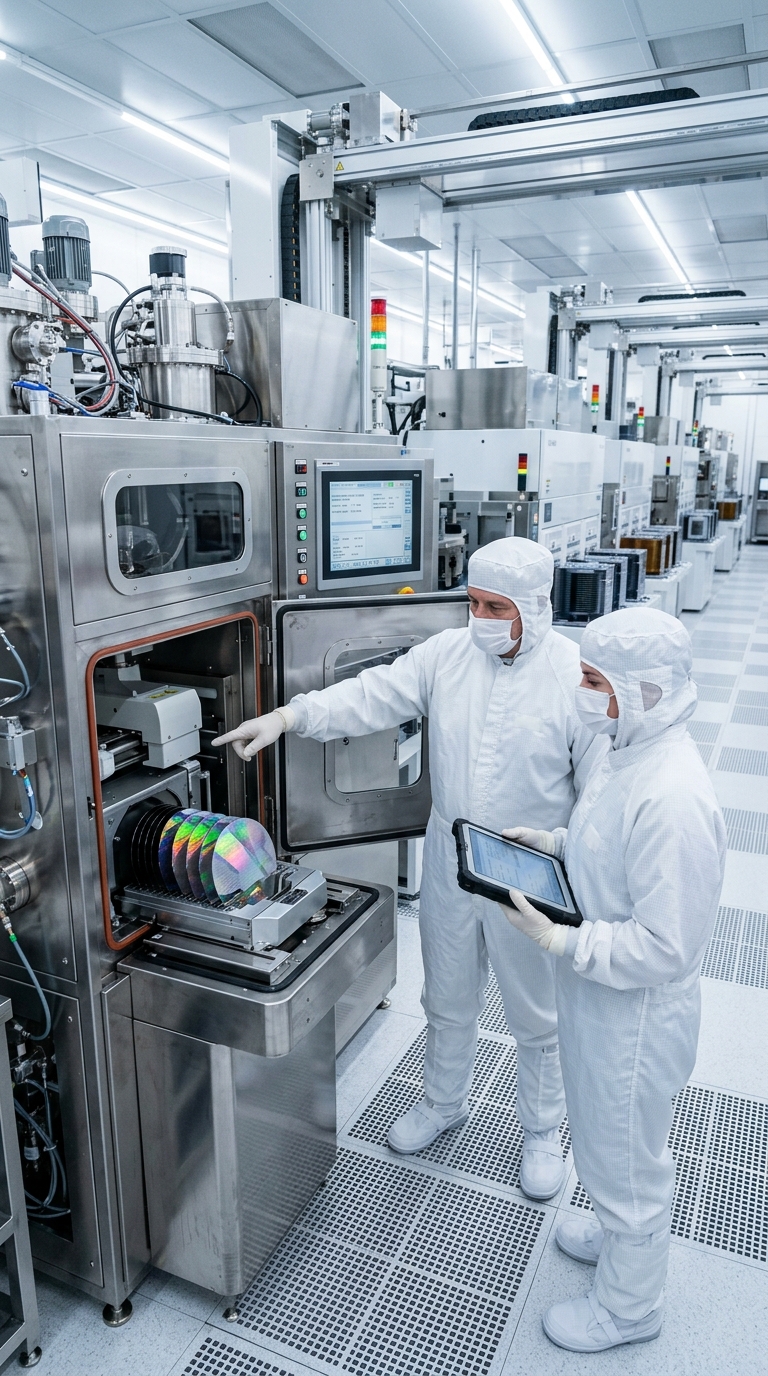
Semiconductors have become the industrial foundation of artificial intelligence, defense, clean energy and consumer technology, pushing governments to rebuild manufacturing capacity at historic scale.
The modern semiconductor is smaller than a fingernail and larger than geopolitics. It powers phones, cars, data centers, satellites, medical devices, weapons systems and the artificial intelligence models now reshaping the global economy. That importance has turned chip manufacturing into one of the most contested industrial arenas in the world.
For decades, the semiconductor industry optimized for efficiency. Design, fabrication, packaging, equipment and materials spread across specialized hubs. Taiwan became central to advanced foundry manufacturing. South Korea dominated memory. Japan remained crucial in materials and equipment. The United States led in chip design and some manufacturing tools. Europe retained strength in industrial chips, automotive systems and research.
That system delivered extraordinary technological progress, but it also created strategic vulnerability. The pandemic exposed shortages in automotive and consumer electronics supply chains. Rising tension around Taiwan made advanced chip concentration a national security concern. The growth of AI increased demand for cutting-edge logic chips and high-bandwidth memory. Governments concluded that the market alone could not guarantee resilience.
The United States responded through CHIPS for America, a suite of programs under the Department of Commerce designed to strengthen domestic semiconductor research, development and manufacturing. Europe passed the European Chips Act, aiming to reinforce the EU semiconductor ecosystem, reduce external dependencies and increase its global market share. Other countries, including Japan, South Korea, India and China, have also launched or expanded chip strategies.
The rhetoric is national, but the industry remains global. No country can easily build a complete semiconductor supply chain alone. Advanced chips require extreme ultraviolet lithography systems, specialty gases, ultrapure chemicals, silicon wafers, design software, packaging expertise and thousands of precision steps. A single fab is not a factory in the traditional sense. It is a controlled environment where physics, chemistry and logistics operate at microscopic tolerance.
The race is now moving from announcements to execution. Governments can promise billions, but fabs must be built, equipped, staffed and qualified. Construction delays, cost overruns, permitting challenges and skilled-labor shortages can slow even well-funded projects. A semiconductor plant may take years before it reaches high-volume production, and customers will not use it unless yields and reliability meet exacting standards.
Advanced packaging has become a central battleground. AI chips increasingly rely not only on smaller transistors but on how multiple components are connected in a package. High-performance computing demands memory placed close to processors, fast interconnects and thermal management. Countries that focus only on wafer fabrication may find that crucial value shifts to packaging and integration.
Workforce is another constraint. Semiconductor manufacturing requires technicians, engineers, materials scientists, maintenance specialists and construction workers trained for highly specialized environments. Building fabs without building talent pipelines risks creating expensive facilities that cannot operate at full capacity. Universities, community colleges and companies are now trying to accelerate training programs.
The chip race also affects smaller economies. Countries that cannot host leading-edge fabs may still compete in design, testing, packaging, equipment, materials or specialized chips. Power semiconductors for electric vehicles, analog chips for industrial systems and sensors for medical devices remain strategically important even if they are not at the most advanced node.
China’s position is central to the global debate. Export controls have restricted its access to certain advanced chips and manufacturing tools. Beijing has responded by investing heavily in domestic capability. The result is a fragmented technology environment where efficiency is increasingly balanced against security. Companies must navigate rules on what can be sold, where it can be made and who can access it.
The automotive industry illustrates the stakes. Modern vehicles use hundreds or thousands of chips for engine control, safety systems, infotainment, batteries and driver assistance. Shortages can stop assembly lines. As electric and software-defined vehicles expand, demand for semiconductors will deepen. Automakers that once treated chips as low-cost components now view them as strategic inputs.
Artificial intelligence has intensified the imbalance between demand and supply. Training and deploying advanced models requires specialized accelerators and memory. Cloud companies are designing their own chips to reduce dependence on external suppliers and optimize performance. This vertical integration may reshape the relationship between chip designers, foundries and hyperscale cloud providers.
Public subsidies are politically sensitive. Governments justify them as investments in national security, supply resilience and future industries. Critics warn of corporate welfare, duplication and inefficient competition between allies. If every region subsidizes fabs without coordinating demand, the world could face overcapacity in some segments and shortages in others.
Environmental concerns are also growing. Semiconductor fabs consume large amounts of electricity and ultrapure water. They use chemicals that require careful management. Communities hosting fabs may ask about water stress, emissions and long-term accountability. Sustainable chip manufacturing will require cleaner power, recycling systems and transparent environmental practices.
The chip race is not only about leading-edge technology. Mature chips, often made on older process nodes, remain essential for cars, appliances, industrial equipment and infrastructure. During shortages, these less glamorous chips caused major disruptions. Policymakers now recognize that resilience requires attention to the full stack, not only the most advanced processors.
The market may eventually discipline some ambition. Not every announced project will succeed. Customers will choose suppliers based on cost, quality, reliability and ecosystem support, not national slogans. Semiconductor manufacturing is brutally competitive, and subsidies cannot permanently compensate for weak execution.
Still, the strategic shift is unlikely to reverse. Chips are now treated like energy, food and defense: too important to leave entirely to distant supply chains and just-in-time assumptions. The global economy is entering an era of partial redundancy, where resilience is valued even when it costs more.
For technology users, the effects may appear indirectly. Devices may become more expensive if supply chains are duplicated. Governments may impose restrictions that affect product availability. But successful investment could also reduce the risk of future shortages and strengthen innovation ecosystems.
The factory floor is now where industrial policy becomes real. A signed subsidy agreement is only a beginning. The true test is whether wafers come out, yields rise, workers are trained and customers trust the output.
The semiconductor race is often described as a contest for technological leadership. It is also a contest of patience. The countries that win will be those that can sustain investment, coordinate supply chains and master the unglamorous details of manufacturing at atomic scale.
“””
