
As Google prepares its annual developer conference, the company’s next challenge is to turn Gemini, Android, Chrome, Cloud and AI tools into one coherent experience for users and developers.
Google I/O has always been more than a developer conference. It is the annual moment when Google explains how it sees the future of computing. In earlier years, that future was organized around search, mobile apps, web services and cloud infrastructure. In 2026, the center of gravity is clearly artificial intelligence.
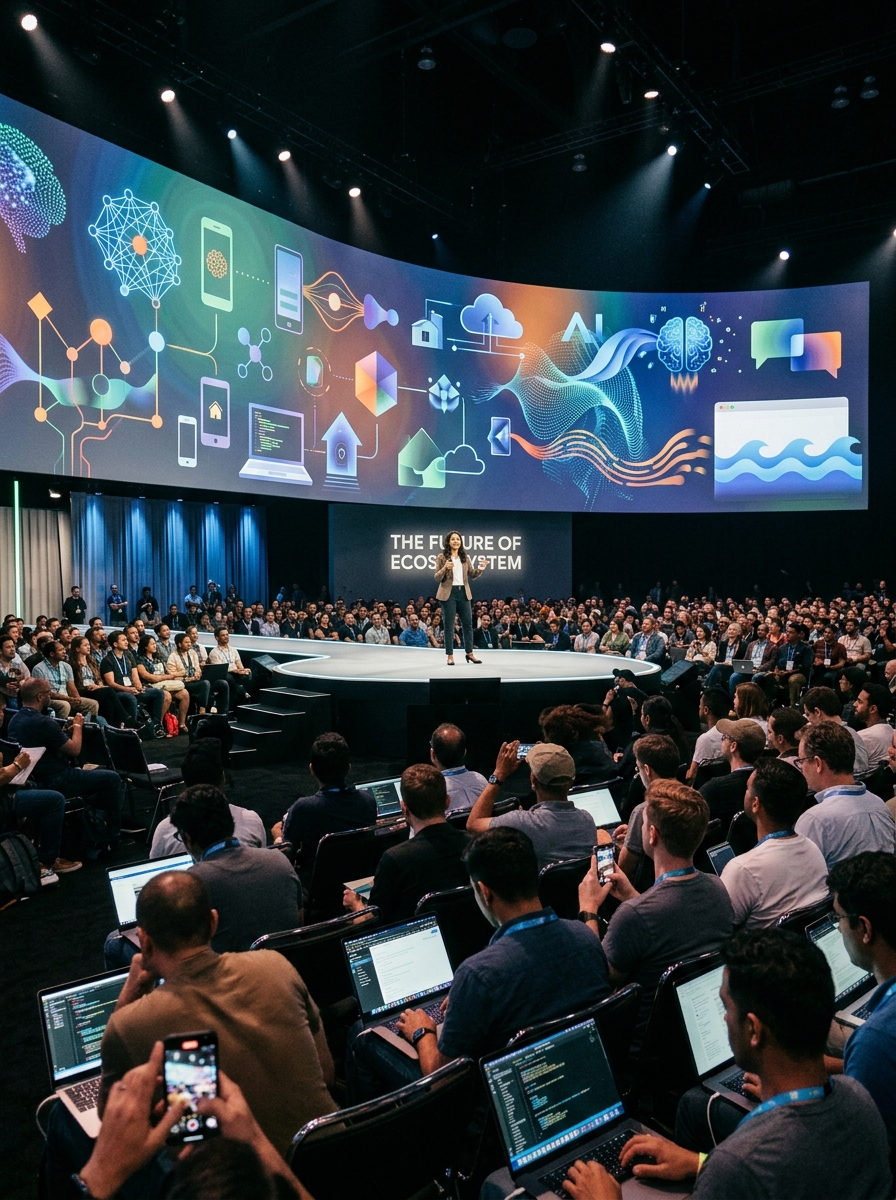
Scheduled for May 19 and 20, Google I/O 2026 is expected to bring updates across Gemini, Android, Chrome, Cloud and developer tools. But the deeper story is not one product announcement. It is the way Google is trying to connect its entire ecosystem around AI: the phone in a user’s hand, the browser on a laptop, the cloud platform behind a company, the coding assistant used by a developer and the model that interprets text, images, audio, video and data.
Android remains the most important gateway to that ecosystem for billions of people. It is where AI becomes personal, mobile and immediate. A feature that lives only in a research demo may impress developers, but a feature that works inside messages, camera, search, translation, accessibility or notifications can change daily behavior. That is why Android’s future is not only about a new version number. It is about whether the operating system can become more adaptive, more secure and more context-aware without becoming intrusive.
Recent Android development has already pointed in that direction. Android 16 has focused on performance, security, camera and media capabilities, improved app behavior and support for a wider range of devices. For users, those technical improvements matter when phones feel faster, apps behave more reliably, photos and videos improve, battery use becomes smarter and tablets or foldables feel less like afterthoughts. For developers, they matter because better APIs make it easier to build experiences that work across screen sizes and hardware categories.
The next phase of Android will likely be judged by how well Gemini fits into everyday tasks. Users do not want AI as a separate destination they must remember to open. They want help where work is already happening. That may mean summarizing a long conversation, finding an image from a vague description, translating speech more naturally, explaining what appears on screen, helping draft a reply, organizing travel information or turning voice instructions into actions across apps. The value of AI on Android will depend less on spectacle and more on convenience.
Privacy and trust will be central to that shift. A phone is not just a device; it is a record of location, health, family, finance, work and private communication. If AI becomes more deeply integrated into Android, Google will have to show users clearly what is processed on-device, what is sent to the cloud, what data is saved and how controls work. The future of mobile AI will be shaped not only by model capability, but by whether people feel safe using it.
Gemini is the most visible symbol of Google’s AI strategy. It is not merely a chatbot brand. It is becoming the connective tissue across consumer apps, developer tools and enterprise platforms. In the consumer world, Gemini competes for attention by helping people write, plan, learn, search, create images, analyze files and interact through voice. In the developer world, it is positioned as a model family and tool layer for building applications. In the enterprise world, it becomes part of workflows, agents and cloud services.
That broad ambition creates both opportunity and risk. The opportunity is obvious: Google can place Gemini across products that people already use, from Android and Chrome to Gmail, Docs, Search, Maps and Cloud. The risk is fragmentation. Users may struggle to understand which Gemini feature works where, what it can do, what it cannot do and whether the experience is consistent. One challenge for Google I/O 2026 will be to make AI feel less like a collection of experiments and more like a dependable platform.
Chrome is another critical piece. The browser has become the workplace for much of modern life. People research, shop, study, manage money, write documents, use web apps and communicate inside browser tabs. Google has already described Chrome as receiving major AI upgrades, including Gemini features that can help users understand complex pages, work across multiple tabs and handle tedious tasks. If that direction continues, Chrome could become less of a passive window and more of an active assistant for the web.
For ordinary users, AI in Chrome could make the internet easier to navigate. A browser that summarizes a long article, compares open tabs, explains a confusing form, highlights a security risk or helps complete a task could save time. For professionals, the stakes are larger. Researchers, students, journalists, analysts and office workers already spend hours moving between sources. The promise of AI in the browser is that it can reduce friction without removing user judgment. The danger is overreliance: if summaries are inaccurate or context is missed, convenience can become misinformation.
Google Cloud brings the same AI shift into business. Enterprises do not only want models that answer questions. They want systems that connect to documents, databases, customer records, supply chains, software tools and compliance rules. Google’s recent emphasis on Gemini Enterprise Agent Platform reflects the industry’s move from simple chatbots toward agents that can plan, use tools, coordinate tasks and operate under governance. That is why Cloud may be one of the most important areas at I/O even for people who never buy cloud services directly.
The enterprise AI race is not just about intelligence. It is about security, permissions, audit trails, reliability, cost and integration. A company may be impressed by an AI demo, but it will ask harder questions before deploying it: Who can access the data? Can the system be monitored? What happens when the model is wrong? Can agents be limited to approved tools? Can workflows be traced? Google Cloud’s future depends on answering those questions as convincingly as it demonstrates model performance.
Developer tools are likely to be another major theme. Google has already signaled interest in agentic coding and AI-assisted development. This reflects a broader transformation in software creation. Developers increasingly expect tools that can explain code, generate tests, find bugs, produce prototypes, manage documentation and help move from idea to working application more quickly. The question is no longer whether AI can write code. It is whether AI can help teams build reliable, maintainable and secure software.
That distinction matters. A coding agent that produces a flashy demo is useful. A coding agent that understands project structure, respects security requirements, works with existing tools and helps teams ship production software is much more valuable. Google’s advantage may lie in connecting AI coding tools with Android, Flutter, Firebase, Chrome DevTools, Cloud and Google AI Studio. If those pieces work together, developers could move from concept to mobile app, web app or cloud service with fewer disconnected steps.
For consumers, the most important “new features” may not arrive as one dramatic product. They may appear as small improvements across the ecosystem: a smarter phone assistant, better photo search, more useful browser summaries, more natural voice interaction, improved translation, stronger spam and scam protection, better accessibility tools, more personalized help and faster app experiences. The future Google is likely to present is ambient rather than isolated. AI will be less something users visit and more something embedded into daily computing.
That future is commercially powerful. The company that controls the operating system, browser, cloud platform, AI model and developer tools can influence how digital life is built and experienced. But it also increases scrutiny. Regulators, competitors and users will watch how Google handles data, market power, transparency and fairness. AI integration can make products more useful, but it can also make ecosystems harder to leave.
Google I/O 2026 therefore arrives at a decisive moment. The AI race is no longer about proving that models can generate impressive answers. It is about turning models into trustworthy products. Android must show that AI can improve the phone without overwhelming the user. Gemini must show that it can be consistent across consumer, developer and enterprise contexts. Chrome must show that AI can help people navigate the web without replacing critical thinking. Cloud must show that agents can be powerful and governed. Developer tools must show that automation can increase productivity without sacrificing quality.
The most important message from Google I/O may be that the future of computing is not a single device or app. It is an ecosystem of assistants, agents, models, screens and services working together. If Google succeeds, users may not think much about where Android ends, where Chrome begins or where Gemini is running. They will simply expect technology to understand context, reduce repetitive work and help them move from intention to action. That is the promise. The challenge is making it useful, safe and reliable enough for everyday life.
“””
