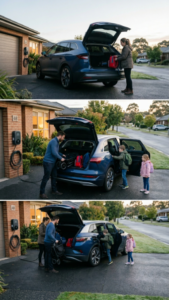
As battery-powered sport utility vehicles become larger, safer and more practical, families are weighing a new kind of household math: range, charging access, price and daily routine.
DETROIT/LONDON — The family SUV has long been sold as a promise of room, safety and control. It carries strollers, sports bags, grandparents, groceries and the quiet anxiety of modern parenting. Now the same vehicle is being asked to carry something else: the expectations of an electric transition that is no longer theoretical.
Electric SUVs are moving quickly from early-adopter driveways into school pickup lines and supermarket parking lots. They are not yet the default choice for every household, but they have become credible family vehicles in a way that would have seemed unlikely a decade ago, when battery cars were often small, expensive or compromised by limited range.
The shift is being driven by two forces meeting at the same time. Automakers know that families around the world continue to prefer higher-riding vehicles with generous cargo space. At the same time, governments, regulators and manufacturers are pushing electrification deeper into the mainstream. The International Energy Agency projected that electric car sales in 2025 would exceed 20 million worldwide, representing more than one-quarter of global car sales, with growth led by China and Europe and stronger adoption in emerging markets.
For families, however, the question is less ideological than practical. A family does not buy an electric SUV because it helps complete an industry forecast. It buys one if the car can manage weekday commutes, weekend trips, child seats, luggage, charging stops, bad weather and household budgets without adding stress to a schedule that is already crowded.
The most important change is that electric SUVs now come in shapes families recognize. Compact and midsize models offer the familiar two-row layout, while larger three-row vehicles have begun to challenge gasoline-powered family haulers directly. The Kia EV9, for example, is marketed with seating for up to seven adults and an EPA-estimated range of up to 305 miles, while Volvo’s EX90 is presented as a six- or seven-seat electric SUV with an estimated range of up to 305 miles. Tesla’s Model Y remains a key reference point in the segment, combining SUV proportions with EPA-estimated ranges that vary by version.
Range still matters, but the meaning of range has changed. A figure above 300 miles can sound reassuring on a showroom floor, yet families quickly learn that real-world driving is shaped by speed, temperature, tire choice, hills, passengers, luggage and the use of heating or air conditioning. A roof box for a ski trip, a trailer for camping gear or a long winter highway run can reduce the distance between charges. The most useful number for many buyers is not the maximum range advertised, but the range left after a normal day ends badly: a delayed pickup, an extra errand, rain, traffic and a forgotten overnight charge.
That is why home charging has become the dividing line between an easy electric experience and a frustrating one. For households with a driveway, garage or assigned parking space, a Level 2 home charger can turn the car into an appliance that refuels while the family sleeps. J.D. Power’s 2025 home-charging study found that home charging remained a key driver of EV owner satisfaction, even as satisfaction scores slipped because of concerns such as charging speed, cord length and cost. For renters, apartment dwellers and families relying entirely on public chargers, the same SUV can feel much less convenient.
Public charging is improving, but it remains uneven. In the United States, federal data and national charging maps show a growing network of public stations and charging ports, while automakers are increasingly giving drivers access to broader fast-charging networks, including Tesla’s North American Charging Standard. That improves confidence for long-distance travel, but the experience can still vary by location, weather, charger reliability and holiday traffic. A gasoline SUV can usually recover from poor planning in five minutes at a filling station. An electric SUV asks families to plan with more discipline.
Automakers are trying to reduce that burden. Route-planning software now estimates charging stops, battery temperature and arrival state of charge. Some vehicles precondition the battery before reaching a fast charger, cutting time at the plug. Large electric SUVs such as the EV9 and EX90 advertise fast-charging windows that can move the battery from 10% to 80% in less than half an hour under ideal conditions. For families, that interval may line up with lunch, bathroom breaks and restless children. Under poor conditions, it can feel much longer.
Safety is another reason electric SUVs have gained traction with family buyers. Battery packs mounted low in the floor can lower the center of gravity, and many EV platforms are designed around strong crash structures. Several electric models have performed well in Insurance Institute for Highway Safety evaluations. Yet safety should not be reduced to a badge. Parents still need to check the basics: rear-seat belt geometry, child-seat anchors, visibility, rear-door opening width, third-row access, head restraints and how much luggage space remains when every seat is occupied.
The third row is especially important. A vehicle that seats seven on paper may not carry seven people and their luggage comfortably on a family trip. Some electric SUVs offer flat floors and generous second-row space, but battery packaging, rooflines and rear crash structures can still affect the third-row experience. Families moving from a minivan may find that an electric SUV looks more stylish but requires more compromise. Families moving from a compact crossover may see the same vehicle as a major upgrade.
Cost remains the hardest question. Electric SUVs often carry higher sticker prices than comparable gasoline models, especially in three-row form. Lower fueling costs and reduced routine maintenance can help narrow the gap, particularly for households that drive many miles and charge at home. But insurance costs, tire wear, depreciation, repair complexity and changing incentives can complicate the calculation. In some markets, leasing has become attractive because it shifts some resale-value risk away from the family. Used electric SUVs may offer better value, but buyers must examine battery warranty coverage, charging history and software support carefully.
The environmental argument is also more nuanced than a simple comparison between gasoline and electricity. Electric SUVs produce no tailpipe emissions, a meaningful advantage in cities and near schools. Their climate benefit generally improves as power grids become cleaner. But large vehicles require larger batteries, more materials and more energy to move. A right-sized electric SUV driven efficiently will usually make more environmental sense than the biggest battery pack bought for occasional long trips. The cleanest family vehicle is not only electric; it is also appropriately sized for the job.
Inside the cabin, electric SUVs are changing expectations of what a family car should feel like. Many are quiet, quick and smooth, with flat floors, multiple USB-C ports, panoramic roofs and app-based climate control that lets parents cool or warm the cabin before loading children. But the same digital shift brings concerns. Touchscreen-heavy controls can frustrate drivers who want simple physical buttons for wipers, mirrors, temperature and defrosting. Over-the-air updates can improve a vehicle, but subscriptions and software changes can also make ownership feel less permanent.
For many families, the best answer may not be the largest electric SUV or the one with the most dramatic acceleration. It may be the model that fits a weekly pattern without drama: enough range for the commute, enough room for real passengers, a comfortable second row, predictable charging, good safety performance and a price that does not depend on optimistic fuel savings. The right electric SUV should feel boring in the best possible way.
The rise of electric SUVs does not mean the gasoline family car will disappear overnight. Rural households, apartment dwellers, frequent towers and families in regions with thin charging networks may still find hybrids, plug-in hybrids or efficient gasoline models more practical. But the center of gravity has shifted. Electric SUVs are no longer experimental symbols parked at the edge of the market. They are becoming ordinary family tools, judged not by novelty but by the oldest standard in family transportation: whether they make daily life easier.