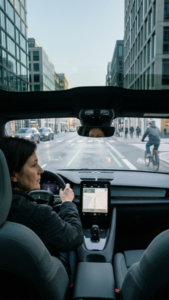
Artificial intelligence is moving from the research lab into dashboards, safety systems and robotaxi fleets, but the road to trust still runs through regulation, transparency and human responsibility.
DETROIT — The next big change in the automobile is not only electric power. It is intelligence. A modern car increasingly sees, listens, predicts and updates. It can warn a distracted driver, hold a lane, brake before impact, suggest a charging stop, answer a spoken question and, in limited cases, take over parts of the driving task. The transformation is turning the car from a mechanical product into a rolling computer whose most valuable parts may be sensors, software and data.
The shift is already visible in ordinary vehicles. Cameras identify lane markings. Radar tracks the speed of cars ahead. Ultrasonic sensors detect objects during parking. Driver-monitoring cameras watch whether eyes stay on the road. Software fuses those signals and decides whether to alert, assist or intervene. What once sounded like science fiction now appears in features such as automatic emergency braking, adaptive cruise control, blind-spot warnings, lane keeping and drowsiness alerts.
Yet the industry’s most important message is also its most cautious: most cars on sale today are not self-driving. They are assisted-driving machines. The difference matters. In a partially automated vehicle, the system may steer and control speed, but the human remains responsible for watching the road and taking over. That boundary has become one of the central questions in automotive technology: how much can artificial intelligence do before people begin trusting it too much?
The safety case for AI is powerful. Road crashes are often linked to inattention, poor judgment, speed, fatigue or delayed reaction. Machines do not get drunk, text friends, fall asleep or lose patience in traffic. In the best cases, a vehicle can detect a developing threat faster than a person and brake before the driver fully understands what is happening. For pedestrians, cyclists and motorcyclists, that promise is especially important because the difference between a warning and an impact can be measured in fractions of a second.
Governments are beginning to treat these systems not as luxury options but as core safety equipment. In the European Union, new general safety rules now require a range of advanced driver-assistance systems on all new motor vehicles sold in the bloc, including intelligent speed assistance, reversing detection, driver drowsiness and attention warnings, emergency stop signals, lane keeping, automated braking and event data recorders. European officials expect the measures to help save more than 25,000 lives and avoid at least 140,000 serious injuries by 2038.
In the United States, federal regulators have moved more slowly, partly because the market includes both conventional driver-assistance systems and experimental automated vehicles. The National Highway Traffic Safety Administration says automated technologies have the potential to reduce crashes, prevent injuries and save lives, while also updating its framework for automated vehicles and Level 2 driver-assistance systems. The challenge is to encourage innovation without allowing marketing language to outrun real-world capability.
That challenge is clearest in the language of automation. The Society of Automotive Engineers uses six levels, from Level 0, with no driving automation, to Level 5, full automation in all conditions. Most consumer systems remain Level 2, meaning they can assist with steering and speed but require constant human supervision. Level 3, conditional automation, is rarer: the system drives under specific conditions, but the driver must be ready to resume control when asked. Level 4 systems can operate without a driver, but only within defined areas or conditions.
Those definitions can sound technical, but they shape everyday responsibility. A driver using a supervised highway feature cannot treat the car as a chauffeur. A passenger in a geofenced robotaxi may be riding in a vehicle that has no human driver at all, but only inside an area the company has mapped, tested and approved. A Mercedes-Benz system approved for limited Level 3 use in California, for example, is restricted to certain highways and conditions. Tesla’s Full Self-Driving product is explicitly branded as supervised, meaning the driver must remain attentive.
Robotaxis show both the promise and the difficulty of the next stage. Waymo, one of the most advanced operators, has reported more than 170 million rider-only miles without a human driver through December 2025 and says its vehicles have recorded lower rates of serious injury crashes, airbag-deployment crashes and injury-causing crashes than human benchmarks in the cities where it operates. Such data is significant because autonomous vehicles need evidence from real roads, not just simulations.
But even successful robotaxi deployments remain carefully bounded. They depend on detailed maps, remote support, sensor redundancy, constant software updates and local operating rules. A vehicle that performs well in Phoenix or San Francisco may face different challenges in heavy snow, chaotic construction zones, unmarked rural roads or cities where traffic behavior is less predictable. AI systems can be highly capable and still brittle at the edges.
Inside the cabin, a different form of automotive AI is advancing faster: the conversational assistant. Automakers are integrating large language models into voice systems so drivers can ask more natural questions instead of memorizing fixed commands. Volkswagen says its IDA assistant can forward queries anonymously to ChatGPT when the vehicle’s own system cannot answer, while keeping ChatGPT from accessing vehicle data. BMW says its next-generation assistant using Amazon Alexa+ will allow more natural conversations in new models beginning with the iX3. Mercedes-Benz has also expanded AI-assisted voice features through its MBUX system.
The appeal is clear. A better voice assistant can reduce screen tapping, explain a warning light, find a charger, adjust climate settings, summarize a route or help a driver understand vehicle functions. In an electric car, AI can estimate range more accurately by analyzing weather, traffic, terrain, speed and battery temperature. In fleet vehicles, it can predict maintenance needs before a breakdown. In manufacturing, automakers use AI to inspect parts, manage supply chains and shorten development cycles.
But as cars become smarter, they also become more intimate data machines. A connected vehicle can know where people live, where they work, how fast they drive, who sits in the cabin, what phone is connected, what voice commands are spoken and whether the driver appears tired or distracted. Privacy advocates warn that consumers often have little real control over how such information is collected, shared or sold. Mozilla’s 2023 review of 25 major car brands found that all failed its privacy test, highlighting concerns about sensitive personal data gathered by sensors, apps, microphones, cameras and connected devices.
That makes privacy a safety issue, not just a consumer-rights issue. If drivers do not trust what their car records, they may disable features that could protect them. If manufacturers store or transmit sensitive data carelessly, vehicles become targets for cyberattacks, stalking, fraud or state surveillance. The more AI depends on data, the more automakers must prove that data is limited, secured and used for clearly explained purposes.
The economics of the industry are also changing. A software-defined vehicle can be improved after sale through over-the-air updates, but it can also create disputes over subscriptions, repair rights and feature access. Automakers see recurring revenue in driver-assistance packages, navigation intelligence, entertainment, battery optimization and cabin services. Customers may welcome improvements but resist paying repeatedly for capabilities they believe should be included in the vehicle they bought.
The next phase will likely be gradual rather than revolutionary. Fully driverless private cars that can travel anywhere, in any weather, without human oversight remain beyond the mainstream market. More likely, AI will expand through narrow but useful functions: safer emergency braking, stronger driver monitoring, better highway assistance, smarter parking, predictive maintenance, natural voice interaction and limited autonomous ride-hailing in mapped urban areas.
The central test will not be whether cars can perform impressive demonstrations. It will be whether they can behave safely and predictably on the worst days: in glare, rain, dust, faded lane markings, confusing roadworks, crowded school zones and mixed traffic with scooters, bicycles and pedestrians. Regulators will demand evidence. Insurers will study crash outcomes. Drivers will judge the technology by whether it reduces stress without creating false confidence.
Artificial intelligence is not replacing the car so much as redefining it. The vehicle is becoming a sensor platform, a data terminal, a safety system and a digital companion. Its success will depend less on futuristic promises than on ordinary reliability: seeing the child at the crosswalk, refusing to speed through fog, warning the tired commuter, protecting private data and handing control back clearly when the machine reaches its limit. The smartest car will not be the one that claims to do everything. It will be the one that knows exactly what it can do, what it cannot do and how to keep people safe in between.