A £1,500 government discount and Fiat’s own price repositioning have pushed the small electric crossover into unusually competitive territory as Britain tries to accelerate the shift away from combustion engines.
LONDON — The Fiat 600e, a compact electric crossover aimed at urban families and cost-conscious private buyers, has become cheaper in Britain than some comparable petrol and hybrid models after qualifying for the UK government’s Electric Car Grant, sharpening the price battle in one of Europe’s most closely watched electric vehicle markets.
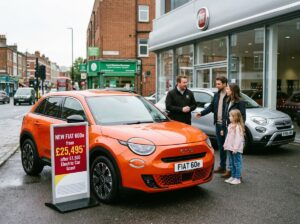
Fiat’s UK arm said the 600e now starts at £25,495 once the £1,500 grant is applied. The figure follows a broader price adjustment by the Italian brand at the start of 2026 and represents a total saving of £4,785 compared with the model’s December 2025 pricing. The performance-focused Abarth 600e has also been confirmed as eligible for the same grant, bringing its starting price to £32,495.
The numbers matter because one of the largest barriers to electric vehicle adoption in Britain has been the higher upfront cost of battery-powered cars compared with petrol and hybrid alternatives. For years, electric models were sold largely as premium purchases, often justified by lower running costs, company-car tax advantages or environmental considerations. The latest pricing of the 600e suggests that, at least in selected parts of the market, that gap is beginning to narrow — and in some cases reverse.
The entry-level Fiat 600 Hybrid Pop is currently listed by consumer car marketplaces at around £25,995, while several mild-hybrid versions of the 600 and rival compact crossovers sit above the newly discounted electric 600e. The Ford Puma Gen-E, an electric rival that has qualified for a larger £3,750 grant, starts slightly higher than the Fiat 600e despite receiving the top-tier subsidy. That makes Fiat’s position notable: even with a smaller government contribution, the 600e has moved into one of the most price-sensitive areas of the new-car market.
The UK’s Electric Car Grant was launched in July 2025 as part of a £650 million effort to make zero-emission cars more affordable. Under the scheme, eligible new electric cars priced at or below £37,000 can receive a discount at the point of sale. Vehicles are assessed against sustainability criteria linked to production, with Band 1 models receiving up to £3,750 and Band 2 models receiving up to £1,500. The programme is due to run until March 2030, subject to funding and eligibility rules.
For buyers, the grant is designed to operate simply. Manufacturers apply for eligibility, and the approved discount is deducted from the retail price by dealers rather than claimed directly by the customer. That structure is intended to reduce friction in showrooms and online sales channels, where uncertainty about incentives has historically complicated purchase decisions.
Fiat’s 600e sits in a category that may be especially important for the transition to electric mobility. It is not a large luxury SUV, nor a niche city runabout. Instead, it is a small crossover with family-oriented packaging, a familiar European badge and a stated electric range of up to 254 miles on a charge, depending on specification and conditions. That places it in the mainstream zone where policy makers and manufacturers need stronger uptake if national emissions targets are to be met.
Britain has committed to phasing out the sale of new petrol and diesel cars by 2030, with hybrids permitted for a longer transition period under specified conditions. At the same time, carmakers face the Zero Emission Vehicle mandate, which requires an increasing share of new-car sales to be electric. Missing those targets can expose manufacturers to penalties, giving brands a strong incentive to discount, reposition models and push more battery-powered vehicles into private hands.
The result is a market shaped by both regulation and competition. Electric cars have become more common on UK roads, but private retail demand has not always matched the pace seen in company fleets. Fleet buyers benefit from tax structures that strongly favour electric cars, while households tend to focus more directly on purchase price, charging access and resale values. The Fiat 600e’s new price is therefore more than a single-model adjustment. It is a test of whether lower entry prices can persuade mainstream buyers who might otherwise choose a petrol or hybrid crossover.
Fiat has framed the move as part of its broader push to make electric mobility more accessible. The company previously offered its own electric incentive after the end of the UK’s earlier Plug-in Car Grant, and it has repeatedly argued that affordability is central to EV adoption. The government grant now gives the brand a public subsidy to add to its own pricing strategy, helping the 600e compete more directly against combustion-engine alternatives.
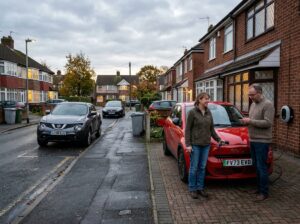
For consumers, the calculation remains more complex than the sticker price alone. Electric cars can be cheaper to run if owners can charge at home on favourable tariffs, and they are generally less exposed to volatile petrol prices. Maintenance costs can also be lower because electric drivetrains have fewer moving parts. But buyers without driveways or reliable access to affordable charging may face higher public charging costs, reducing the advantage. Insurance premiums and residual values also vary by model and market conditions.
The 600e’s appeal will therefore depend not only on its new list price, but on the practical realities of British car ownership. In dense urban areas, where Fiat has long enjoyed brand recognition through models such as the 500, the 600e’s compact size and electric powertrain may suit drivers who make shorter daily journeys and can charge at home or nearby. In rural areas or for high-mileage households, range confidence and charging infrastructure remain more decisive.
The grant also raises broader questions about how governments should support the transition from combustion engines. Supporters argue that targeted discounts are necessary because electric vehicles still face higher production costs, especially for batteries, and because early adoption helps build scale. Critics warn that subsidy schemes can be complicated, favour some manufacturers over others and create uncertainty if eligibility rules change. The UK scheme’s sustainability-based bands have already placed additional emphasis on where and how cars are made, not simply on whether they emit exhaust pollution.
That approach has consequences for the competitive landscape. European-built models and vehicles produced with lower-carbon supply chains may have an advantage, while some imported electric cars may qualify only for lower support or none at all. For carmakers, the message is clear: pricing, production emissions and supply-chain transparency are now part of the same commercial equation.
Fiat’s latest move arrives as traditional manufacturers face pressure from several directions. Chinese EV brands are expanding in Europe with aggressive pricing, established European groups are trying to protect margins while meeting emissions rules, and consumers are comparing electric models against increasingly efficient hybrids. In that environment, a familiar brand offering a mainstream EV below or near the price of petrol and hybrid alternatives could help reset expectations.
The Fiat 600e is unlikely by itself to transform Britain’s EV market. It is one model in an expanding list of eligible electric cars, including vehicles from Citroën, Nissan, Renault, Vauxhall, Ford, Kia, Peugeot, Volkswagen and others. But its new price point is symbolically important. For many buyers, the question has shifted from whether an electric car is cheaper to run over several years to whether it can also be competitive on day one.
If the answer increasingly becomes yes, the politics and economics of the transition may change. Lower upfront prices make electric vehicles less dependent on environmental motivation and more competitive on ordinary household budgeting. That is the territory where mass-market car buying happens.
For Fiat, the 600e’s grant-backed price gives the brand a stronger argument in showrooms: an electric crossover with a practical range, familiar styling and a lower starting price than some petrol and hybrid alternatives. For the UK government, it offers an early example of what the Electric Car Grant was designed to achieve — not merely rewarding buyers who had already decided to go electric, but making the electric option harder to ignore.