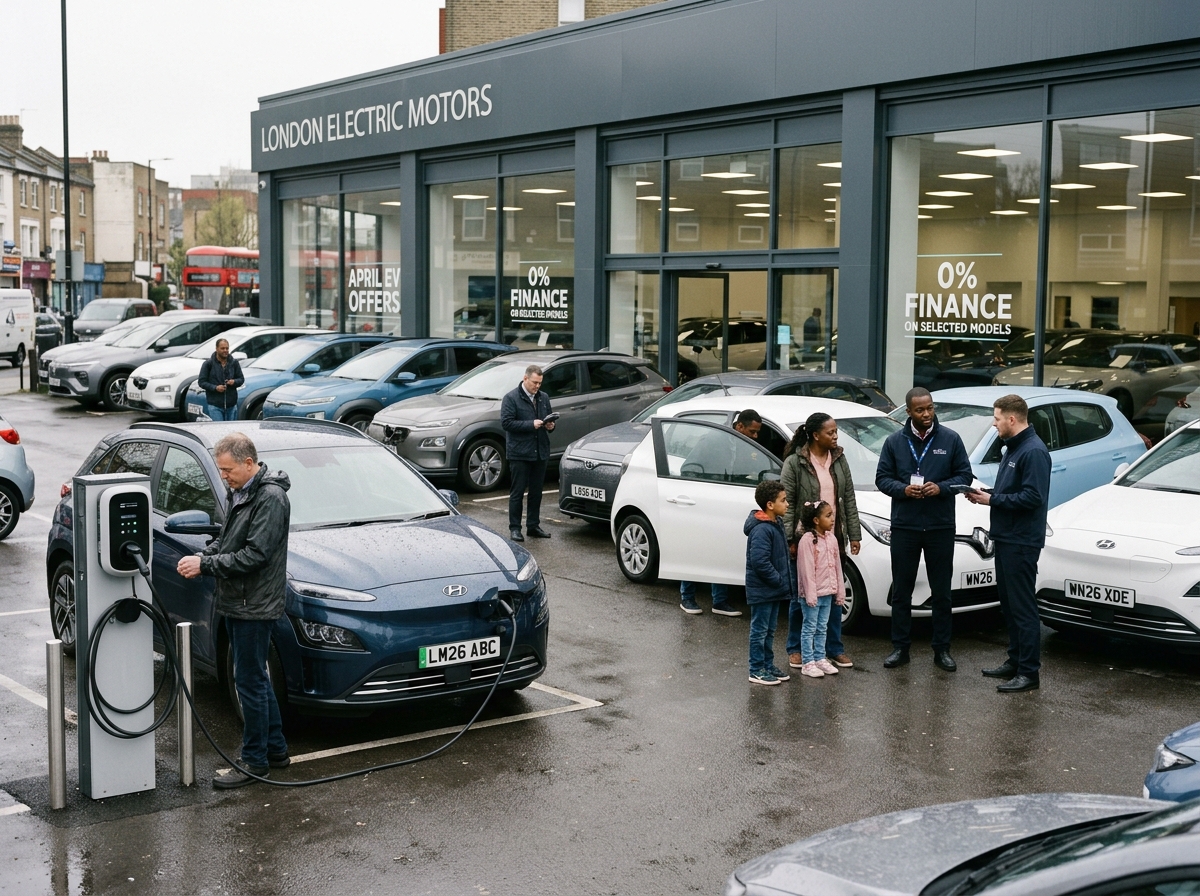
Battery-electric registrations jumped 59.1% year on year, but the industry remains below the pace required to meet Britain’s 2026 zero-emission vehicle target.
LONDON, May 6 — Britain’s electric car market accelerated sharply in April, with battery-electric vehicles accounting for more than one in four new cars registered, a milestone that underscores both the speed of the country’s shift away from petrol and diesel and the scale of the challenge still facing manufacturers, policymakers and charging operators.
New figures from the Society of Motor Manufacturers and Traders showed 39,084 battery-electric vehicles, or BEVs, were registered in April, up 59.1% from the same month last year. That lifted BEVs to 26.2% of all new car registrations, compared with 20.4% in April 2025, making fully electric models the second-largest fuel category after petrol.
The overall new car market also rebounded strongly. Registrations rose 24.0% year on year to 149,247 units, compared with 120,331 in April 2025. The rise was flattered by a weak comparison: last April’s market was depressed after some buyers brought purchases forward into March to avoid tax changes affecting new vehicles, including electric models. Even allowing for that distortion, April’s figures point to a market in which electric demand is no longer confined to early adopters or corporate sustainability programmes.
The data show a broadening of electrified demand. Plug-in hybrid registrations rose 46.4% to 20,597 units, taking 13.8% of the market. Hybrid electric vehicles, which cannot be plugged in but use electric assistance to improve fuel economy, rose 18.8% to 19,711 units, or 13.2% of the market. Combined, fully electric, plug-in hybrid and hybrid vehicles made up more than half of new car registrations in April.
Petrol cars remained the largest single category, with 63,541 registrations and a 42.6% share, but their dominance continued to erode. Diesel, once the favoured choice for high-mileage British drivers, fell again to 6,314 registrations, representing just 4.2% of the market. A decade ago, diesel’s decline at this speed would have seemed improbable; in April 2026, it appeared almost structural.
The numbers also highlight the central role of company fleets. Fleet registrations reached 90,462 vehicles in April, up 26.8% year on year and representing 60.6% of the market. Private registrations rose 20.2% to 56,116, a healthier result than in several recent months but still leaving business and fleet buyers as the main engine of the market. The split matters because fleet customers have been quicker to adopt electric vehicles, helped by company-car tax incentives, predictable mileage patterns and the ability to install or manage charging infrastructure.
For manufacturers, April’s BEV performance offers welcome evidence that heavy investment in electric models is translating into volume. Carmakers have expanded their electric lineups, discounted aggressively in parts of the market and pushed more zero-emission vehicles through fleet channels as the UK’s regulatory framework tightens. New entrants, including Chinese brands, have also added competition, increasing pressure on established European, Japanese and American carmakers.
The rise of Chinese-owned brands is becoming increasingly visible in the British market. BYD registered 5,059 vehicles in April, more than double its year-earlier total, while Chery, Omoda and Jaecoo have rapidly built recognition among buyers attracted by competitive pricing, long equipment lists and warranty offers. Their growth is reshaping a market long dominated by European and Japanese manufacturers and is likely to intensify debate over industrial competitiveness, supply chains and the future of UK car production.
Yet the strong monthly result does not remove the industry’s central problem: the market is still behind the trajectory demanded by regulation. Under Britain’s zero-emission vehicle mandate, manufacturers face a 33% target for new car sales in 2026. April’s 26.2% BEV share was a significant improvement, but year-to-date registrations tell a more cautious story. In the first four months of 2026, BEVs reached 176,698 units, up 22.1% from a year earlier, but their market share stood at 23.1%.
That gap between market reality and regulatory ambition is the focus of growing pressure on ministers. Carmakers argue that they are spending billions on electric technology while also discounting vehicles to stimulate demand, a combination that supports sales but squeezes margins. Industry bodies have called for more targeted consumer incentives, lower charging costs and policies to reassure households that the transition will be affordable and practical.
The government’s position is that the mandate is essential to cutting transport emissions, improving air quality and giving investors confidence that the UK will remain committed to the electric transition. The policy is also designed to support charging infrastructure by giving operators a clearer view of future demand. But the April figures show that consumer adoption remains uneven, especially among private buyers without access to home charging.
Charging remains one of the main barriers to wider take-up. Drivers with off-street parking can often charge overnight at lower domestic electricity rates, while those dependent on public chargers may face higher costs and less convenience. That split has become a fairness issue as electric vehicles move from premium segments into the mass market. For households considering a switch, the economics can vary sharply depending on where they live, how far they drive and whether they can install a charger at home.
The timing is also complicated by wider economic uncertainty. Higher borrowing costs make car finance more expensive, while volatile energy prices can undermine confidence in the long-term savings promised by electric vehicles. Rising petrol prices may push some drivers toward BEVs, but higher electricity costs and cost-of-living pressures can have the opposite effect. The result is a market moving quickly, but not always predictably.
SMMT’s latest outlook reflects that tension. The trade body expects the total new car market to rise in 2026 to just over two million units, while BEV volumes are forecast to grow to about 562,000 units. That would lift the electric share to around 26.8% for the year, a substantial increase from 2025 but still below the 33% mandate level. The forecast suggests that April’s 26.2% share may be closer to the expected annual market rate than to a decisive breakout.
There are signs, however, that momentum is becoming harder to reverse. The UK’s stock of fully electric cars has now passed the two million mark, creating a larger used-EV pipeline and making electric ownership more visible in everyday life. As more vehicles enter the second-hand market, lower purchase prices could bring BEVs within reach of households that have so far been priced out of the new-car transition.
The April figures also suggest that the market is becoming more diverse by technology and brand. Buyers are not simply choosing between petrol and pure electric vehicles; they are weighing hybrids, plug-in hybrids and BEVs against price, tax treatment, charging access and driving needs. That complexity may slow the clean break from combustion engines, but it also gives consumers stepping stones toward electrification.
For now, April stands as one of the clearest signs yet that Britain’s electric car transition is deepening. BEVs captured more than a quarter of the new car market, plug-in hybrids continued to grow rapidly and diesel slipped further toward the margins. The direction of travel is unmistakable.
The unresolved question is whether policy, infrastructure and household economics can move fast enough to turn a strong month into a sustained national shift. Britain’s car market is no longer debating whether electric vehicles will become mainstream. It is debating how quickly, how evenly and at what cost that transformation will unfold.